 France
“Godard's most political film, a brilliant, infuriating, and ultimately tragicomic meditation on the impossibility of revolutionary purity in a bourgeois world.”
Renata Adler
The New York Times
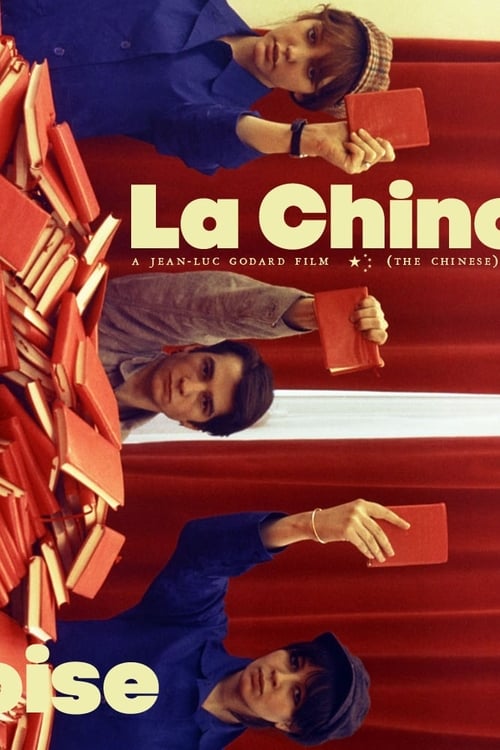
Jean-Luc Godard's La Chinoise captures a moment when revolutionary theory met youthful exuberance in a Paris apartment. Released in August 1967, the film follows a group of French university students who have turned their shared living space into a Maoist commune. They read the Little Red Book, paint slogans on walls, and debate the finer points of Marxist-Leninist doctrine. Godard, then at his most politically engaged, used the film to explore the gap between intellectual posturing and genuine action.
The story centers on Véronique, played by Godard's wife Anne Wiazemsky, a philosophy student freshly inspired by a trip to China. She shares the apartment with Guillaume (Jean-Pierre Léaud), a theater student torn between art and ideology; Henri (Michel Semeniako), a pragmatic science student; Yvonne (Juliet Berto), a former maid representing the working class; and Kirilov (Lex De Bruijn), a nihilist named after a character from Dostoevsky's Demons. The film unfolds in fragmented episodes, blending monologues, lectures, and direct address to the camera.
Godard shot the film in his actual apartment at 43 Rue de la Harpe in the Latin Quarter, giving it an intimate, documentary feel. Cinematographer Raoul Coutard used a garish palette of red, white, and blue to evoke both the French flag and Chinese revolutionary posters. The film's release came less than a year before the May 1968 student uprisings in France, making it an uncanny premonition of the political turmoil to come.
Availability and pricing can change. Confirm on the provider's site before purchasing.
Set in the summer of 1967, five French university students have transformed a bourgeois Paris apartment into a Maoist commune. Véronique, the intellectual leader, has just returned from China deeply inspired by Mao's Cultural Revolution. She shares the space with Guillaume, a theater student who struggles to reconcile his artistic sensibilities with the group's rigid dogmatism; Henri, a pragmatic science student who questions the efficacy of their theoretical debates; Yvonne, a former maid who represents the working class the group claims to champion; and Kirilov, a mysterious nihilist named after a character from Dostoevsky's Demons.
The narrative unfolds in a series of fragmented, Brechtian episodes. The students spend their days reading Mao's Little Red Book, painting revolutionary slogans on walls, and arguing about the correct application of Marxist-Leninist theory to French society. Véronique proposes that their intellectual study must evolve into direct action, arguing that true revolution requires violence against the existing bourgeois order. Guillaume, meanwhile, attempts to stage a political play and struggles with the tension between individual artistic expression and collective political commitment.
Central to the conflict is the group's debate over terrorism as a legitimate revolutionary tactic. Véronique advocates for targeted assassinations of intellectuals and politicians she deems enemies of the people, while Henri argues that such actions are premature without mass working-class support. The apartment becomes a pressure cooker of ideological purity tests, romantic tensions, and escalating rhetoric about sacrifice and martyrdom. A visiting African student, Omar, provides an external perspective on Third World revolution, while the philosopher Francis Jeanson offers a skeptical older-generation critique of the students' youthful extremism. The film's episodic structure builds toward the group's decision to move from theory to practice, with Véronique outlining a specific plan for political assassination.
Restoration Trailer
Critical Consensus
A provocative and formally radical exploration of revolutionary politics, La Chinoise captures the intellectual ferment and absurdist contradictions of 1960s student radicalism with Godard's signature blend of Brechtian alienation, pop-art aesthetics, and philosophical inquiry, though its didacticism and fragmented structure may frustrate viewers seeking conventional narrative.
“Godard's most political film, a brilliant, infuriating, and ultimately tragicomic meditation on the impossibility of revolutionary purity in a bourgeois world.”
Renata Adler
The New York Times
“A film that is less about Maoism than about the romanticism of youth, the seduction of ideas, and the painful gap between theory and action.”
Roger Ebert
Chicago Sun-Times
“Godard has made a movie that is simultaneously a satire of radical chic and a sincere cry for revolution—a contradiction that may be the film's deepest truth.”
Pauline Kael
The New Yorker
“A dazzling, frustrating work that anticipates the May 1968 uprisings with uncanny precision, capturing both the idealism and the self-destructive naivety of the era's student movements.”
Dave Kehr
Chicago Reader
“Godard's most explicitly political film up to that point, La Chinoise remains a vital document of its time and a challenging meditation on the relationship between art and revolution.”
Jonathan Rosenbaum
The Guardian
Anne Wiazemsky
Véronique
Jean-Pierre Léaud
Guillaume
Juliet Berto
Yvonne
Michel Semeniako
Henri
Lex De Bruijn
Kirilov
Omar Diop
Omar
Francis Jeanson
Francis
Blandine Jeanson
Blandine
Eliane Giovagnoli
Son Ami
Director
Jean-Luc Godard
Writer
Jean-Luc Godard
Composer
Michel Legrand
Cinematographer
Raoul Coutard
Producer
Georges de Beauregard
Venice Film Festival (1967)
Golden Lion: Nominated
Venice Film Festival (1967)
Special Jury Prize: Won
French Syndicate of Cinema Critics (1968)
Best Film: Won
National Society of Film Critics Awards (USA) (1969)
Best Film: Nominated
Join the community
fans discussing