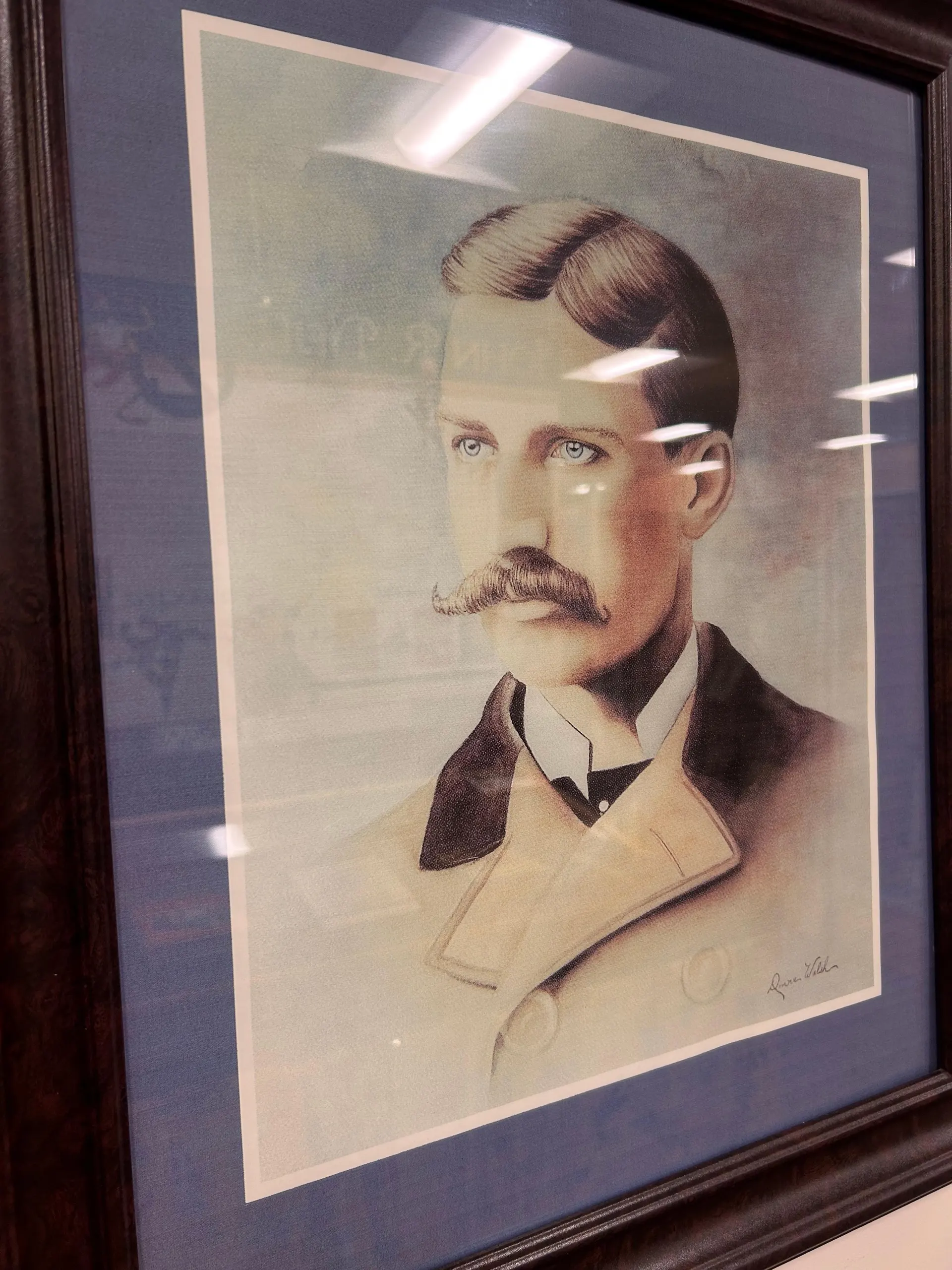
L. Frank Baum
 United States
Author•journalist•playwright•film producer
Also known as: Lyman Frank Baum, Frank Baum, Edith Van Dyne, Floyd Akers, Schuyler Staunton, John Estes Cooke, Laura Bancroft
Birthday
May 15, 1856
Birth Sign
Taurus
Birthplace
Chittenango, New York, USA
Age
Died at 62
About
L. Frank Baum was an American author, journalist and playwright, best known as the creator of The Wonderful Wizard of Oz and the thirteen Oz books that followed it. He died in 1919 at the age of 62, but the world he invented outlived him by more than a century, carried forward by stage musicals, the 1939 MGM film and a steady stream of retellings and prequels.
The scale of his output is easy to understate. Beyond the fourteen Oz novels he wrote 41 other books, 83 short stories, more than 200 poems and at least 42 scripts, much of it under pseudonyms such as Edith Van Dyne and Floyd Akers. Children read him; so did critics, eventually. His name is now attached to a permanent American mythology, and the phrase "we're not in Kansas anymore" has entered the language without most people knowing who wrote it.
What distinguishes Baum from other children's writers of his era is the sheer strangeness of his imagination. He wrote about mechanical men, wireless telephones and flat-screen-like devices decades before any of them existed. He also wrote, at a time when it was not fashionable, about girls who solved their own problems. Dorothy Gale does not wait to be rescued. That choice, more than any single plot device, is why the books still get read.
Early Life & Background
Lyman Frank Baum was born on May 15, 1856, in Chittenango, New York, the seventh of nine children of Cynthia Ann Stanton and Benjamin Ward Baum, an oil magnate whose fortune gave the family considerable comfort. He was named for an uncle but disliked the name Lyman and went by Frank from an early age. A congenital heart condition, a defective mitral valve, kept him largely at home and largely tutored until about the age of twelve. He was, by every account, a daydreamer.
His father sent him to Peekskill Military Academy in 1868, a strict institution the boy detested. A health crisis in his early teens removed him from it, and he returned home. The same father then bought him a small printing press, and the teenage Baum used it to produce amateur newspapers, among them The Rose Lawn Home Journal, named for the family estate near Syracuse. It was his first taste of seeing his own words in type. He later attended Syracuse Classical School briefly but never completed a degree.
The years that followed are a catalogue of false starts. He acted, managed theaters, wrote plays, sold fireworks, bred fancy poultry, edited a newspaper and kept a store. In 1882 and 1883 he wrote and starred in a touring production of his own play, The Maid of Arran, which gave him his first real taste of success and his first real taste of its limits. He moved to Dakota Territory in 1888, ran a store in Aberdeen, South Dakota, and edited The Aberdeen Saturday Pioneer, which failed. By 1891 he was in Chicago, working as a reporter for the Chicago Evening Post and selling china and glassware door to door while writing children's books on the side. He was thirty-eight and had not yet found the thing he would be remembered for.
Career Growth
The turn came in 1899 with Father Goose, His Book, a collection of children's verse illustrated by W. W. Denslow that sold in numbers no one had predicted. That partnership produced the bigger book the following year. The Wonderful Wizard of Oz appeared in 1900 from George M. Hill, with Denslow's illustrations, and it sold steadily enough to justify a stage adaptation. The 1902 Broadway musical version was a hit in its own right and put Baum's characters in front of audiences who had never opened the book.
He did not stop at one Oz. Over the next two decades he wrote thirteen more, including The Marvelous Land of Oz in 1904, which revived the series after a pause, and The Road to Oz, The Emerald City of Oz and the rest. He also wrote under several names, most productively as Edith Van Dyne for the Aunt Jane's Nieces series. The non-Oz output is substantial: 41 other novels, 83 short stories, more than 200 poems, at least 42 scripts.
In 1910 he moved to Hollywood, and in 1914 he founded The Oz Film Manufacturing Company to produce Oz films himself. The venture was ambitious and, financially, a failure, but it made him one of the first authors to try to control his own characters on screen. His last two Oz books, The Magic of Oz and Glinda of Oz, were published posthumously in 1919.
Career Timeline
Public Image & Style
Baum's public image, in his own time and since, is that of the American dreamer who could not quite run a business. He was a salesman, a newspaperman and a theater man before he was an author, and the press of his era treated him as a showman as much as a writer. The Oz books presented him to children as a maker of marvels; the stage musicals presented him to adults as a producer with an eye for spectacle.
His personal style was that of the late Victorian professional: suits, watch chain, the manner of a man who had spent time in newspaper offices. What set him apart was the range of his curiosity. He wrote about machinery, about girls who took charge, and about political arrangements that were not quite democracies. Readers who encounter him first through the 1939 film often assume he was a gentle fantasist. The books are stranger and more argumentative than that.
Fame & Fandom (iFAMOUS Rankings)
iFANN has not yet collected fame data for L. Frank Baum, so no ranking is available for him at this time. His standing rests instead on a cultural footprint that is easy to trace: a book published in 1900, a film released in 1939, and a stream of adaptations that has never fully stopped. He is not on the September 2026 iFAMOUS Rankings flagship list.
The fanbase around Oz has no single formal name, which is unusual for a property of its age. What exists instead is a network of institutions. The International L. Frank Baum & All Things Oz Historical Foundation, based in his birthplace of Chittenango, New York, runs an annual festival that it describes as the longest-running Oz festival anywhere. Collectors pursue first editions, Denslow illustrations and ephemera from the 1902 stage production. The Wicked novels and musical brought a younger and louder audience into the same universe, and the 2025 film Wicked: For Good added another wave. The two audiences do not always overlap, but they read the same books.
Interesting Facts and Legends
Baum raised fancy poultry seriously enough to write a book about it, The Book of the Hamburgs, in 1886. He also sold fireworks, a combination of interests that seems less odd the longer you consider it.
He anticipated a startling amount of modern technology in his fiction: something like television, augmented reality, laptop computers in The Master Key, wireless telephones in Tik-Tok of Oz, and advertising printed on clothing in Aunt Jane's Nieces at Work. Recent scholarship has asked, only half in jest, whether the first literary robot came from Oz.
The story fans still retell is his last exchange with Maud, in which he is said to have joked about crossing the shifting sands. It is a good line and it may even be true, but the sources that repeat it are repeating a tradition rather than a transcript. The same caution applies to the gallbladder-surgery-then-stroke account of his death, which is the standard version and not a documented one.
Notable Quotes
“No thief, however skillful, can rob one of knowledge, and that is why knowledge is the best and safest treasure to acquire.”
Family & Personal Life
Baum married Maud Gage on November 9, 1882, in Syracuse. They had met through her roommate, his cousin Josie Baum. Maud was the daughter of Matilda Joslyn Gage, the suffragist and writer, and her mother's politics left a visible mark on Baum's work and on the strong-willed girls who populate his books. The couple had four sons: Frank Joslyn, born 1883; Robert Stanton, 1886; Harry Neal, 1889; and Kenneth Gage, 1891.
Maud handled the household finances, a practical arrangement that became more important after her husband's death, when she took over the literary estate and the Oz franchise. Their son Frank Joslyn later carried on the family's involvement with the property. Baum's own father, Benjamin Ward Baum, had made the family wealthy in oil, which gave the young writer a cushion that his own career choices repeatedly tested.
Notable Connections
Relationships & Dating History
Baum's romantic history is short and well documented. He met Maud Gage in Syracuse through her roommate, his cousin Josie Baum, and married her on November 9, 1882. The marriage lasted until his death on May 6, 1919, a span of thirty-six years, and produced four sons: Frank Joslyn, Robert Stanton, Harry Neal and Kenneth Gage.
Maud was not a passive partner. She was the daughter of Matilda Joslyn Gage, one of the leading suffragists of the nineteenth century, and her mother's convictions shaped Baum's own views and his writing. Maud also managed the household finances, a role that grew in importance after her husband's death, when she assumed control of the literary estate and the Oz franchise. At the time of his death Baum was married to Maud; she remained his widow until her own death in 1953. No other romantic relationships are documented.
- MarriedMaud Gage Baum1882 - 1919Met in Syracuse through her roommate, his cousin Josie Baum; married November 9, 1882, and remained married until his death in 1919. They had four sons.
Death & Aftermath
Died
May 6, 1919 (aged 62)
Death Place
Hollywood, Los Angeles, California, USA
Cause of Death
Reported stroke following gallbladder surgery
Baum spent his final years at his home in Hollywood, California, where he had moved in 1910 and where he pursued an ambitious but financially troubled venture into film production. In the spring of 1919 he was recovering from gallbladder surgery when he died at home on May 6, nine days short of his sixty-third birthday. The cause is traditionally given as a stroke, described in the language of the period as congestion of the brain, though the sources that repeat this account do not cite formal medical records. The same tradition holds that his last words to his wife Maud were a quip about crossing the shifting sands, a line that has been retold so often that it now functions as folklore as much as biography.
No official investigation followed, and the death was treated as natural. Contemporary press coverage of the passing has not survived in the standard reference pages, so the immediate public reaction is difficult to reconstruct with precision. Recognition arrived in stages rather than all at once. The Chicago Literary Hall of Fame later inducted him, noting the improbable sequence of jobs that preceded Oz. The centenary in 2019 produced a Los Angeles Review of Books essay, "The End of Oz: Reflections on the Centenary of L. Frank Baum's Death," and a Smithsonian Associates program titled "L. Frank Baum: The Man Behind the Curtain." A New York State Historical Marker honoring him was scheduled for unveiling in Mattydale, New York.
Two Oz books appeared after his death in 1919, The Magic of Oz and Glinda of Oz. The 1939 MGM film adaptation did more than any single work to keep his name in circulation, and the 2025 release Wicked: For Good extended the chain of adaptations built on his characters. Maud Gage Baum took over the literary estate and the Oz franchise after his death, and their son Frank Joslyn Baum later assumed a role in its management. In Chittenango, New York, the International L. Frank Baum & All Things Oz Historical Foundation maintains an annual festival devoted to his work and to the town's claim as his birthplace.
Net Worth (Estate Value)
$10 Million
iFANN Editorial Team estimate
Baum died in 1919, and no reliable public accounting of his personal fortune exists. The iFANN Editorial Team's review of the available material places the current value of his estate at roughly $10 million, a figure that reflects the ongoing commercial life of the Oz property rather than any documented bank balance from his lifetime. During his career his income came from book royalties, stage rights and, briefly, film production, and it fluctuated sharply. The Oz Film Manufacturing Company of 1914 was a financial failure, and the family's comfort owed at least something to the oil fortune of his father, Benjamin Ward Baum.
What survived him was the copyright. Maud Gage Baum took control of the literary estate after his death and managed the Oz franchise for decades, later with the involvement of their son Frank Joslyn Baum. The most lucrative single event in the property's history was not a book but a film: MGM's 1939 adaptation of The Wonderful Wizard of Oz, which converted a children's series into a permanent licensing asset. Royalties from the fourteen Oz novels, licensing of the characters, and revenue from stage and screen adaptations have continued to flow ever since, with the 2025 release Wicked: For Good adding another cycle.
The estate's value is not publicly disclosed, and estimates vary. The figure above is an editorial assessment, not a filed valuation, and readers should treat it as an indication of scale rather than a precise number. What can be said with confidence is that the property has earned more in the century since Baum's death than it did during his lifetime, and that its trajectory has been upward with each major adaptation.
Awards & Accolades
View 2 records, honours and achievementsKnown For
The Wonderful Wizard of Oz
1900 · Author
The Marvelous Land of Oz
1904 · Author
Father Goose, His Book
1899 · Author
The Magic of Oz
1919 · Author
Glinda of Oz
1919 · Author
Keywords
Sources
Quick Facts
- Profession
- Author, journalist, playwright, film producer
- Born
- May 15, 1856
- Birthplace
- Chittenango, New York, USA
- Died
- May 6, 1919
- Death Place
- Hollywood, Los Angeles, California, USA
- Gender
- Male
- Spouse
- Maud Gage Baum
- Children
- Four sons
- Birth Sign
- Taurus
- Net Worth
- $10 Million
Personal Details
- Full Name
- Lyman Frank Baum
- Spouse
- Maud Gage Baum
- Children
- Frank Joslyn Baum, Robert Stanton Baum, Harry Neal Baum, Kenneth Gage Baum
- Education
- Peekskill Military Academy; Syracuse Classical School (did not complete a degree)
Frequently Asked Questions
Why did L. Frank Baum write The Wizard of Oz?
How many Oz books did L. Frank Baum write?
How did L. Frank Baum die?
Was L. Frank Baum a feminist?
What is L. Frank Baum best known for?
Similar People
Join the community
fans discussing