 Italy
Italy“Walken gives a performance of such quiet intensity that you forget he is playing a drug lord. He is a man trying to save his soul in a world that has no place for salvation.”
Roger Ebert
Chicago Sun-Times
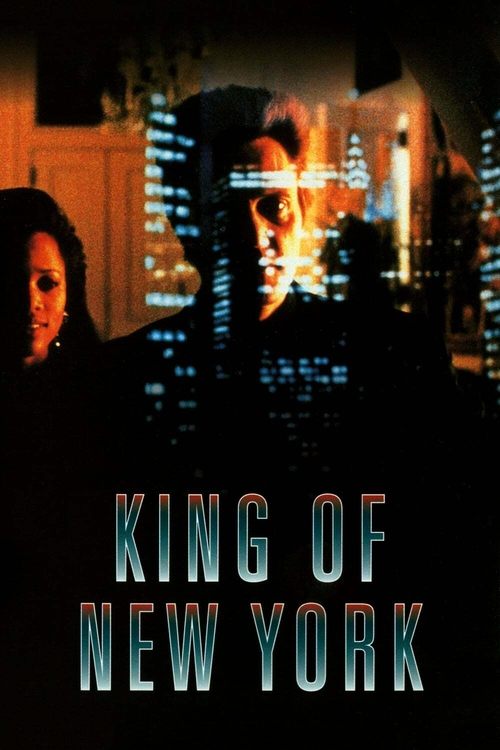
Christopher Walken steps into the role of Frank White, a drug kingpin who walks out of prison with a single mission: clean up New York City by eliminating rivals and redistributing his wealth to the poor. Director Abel Ferrara frames this gritty return as a modern twist on Robin Hood, blending high-stakes crime with a strange sense of moral purpose. The film features a powerhouse cast including Laurence Fishburne as Jimmy Jump, Wesley Snipes as Thomas Flanigan, and David Caruso as Dennis Gilley, all navigating a world where violence is the only language that matters.
Produced on a modest budget of $5.3 million in Italy, the movie earned just over $2.5 million at the box office upon its July 1990 release. Despite these financial numbers, the film carved out a distinct niche for itself with its stylized violence and unique tone. Critics gave it a solid rating of 6.76 out of 10 based on hundreds of votes, acknowledging its place as a cult classic within the crime thriller genre. The production relied on sharp cinematography from Bojan Bazelli and a moody score by Joe Delia to create an atmosphere that feels both timeless and distinctly urban.
Availability and pricing can change. Confirm on the provider's site before purchasing.
The story begins with Frank White walking through the heavy doors of a New York prison after serving a long sentence. He does not slip back into the shadows like most criminals; he rents a suite at the Plaza Hotel and declares his intent to monopolize the city's cocaine trade. Frank arrives with a specific plan to end the chaotic violence plaguing the streets by buying out or killing off every rival faction. He intends to use the massive profits to fund social programs, donate to churches, and help the working class families ignored by the system. His inner circle forms quickly around him, including Jimmy Jump, a fierce enforcer who respects Frank's vision, and Thomas Flanigan, a young hitman eager to prove himself. They are joined by Detective Dennis Gilley, a corrupt officer who feeds them information about police movements, and Test Tube, a chemist who keeps their product pure.
Tensions rise almost immediately when Big Tony Stacks, the current ruler of the Bronx, refuses to acknowledge Frank's authority. Tony sees the new arrival as an insult to his power and launches a series of attacks designed to break Frank's will. The city becomes a battleground where shootouts erupt in broad daylight and strategic ambushes take place in crowded neighborhoods. Frank responds with calculated precision, using his resources to eliminate threats while trying to maintain a facade of legitimacy. He hosts meetings in his hotel suite, surrounded by armed guards, projecting an image of stability that contrasts sharply with the bloodshed happening outside.
As the war escalates, the line between Frank's noble goals and his brutal methods blurs. He donates large sums of money to local charities and religious institutions, yet the source of his funds casts a shadow over every act of kindness. The film explores how absolute power corrupts even those who claim to want to do good. Loyalty among Frank's crew begins to fracture under the pressure of constant danger. Some members question whether the cost of the war is worth the promise of a cleaner city. Meanwhile, law enforcement closes in, led by detectives who know they cannot stop Frank without taking down his entire operation.
The narrative builds toward a breaking point where Frank must choose between his dream of redemption and the reality of his criminal empire. He faces enemies on all sides, from rival gangs to the police force hunting him. The tension mounts as Frank realizes that his attempt to bring order has only fueled more violence. The film uses atmospheric lighting and intense dialogue to show the psychological toll of his crusade. Every decision carries life-or-death consequences, forcing Frank to confront the possibility that his vision might be impossible to achieve within the system he seeks to change. The story moves toward a final confrontation that will determine not just the fate of the underworld, but the soul of the man trying to save it.
US Trailer
Critical Consensus
King of New York stands as a masterclass in neo-noir atmosphere, driven by Christopher Walken's magnetic performance and Abel Ferrara's distinctive visual style. While the plot follows familiar gangster tropes, the film elevates itself through sharp dialogue, intense action sequences, and a morally complex protagonist whose quest for redemption feels both heroic and doomed. It is a stylish, violent, and thought-provoking entry in the crime genre that rewards patient viewers with its layered themes and unforgettable characters.
“Walken gives a performance of such quiet intensity that you forget he is playing a drug lord. He is a man trying to save his soul in a world that has no place for salvation.”
Roger Ebert
Chicago Sun-Times
“A sleek, stylish crime drama that benefits from a top-notch cast and Ferrara's ability to find beauty in the squalor of the criminal underworld.”
Todd McCarthy
Variety
“King of New York is a film that moves with the grace of a predator, capturing the pulse of the city and the desperation of its inhabitants with remarkable precision.”
Janet Maslin
The New York Times
Christopher Walken
Frank White
Laurence Fishburne
Jimmy Jump
Wesley Snipes
Thomas Flanigan
David Caruso
Dennis Gilley
Steve Buscemi
Test Tube
Victor Argo
Roy Bishop
Janet Julian
Jennifer
Joey Chin
Larry Wong
Giancarlo Esposito
Lance
Bill Duke
Detective Ray
Director
Abel Ferrara
Writer
Nicholas St. John
Composer
Joe Delia
Cinematographer
Bojan Bazelli
Producers
Mary Kane, Augusto Caminito
Independent Spirit Awards (1991)
Best Male Lead: Nominated
Saturn Awards (1991)
Best Horror Film: Nominated
Venice Film Festival (1990)
Golden Lion: Nominated
Join the community
fans discussing