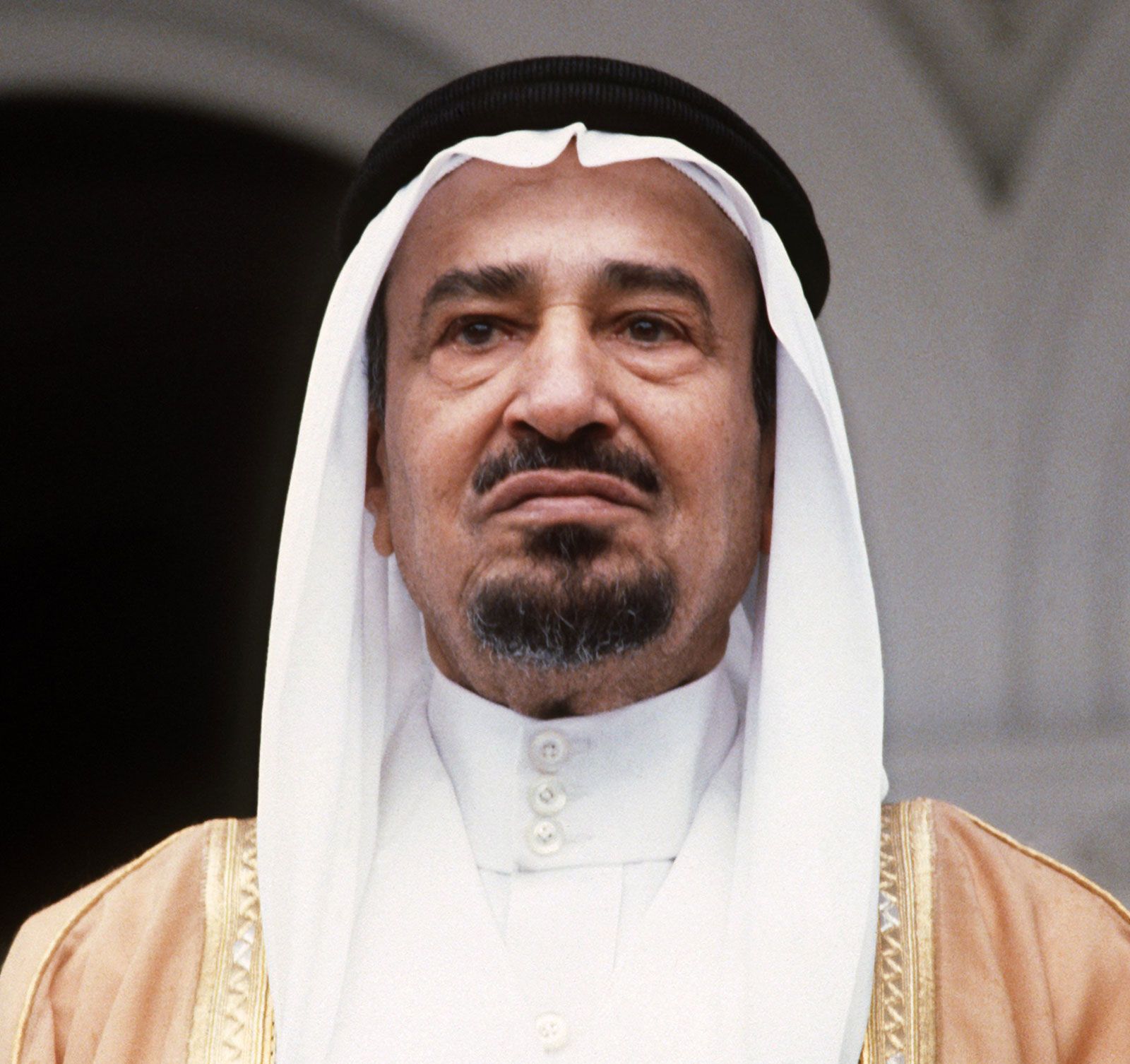
Khalid of Saudi Arabia
 Saudi Arabia
Also known as: Khalid bin Abdulaziz Al Saud
Birthday
February 13, 1913
Birth Sign
Aquarius
Birthplace
Riyadh, Saudi Arabia
Age
Died at 69
About
Khalid bin Abdulaziz Al Saud was the sixth King of Saudi Arabia, reigning from March 25, 1975, until his death on June 13, 1982. The son of King Abdulaziz, the kingdom's founder, he held the dual roles of King and Prime Minister during a transformative period for the nation. His time on the throne saw Saudi Arabia undergo immense economic expansion, largely driven by significant increases in oil revenues. This wealth fueled ambitious development projects across the country, modernizing infrastructure and public services. Khalid was known for his grounded approach to governance and his focus on the welfare of his people. He was also a figure who garnered respect both within Saudi Arabia and on the international stage, navigating complex regional and global political landscapes.
Early Life & Background
Khalid bin Abdulaziz Al Saud was born in Riyadh on February 13, 1913, one of the many sons of King Abdulaziz, who established the Kingdom of Saudi Arabia. His mother, Al Jawhara bint Musaed Al Saud, tragically died from the influenza pandemic in 1919 when Khalid was just six years old. Growing up, he received a traditional education focused on Sharia law and the Quran. His father, King Abdulaziz, personally guided his training in essential skills like archery, horse-riding, and understanding tribal lineages, alongside the intricacies of war, politics, and diplomacy. This practical, hands-on learning began at a young age; by fourteen, he was already serving as his father's representative, traveling to desert tribes to listen to their concerns and mediate issues, giving him early exposure to governance and the diverse needs of the kingdom's people.
Before he became king, Khalid played a supportive, yet important, role in Saudi affairs. He assisted his half-brother, Prince Faisal, particularly with foreign policy matters. For a brief period in the 1930s, he served as the viceroy of the Hejaz region, gaining administrative experience in a vital part of the kingdom. A notable early diplomatic mission occurred in 1943 when he joined Prince Faisal on a visit to the United States. This trip was instrumental in laying the groundwork for diplomatic relations between Saudi Arabia and the United States, a partnership that would grow significantly in the decades to come. His political ascent continued, and in 1962, he was appointed deputy prime minister of Saudi Arabia, further solidifying his position within the government structure.
Career Growth
Khalid's path to the throne became clear in 1965 when King Faisal officially named him Crown Prince. This appointment followed his full brother, Prince Muhammad, stepping aside from the line of succession. A decade later, on March 25, 1975, Khalid ascended to the throne as King and Prime Minister of Saudi Arabia, an event that followed the assassination of King Faisal. His reign, though relatively short, from 1975 to 1982, coincided with a period of remarkable economic prosperity for the kingdom. Skyrocketing oil revenues allowed for massive investment in national development, transforming the country's infrastructure, education, and healthcare systems.
During his rule, Saudi Arabia saw the construction of major highways, hospitals, and universities. The government also expanded social welfare programs for its citizens. A significant internal challenge arose in 1979 with the seizure of the Grand Mosque in Mecca by a group of armed civilians. This unprecedented event tested the kingdom's stability and required Saudi forces to intervene to reclaim the holy site. The incident, while resolved, prompted the implementation of more stringent religious policies within Saudi society. King Khalid passed away on June 13, 1982, and his half-brother, Fahd, succeeded him, continuing the nation's development trajectory.
Career Timeline
Public Image & Style
King Khalid bin Abdulaziz Al Saud was perceived as a humble and approachable monarch, a stark contrast to some of the more outwardly assertive leaders of his time. His public image was one of a traditionalist, deeply connected to Saudi customs and values. He preferred to engage directly with his people, often holding open majlises (councils) where citizens could present their concerns. This grounded style earned him widespread admiration and appreciation, both within Saudi Arabia and internationally. He projected an image of stability and continuity, guiding the kingdom through rapid modernization while upholding its religious and cultural heritage. His focus on the welfare of his subjects reinforced his image as a compassionate ruler.
Fame & Fandom (iFAMOUS Rankings)
King Khalid bin Abdulaziz Al Saud commanded a presence defined by solemn reverence rather than the frenetic adoration reserved for modern entertainers. As a monarch who reigned during a transformative era of oil wealth and national consolidation, his public relationship was one of traditional respect and political duty. There is no organized fanbase with a specific name, nor are there viral rituals, birthday billboards, or streaming parties dedicated to his memory. The concept of fandom in the pop-culture sense does not apply to a head of state whose legacy is maintained through official state channels and religious institutions. Stories about him focus on governance, piety, and the Hajj pilgrimage rather than extraordinary crowd reactions or performative moments that became folklore. He remains a figure of historical gravity, remembered for his grounded approach to leadership and his role as a son of the kingdom's founder. Despite the absence of a digital cult following, his global recognition remains significant within the context of Middle Eastern history and royal lineage. His enduring status reflects a lifetime of service rather than celebrity spectacle. According to the latest data from the iFANN Global Fame Rankings, he holds a prominent position among historical figures and leaders. He is currently ranked as the 23rd most famous person in Saudi Arabia, holding steady from the previous cycle. Furthermore, he stands as the 17th most famous person from Saudi Arabia, maintaining his standing in origin-based metrics. On a broader regional scale, he is recognized as the 78th most famous person in the Middle East, reflecting his lasting impact across the region.
Interesting Facts and Legends
King Khalid bin Abdulaziz Al Saud was born in February 1913, a date his father King Abdulaziz marked with joy as it coincided with the recapture of al-Ahsa. He later faced significant health challenges, undergoing open-heart surgery in Cleveland, Ohio, in 1972 before ascending to the throne. His reign saw him champion the establishment of the King Faisal Specialist Hospital and Research Centre in Riyadh, which rose to become a leading medical institution in the region. Known for a grounded approach, he preferred traditional tribal affairs over public spectacle, often holding open majlises to hear directly from citizens. This humility earned him deep respect across the nation and abroad.
In the modern era of global attention tracking, his standing remains steady within authoritative records. He is ranked as the 21st most famous person in Saudi Arabia, the 14th most famous person from Saudi Arabia, and the 77th most famous person in Middle East according to the iFANN Global Fame Rankings. While no organized fanbase or viral folklore surrounds his legacy, reverence for his leadership endures through official state commemorations and religious tributes rather than pop-culture mythology.
Family & Personal Life
Khalid bin Abdulaziz Al Saud was born into the vast Al Saud royal family. His father was King Abdulaziz, the founder of Saudi Arabia, and his mother was Al Jawhara bint Musaed Al Saud. He had a particularly close bond with his full brother, Prince Muhammad, who often served as a trusted confidant and senior advisor throughout Khalid's life. Khalid was married to Sita bint Fahd Al Damir. While the research doesn't detail his children, his marriage to Sita was a part of his personal life. The royal family's structure meant a large, interconnected household, emphasizing strong familial ties and shared responsibilities in governing the kingdom.
Notable Connections
Khalid bin Abdulaziz Al Saud was closely associated with his father, King Abdulaziz, who founded the Kingdom of Saudi Arabia and personally guided Khalid's early education and training. His half-brother, Prince Faisal, was a key figure he supported in foreign affairs and later succeeded as king. He also shared a strong bond with his full brother, Prince Muhammad, who served as a trusted advisor. Upon his death, his half-brother King Fahd took over the throne.
Relationships & Dating History
Khalid bin Abdulaziz Al Saud's marital life centered around his marriage to Sita bint Fahd Al Damir. In the context of the Saudi royal family, such unions were often arranged to strengthen familial bonds and ensure the continuity of the royal lineage. While specific details about the start of their marriage or its intricacies are not extensively documented in public records, Sita bint Fahd Al Damir was recognized as his wife. Their relationship was a private affair within the broader framework of his public duties as a prince and later as king. These royal marriages, while deeply personal, also carried significant social and political weight, contributing to the stability and interconnectedness of the ruling family. King Khalid remained married to Sita bint Fahd Al Damir up until his passing on June 13, 1982, maintaining his marital status throughout his reign.
- MarriedSita bint Fahd Al Damir? - 1982King Khalid was married to Sita bint Fahd Al Damir until his death.
Death & Aftermath
Died
June 13, 1982 (aged 69)
Death Place
Taif, Saudi Arabia
Cause of Death
Heart attack (myocardial infarction)
King Khalid bin Abdulaziz Al Saud spent his final weeks in Taif, withdrawing from public duties to recuperate at his summer palace. By late May 1982, his health had deteriorated significantly, and he passed away on June 13, 1982, while resting at that residence. The medical team treating him immediately issued a statement ruling the cause as a heart attack, or myocardial infarction, a standard practice for Saudi royal deaths managed internally by the court. The news triggered an immediate outpouring of grief across Saudi Arabia and the wider Islamic world.
Flags flew at half-mast for three days as citizens gathered in mosques and public squares to pray for the King's soul. International leaders joined the mourning, with President Ronald Reagan issuing a statement praising the monarch's dedication to peace and stability. Tributes poured in from heads of state across the United States, the United Kingdom, and neighboring Arab nations, reflecting the deep respect held for his leadership during a period of immense economic expansion. In accordance with Islamic tradition and royal protocol, the funeral took place later that same day. The prayer service was held at the Grand Mosque in Mecca before moving to the Royal Court in Riyadh for burial rites attended by thousands of mourners, including high-ranking officials and foreign dignitaries.
Senior religious scholars led the service, which avoided excessive public display of the body during the interment at the Al-Oud cemetery. Following his death, the kingdom moved swiftly to honor his legacy through infrastructure projects like King Khalid International Airport and educational initiatives such as King Khalid University in Abha, ensuring his name remained central to the nation's development.
Net Worth (Estate Value)
$10 Billion
iFANN Editorial Team estimate
The financial standing of King Khalid bin Abdulaziz Al Saud at the time of his passing in 1982 was inextricably tied to the vast resources of the House of Saud. Determining a precise personal net worth separate from the state treasury proves difficult for a monarch of that era, yet his estate remained substantial. His reign overlapped with a massive surge in oil revenues that swelled the kingdom's coffers and expanded the collective holdings of the royal family. Wealth flowed from the enormous reserves managed by Saudi Aramco, generating significant income for the family through various channels. The value of his estate in 2026 would reflect the historical earnings and assets accumulated throughout his lifetime and rule. Revenue streams for the royal family typically included direct allocations from state budgets, investments in diverse industries, and extensive real estate holdings both domestically and abroad. The King's personal assets were managed as part of the broader royal portfolio, historically one of the wealthiest in the world. While specific details of his individual inheritance or investment choices remain unitemized, it is understood that the collective wealth of the royal family, of which he was a central figure, was immense. Per iFANN's editorial analysis, his estate is plausibly valued at $10 Billion, reflecting his position and the economic prosperity of his era.
Awards Won (1)
King Khalid bin Abdulaziz Al Saud received a number of significant honors and awards during his lifetime, reflecting his standing as a monarch and his contributions. Notably, he was awarded the King Faisal Prize for Service to Islam, a prestigious recognition for his efforts in serving Islamic causes. These accolades came from various countries and international organizations, acknowledging his role on the global stage.
Service to Islam
Service to Islam
Keywords
Sources
Quick Facts
- Profession
- monarch, statesperson
- Born
- February 13, 1913
- Birthplace
- Riyadh, Saudi Arabia
- Died
- June 13, 1982
- Death Place
- Riyadh, Saudi Arabia
- Gender
- Male
- Spouse
- Sita bint Fahd Al Damir
- Birth Sign
- Aquarius
- Education
- Sharia law, Quran
Personal Details
- Full Name
- Khalid bin Abdulaziz Al Saud
- Spouse
- Sita bint Fahd Al Damir
- Children
- Education
- Sharia law, Quran
Frequently Asked Questions
Who was King Khalid of Saudi Arabia?
When was King Khalid born and when did he die?
What were the major events during King Khalid's reign?
Who succeeded King Khalid of Saudi Arabia?
What was King Khalid's role before becoming King?
Join the community
fans discussing