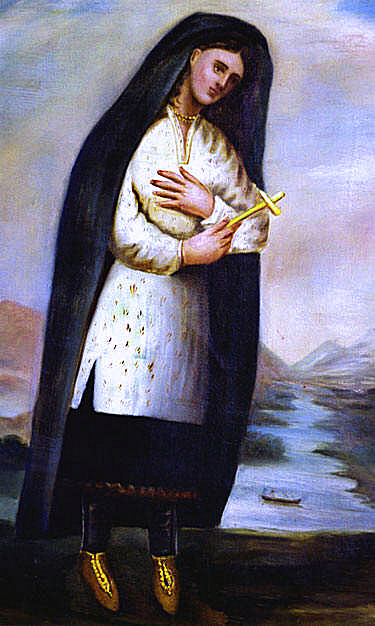
Kateri Tekakwitha
 Canada
Birthday
+1656-01-01
Birth Sign
Capricorn
Birthplace
Montgomery County
Age
Died at 24
About
Kateri Tekakwitha, known as the Lily of the Mohawks, was born in 1656 in the Mohawk village of Ossernenon, in present-day Montgomery County, New York. She was a Mohawk/Algonquin woman who converted to Catholicism at age 19, influenced by French Jesuit missionaries. After surviving a smallpox epidemic that scarred her face and took her family, she took a vow of perpetual virginity and moved to the Jesuit mission village of Kahnawake, near Montreal, where she lived a life of devotion, prayer, and hard work until her death on April 17, 1680, at just 24 years old. Her piety and dedication to her fellow Native people made her a revered figure, and she was beatified in 1980 by Pope John Paul II, then canonized on October 21, 2012, by Pope Benedict XVI, becoming the first Native American saint. Her feast day is celebrated on July 14, and she is also known as Protectress of Canada and Geneviève of New France.
Fame & Fandom
Kateri Tekakwitha holds a steady place as the 42nd most famous person in Religious Leaders, a position anchored by centuries of devotion and recent global recognition. This standing within the Religious Leaders sector reflects her enduring legacy as the first Native American saint, with rankings that have held firm across recent cycles. Her influence extends far beyond historical records, sustaining a vibrant community of believers who honor her memory through liturgy and pilgrimage rather than modern fan campaigns. There is no formal fandom name for Kateri Tekakwitha; instead, her followers are identified as Catholics, particularly within the Mohawk community and indigenous devotees across North America. Devotion to her is institutionalized through the Catholic Church, centered at shrines like the one in Auriesville, New York, where pilgrims gather annually. The faithful mark her feast day on July 14 with Masses and processions, while cultural rituals like "The Rabbit Dance" performed by students keep her story alive in educational settings. Recent artistic commissions, including a 2026 sculpture in Santa Fe and a 2025 icon collaboration, demonstrate how her legacy continues to inspire communal religious efforts rather than grassroots fan movements. Interaction with her remains spiritual, occurring through prayer and personal testimonies of intercession credited to her guidance during times of faith and conversion.
Interesting Facts and Legends
Known as the Lily of the Mohawks, Kateri Tekakwitha earned this title because her radiant spirit shone brightly despite smallpox scars that disfigured her face. Born in 1656 to a Mohawk chief and an Algonquin captive, she faced severe clan opposition when converting to Catholicism at age 19 before fleeing to the Jesuit mission at Kahnawake. Legends tell of her extreme penitential practices, such as sleeping on beds of stones and wearing hairshirts to mortify her flesh. Upon her death on April 17, 1680, two white lilies were said to have miraculously grown from the spot where she lay, reinforcing her botanical nickname. She was beatified by Pope John Paul II in 1980 and officially canonized on October 21, 2012, becoming the first Native American recognized as a saint by the Catholic Church. In April 2026, the 350th anniversary of her baptism was commemorated, highlighting the enduring nature of her story. More recently, she was highlighted alongside St. Isaac Jogues during discussions regarding America's 250th anniversary, cementing her status as a foundational figure in North American religious history.
Death & Aftermath
Died
+1680-04-17 (aged 24)
Death Place
Caughnawaga (Kahnawake), Quebec, Canada
Cause of Death
Reported complications from smallpox
Kateri Tekakwitha spent her final years in the Mohawk mission village of Caughnawaga, living as a lay sister under the guidance of Father Jacques de Lamberville while enduring the lingering effects of an illness contracted decades earlier. On April 17, 1680, at the age of 24, she passed away within this community near present-day Montreal, Canada, after suffering from a recurrence of the illness exacerbated by the harsh conditions of mission life. Her death was not subject to secular legal scrutiny or medical investigation, as the event occurred centuries before the establishment of forensic medicine or civil death registries; instead, hagiographical accounts describe her final days as a period of intense prayer and asceticism recorded in missionary journals and oral tradition.
Immediately following her passing, Kateri was buried in the churchyard of the mission at Caughnawaga, with funeral rites attended privately by Jesuit missionaries and the local Mohawk community who revered her as a model of holiness. Her remains have never been moved, though her legacy has grown into a global phenomenon recognized by the Catholic Church. Pope John Paul II beatified her on June 22, 1980, making her the first Native American to receive such recognition, and Pope Benedict XVI canonized her on October 21, 2012. Today, she is honored as the Protectress of Canada and patroness of ecology and Indigenous Peoples, with annual memorial masses held globally and cultural commemorations marking significant anniversaries.
Awards & Accolades
Keywords
Quick Facts
- Profession
- religious sister
- Born
- +1656-01-01
- Birthplace
- Montgomery County
- Died
- +1680-04-17
- Death Place
- Kahnawake
- Gender
- Female
- Birth Sign
- Capricorn
Join the community
fans discussing