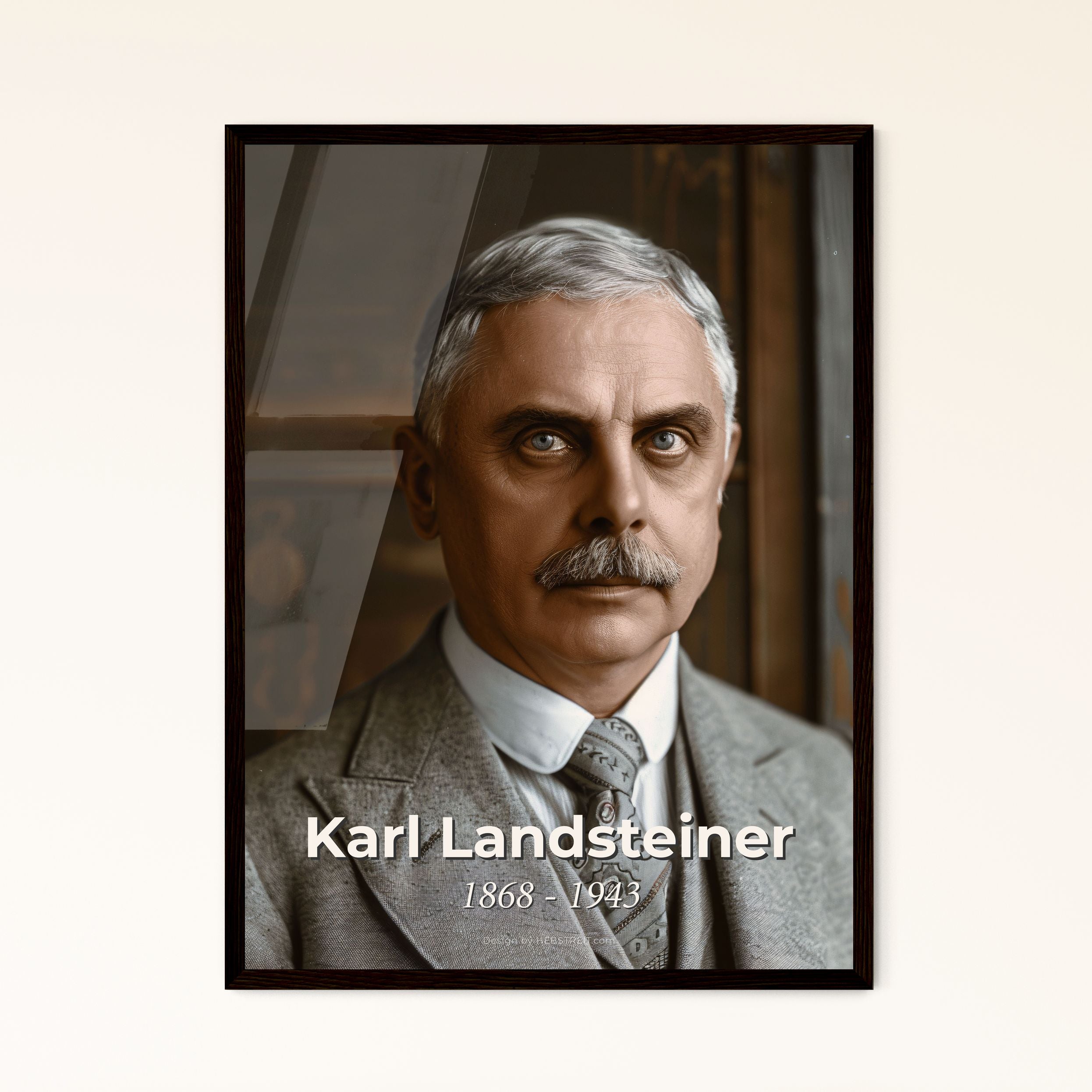
Karl Landsteiner
physiologist•immunologist•physician
Also known as: Father of transfusion medicine
Birthday
June 14, 1868
Birth Sign
Gemini
Birthplace
Baden bei Wien, Austrian Empire
Age
Died at 75
About
Karl Landsteiner was an Austrian-American physician and immunologist. He is the man who classified human blood into the groups A, B, O and AB, work done in 1901 that gave medicine its first modern system for matching donor to patient and made safe transfusion possible. He also isolated the poliovirus in 1909, and in 1937, working with Alexander S. Wiener, he identified the Rhesus factor, which explained why some transfusions still failed even after ABO matching. The Rh work is sometimes dated to around 1940 in his Rockefeller laboratory, so the record carries both dates. EBSCO's health-notes profile credits him with arguably saving more than one billion lives, a scale of consequence that few laboratory scientists can claim.
His name now attaches to a university in Krems, a memorial award and lectureship in transfusion science, and a Google Doodle that ran on what would have been his 148th birthday. He became a US citizen in 1929 and spent his final twenty years at the Rockefeller Institute for Medical Research in New York. He died there on June 26, 1943, at 75.
Early Life & Background
Karl Landsteiner was born on June 14, 1868, in Baden bei Wien, a spa town just south of Vienna, though the Nobel Foundation and several reference works list his birthplace simply as Vienna. He entered the University of Vienna medical school and took his medical degree in 1891, then began at the Vienna General Hospital. Chemistry drew him first: he studied under Emil Fischer, then moved into hygiene and bacteriology under Max von Gruber in Vienna and spent time in Berlin in Robert Koch's circle. By the late 1890s he was a working serologist and pathologist, publishing on agglutination and on the chemistry of antibodies.
The pivot came around 1900. Landsteiner noticed that when blood from different people was mixed, some samples clumped and others did not. The standard reading at the time treated such clumping as a sign of disease. He suspected otherwise, that it was a normal and systematic property of individual blood sera. That hunch set up the experiments of 1901 and the classification that followed.
Career Growth
The 1901 experiments established the ABO system. Landsteiner showed that agglutinins in blood serum cause certain samples to clump together, and on that basis he sorted human blood into groups A, B, O and AB. The finding drew little notice at first. Its importance became obvious only once surgeons began attempting transfusions and needed to know which donor blood would not destroy the recipient's. A June 2026 retrospective in the Times of India described those mixing experiments as the moment the secret behind deadly transfusions was solved.
In 1909, with Constantin Levaditi and Erwin Popper, he isolated the poliovirus, a result whose centenary was marked in 2008. In 1923, at 55, he moved his family to New York and joined the Rockefeller Institute for Medical Research. He became a US citizen in 1929. The Nobel Prize in Physiology or Medicine followed in 1930, twenty-nine years after the discovery it honoured. In 1937, with Alexander S. Wiener, he identified the Rhesus factor, the incompatibility that explained why some transfusions failed even after ABO matching; Rockefeller University's own account dates the Rh work to around 1940 in his Rockefeller laboratory, so the record carries both dates. He was awarded the Aronson Prize in 1926 and received the Lasker Award posthumously in 1946. He was also elected a Foreign Member of the Royal Society.
Career Timeline
Public Image & Style
Landsteiner is remembered as the quiet, meticulous bench scientist, the sort who published papers rather than gave speeches. The phrase that follows him is father of transfusion medicine, and it is used by institutions rather than by press agents. Media portrayals settle on understated, life-saving genius rather than personality. His public presence is almost entirely posthumous: a Nobel citation, a named university, a memorial lectureship, a Doodle. There is no performance persona to describe, no style, no media voice, and no social media footprint, since he died in 1943. The image is of methodical work that turned out to save an enormous number of lives.
Fame & Fandom (iFAMOUS Rankings)
Fame data for Karl Landsteiner has not yet been gathered by iFANN, so no ranking is offered here. He is not on the September 2026 iFAMOUS Rankings flagship list. His reputation runs through scientific institutions rather than public attention: the Karl Landsteiner University of Health Sciences in Krems, the Karl Landsteiner Memorial Award and Lectureship, and the Google Doodle of June 14, 2016, which put his name in front of a general audience for a day.
There is no organised fanbase and no fandom name; the fanbase has no formal name in the record. The closest thing to a following is the transfusion medicine and immunology community, which cites his 1901 paper as the founding document of blood banking and marks anniversaries of the poliovirus isolation and the Rh factor work. Readers who come to him usually arrive through a textbook, a blood drive, or a search for why blood types exist. Recent coverage keeps the name in circulation, including a 2024 PMC review of his career and a Nobel Prize feature asking readers to imagine life without landmark discoveries.
Interesting Facts and Legends
Landsteiner was 55 when he left Vienna for New York, an age at which many scientists are winding down. He waited 29 years between the blood group discovery and the Nobel Prize that recognised it. Physical attributes such as his height are not recorded in the sources. The sources also preserve no verbatim quotations from interviews or speeches, since his record is scientific papers rather than public utterances, so any quote attributed to him should be treated cautiously.
The story fans of medical history retell first is the 1901 mixing of sera at the bench, his own blood among the samples, some mixtures clumping and others staying clear. The anecdotal details of whose blood was used vary in the retelling, but the experiment is documented. A second story is the long silence that greeted the ABO paper: the discovery sat largely unnoticed until transfusion practice caught up with it. A third is the Rh factor work with Wiener, framed as the answer to why some transfusions still killed.
Family & Personal Life
Landsteiner was the only child of Leopold Landsteiner, a doctor of law and well-known journalist and newspaper publisher, and Fanny Hess. His father died when Karl was six, and Fanny raised the boy alone; biographers have often noted how close mother and son remained. The family was of Jewish descent, and that background shaped his later path, including his conversion to Catholicism and, eventually, his departure from interwar Austria. No siblings are recorded, and no other children beyond his son Ernst appear in the sources. The household moved together to New York in 1923.
Notable Connections
Relationships & Dating History
Landsteiner's documented romantic history consists of a single marriage. In 1913 he married Leopoldine Helene Wlasto, the sister of a fellow physician. The couple had one son, Ernst Karl Landsteiner, born in 1914, who became a physician. The marriage lasted until Landsteiner's death in New York on June 26, 1943; Leopoldine survived him. No other relationships, engagements, divorces, or rumoured pairings appear in the biographical or institutional record. As of his death, he was married to Leopoldine Helene Wlasto.
- MarriedLeopoldine Helene Wlasto1913 - 1943Sister of a fellow physician; the couple had one son, Ernst Karl Landsteiner, born in 1914. The marriage ended with Landsteiner's death in 1943.
Death & Aftermath
Died
June 26, 1943 (aged 75)
Death Place
New York City, New York, USA
Cause of Death
Natural causes (not publicly documented)
Karl Landsteiner died in New York City on June 26, 1943, twelve days after his 75th birthday. He had spent the last two decades of his life at the Rockefeller Institute for Medical Research, the institution he joined in 1923 after leaving Vienna. The Nobel Foundation's biographical record gives the date and place plainly and stops there. No autopsy report, inquest, or public medical statement followed, and the cause of death was never disclosed in the institutional or biographical accounts that document his career. The sources describe a natural death at 75 and leave it at that.
There was no widely reported funeral or public memorial campaign. Commemoration came later and attached itself to his name rather than to any ceremony. The Karl Landsteiner Memorial Award and Lectureship, administered through the American Association of Blood Banks, was given in 2019 to Dr. Fumiichiro Yamamoto for work on blood group genes. The Karl Landsteiner University of Health Sciences in Krems, Austria, signed an open-access publishing agreement with Frontiers in 2020. Google marked his 148th birthday with a Doodle on June 14, 2016. In 1946 the Albert and Mary Lasker Foundation gave him a posthumous Lasker Award, the first of several honours that arrived after his death. His estate was never publicly valued, and no manager, posthumous-earnings estimate, or estate dispute appears in the record.
Net Worth (Estate Value)
$1 Million
iFANN Editorial Team estimate
The iFANN Editorial Team places the figure at approximately $1 Million as a nominal estimate for a scientist who died in 1943, and that number should be read as a placeholder rather than a measured valuation. His income during his working life came from academic and institutional salaries, chiefly at the University of Vienna and then at the Rockefeller Institute for Medical Research, where he worked from 1923 until his death. The 1930 Nobel Prize carried a cash award, as did the 1926 Aronson Prize, and the 1946 Lasker Award came after his death. He held no patents of note, ran no business, and left no licensing or merchandising operation behind. His name is now used by the Karl Landsteiner University of Health Sciences in Krems and by the Karl Landsteiner Memorial Award and Lectureship, but neither generates income for an estate. No estate figure is documented in any credible source, and no manager, posthumous-earnings estimate, or estate dispute appears in the record. In 2026, the figure stands as a formality for a man whose financial footprint was modest and whose scientific footprint was not.
Awards Won (3)
Landsteiner's awards are few but weighty. He received the Nobel Prize in Physiology or Medicine in 1930 for the discovery of human blood groups, the Aronson Prize in 1926, and the Lasker Award posthumously in 1946. He was also elected a Foreign Member of the Royal Society.
1946 · Basic Medical Research
Blood group research and immunology
1930 · Physiology or Medicine
Discovery of human blood groups
Known For
Discovery of the ABO blood groups
1901 · Discoverer
Isolation of the poliovirus
1909 · Co-discoverer with Constantin Levaditi and Erwin Popper
Identification of the Rhesus factor
1937 · Co-discoverer with Alexander S. Wiener
Nobel Prize in Physiology or Medicine
1930 · Laureate
Keywords
Sources
Quick Facts
- Profession
- physiologist, immunologist, physician
- Born
- June 14, 1868
- Birthplace
- Baden bei Wien, Austrian Empire
- Died
- June 26, 1943
- Death Place
- New York City, New York, USA
- Gender
- Male
- Spouse
- Leopoldine Helene Wlasto
- Birth Sign
- Gemini
Personal Details
- Full Name
- Karl Landsteiner
- Spouse
- Leopoldine Helene Wlasto
- Children
- Ernst Karl Landsteiner
- Education
- University of Vienna (MD, 1891)
Frequently Asked Questions
What did Karl Landsteiner discover?
What is Karl Landsteiner famous for?
How did Karl Landsteiner die?
Who first discovered blood groups?
Why is Karl Landsteiner called the father of transfusion medicine?
Join the community
fans discussing