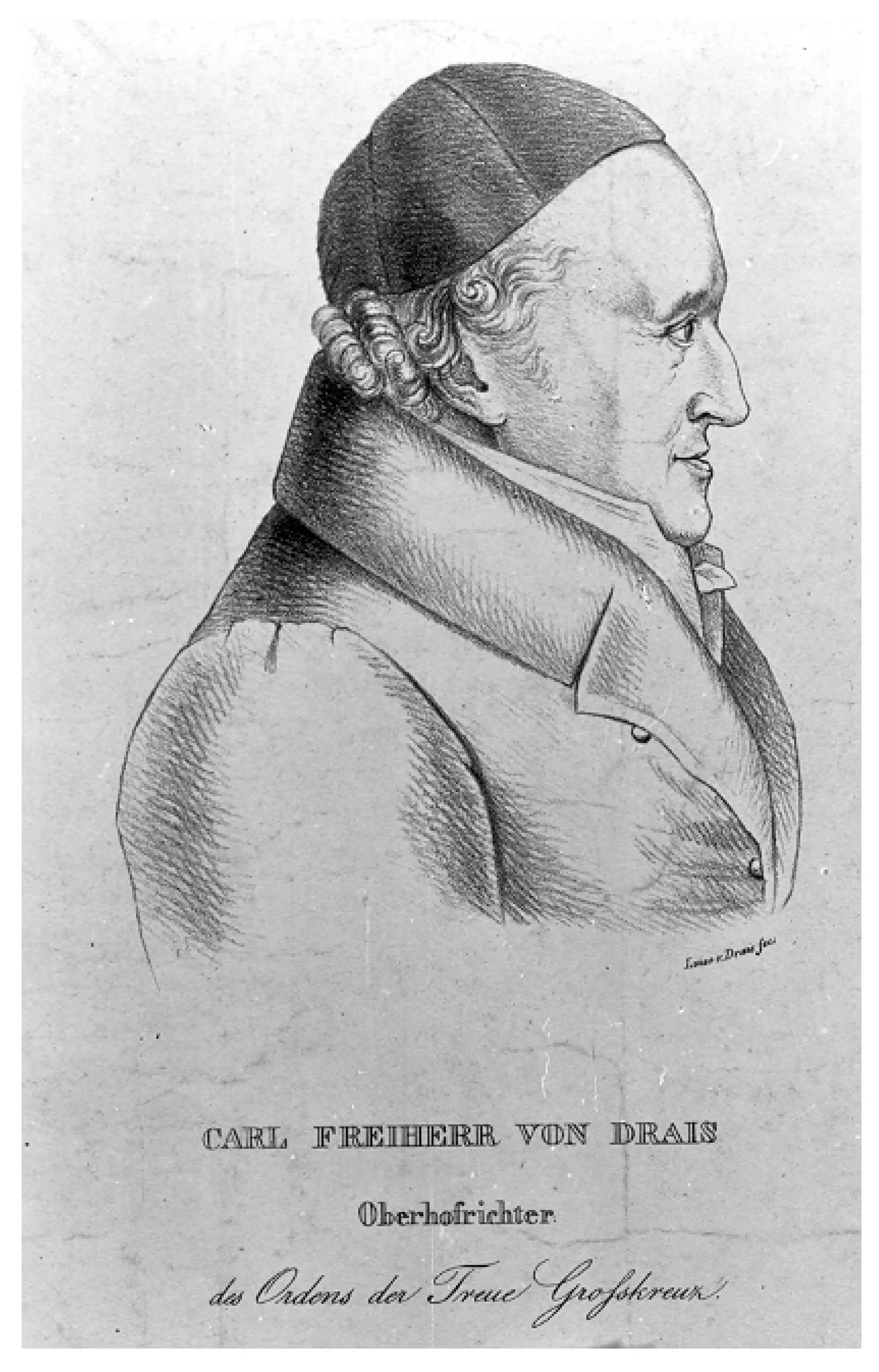
Karl Drais
Also known as: Karl von Drais, Father of the Bicycle
Birthday
April 29, 1785
Birth Sign
Taurus
Birthplace
Karlsruhe
Age
Died at 66
About
Karl Drais was a German inventor and forest official, born in Karlsruhe in 1785, and he was the man most historians credit with building the first bicycle. His 1817 Laufmaschine, a wooden two-wheeler with no pedals, is the direct ancestor of every bike on the road today, and his name lives on in the draisine, the pedal-free running bike still used to teach children balance. He died in 1851, largely forgotten and short of money, but the machine he built outlasted him by two centuries.
Today Drais is remembered as the father of the bicycle, a title that took decades to stick. Museums in Germany hold replicas of his running machine, Karlsruhe has a memorial to him, and cycling groups and the German Patent and Trade Mark Office invoke his name every World Bicycle Day. His story is a reminder that a single practical idea can travel further than the person who had it.
Early Life & Background
Karl Friedrich Christian Ludwig Freiherr Drais von Sauerbronn was born on 29 April 1785 in Karlsruhe, into a noble family of the Grand Duchy of Baden. He trained as a forest official, rising to Oberforstmeister, a post that gave him a practical education in land management, mechanics, and the rough terrain of the Black Forest. That job also put him in daily contact with the limits of animal-powered travel.
The crisis that pushed him toward invention was environmental. In 1815, Mount Tambora erupted in Indonesia, and the ash cloud cooled the atmosphere across Europe. The following year, 1816, became known as the Year Without a Summer. Crops failed, horses died in large numbers, and feeding a horse became a luxury few could afford. Drais, already tinkering with mechanical devices, began working on a vehicle that a person could power without an animal.
His early notebooks and patents show a mind that ranged far beyond forestry. Before the bicycle, he was designing machines for writing and recording, and he had a reputation in Baden as a creative, if impractical, nobleman. The Laufmaschine was not a sudden flash but the product of years of mechanical experimentation and a very specific moment of scarcity.
Career Growth
In 1817, Drais took his Laufmaschine out for its first recorded ride, covering roughly 14 kilometers from Mannheim to Schwetzingen in under an hour. The machine had two wheels in line, a steerable front wheel, and a wooden frame; the rider sat between the wheels and pushed off the ground with his feet. It was the first two-wheeled, steerable, human-powered vehicle, and the Grand Duke of Baden granted him a patent for it.
The invention drew attention across Europe, and the English nicknamed it the dandy horse. Drais continued to invent after 1817, building a horse-drawn rail vehicle, a mechanical typewriter with a keyboard, a stenograph machine, and a food-heating device. None of these brought him lasting fortune. His political sympathies during the Baden revolutions of 1848 and 1849 cost him his title of Baron and his state pension, and he spent his final years in poverty.
The bicycle, however, kept evolving. Later inventors added pedals and better brakes, and by the late 19th century the safety bicycle had become a global phenomenon. Drais's name was attached to the early machines, and the draisine became a standard term for pedal-free running bikes and, later, for rail inspection trolleys.
Career Timeline
Public Image & Style
In his own time, Drais was seen as a clever but eccentric nobleman, a forest official who spent his spare time building strange machines. The Laufmaschine made him briefly famous, but the public soon lost interest, and his later inventions did not restore his reputation. After his death, he faded from memory for decades. The modern image of Drais is that of a pioneer, the father of the bicycle, a man whose practical genius was not fully appreciated until long after he was gone. That image is reinforced by museum exhibits, memorials, and the annual World Bicycle Day tributes.
Fame & Fandom (iFAMOUS Rankings)
iFANN has not yet collected fame data for Karl Drais, so he holds no current placement in the Global Fame Rankings. He is not on the September 2026 iFAMOUS Rankings flagship list. His fame today is historical rather than contemporary, rooted in the two-century legacy of the bicycle. The cycling community has no formal fandom name, but enthusiasts celebrate his invention every year on World Bicycle Day, and the 2017 bicentennial brought exhibitions and media coverage that introduced him to a new generation. Fans of cycling history retell the story of his 1817 ride and the Year Without a Summer, keeping his memory alive through books, documentaries, and museum displays.
Interesting Facts and Legends
Drais was a prolific inventor whose other creations included an early keyboard typewriter, a stenograph machine, and a horse-drawn rail vehicle. The 1817 Laufmaschine had no pedals, so riders literally ran along the ground to propel it. The first ride from Mannheim to Schwetzingen covered about 14 kilometers in under an hour, a respectable pace for 1817. The English called his machine the dandy horse, a nickname that stuck for decades. Fans of cycling history still retell the story of the Year Without a Summer, when a volcanic eruption in Indonesia led to crop failures and horse deaths across Europe, creating the conditions that inspired the bicycle.
Family & Personal Life
Drais was born into the Baden nobility, and his family name carried the title Freiherr, or Baron. The sources do not record his parents' names or his siblings, and he is not known to have married or had children. He spent much of his adult life in Karlsruhe and the surrounding forests, and his household appears to have been a solitary one, especially after he lost his title and pension in 1849. No descendants are documented.
Notable Connections
Relationships & Dating History
Death & Aftermath
Died
December 10, 1851 (aged 66)
Death Place
Karlsruhe, Grand Duchy of Baden, Germany
Cause of Death
Unknown
For a man whose name would one day be spoken in the same breath as the bicycle, the end came quietly. Karl Drais died in Karlsruhe, the city of his birth, on 10 December 1851, at sixty-six, and the Karlsruhe he left behind had largely stopped listening to him. The republican sympathies of the 1848/49 revolutions had cost him his title of Baron and his state pension, and his final years were spent in relative poverty and obscurity. He was, in the plainest sense, forgotten.
The record of his last days is thin. No final public appearance is documented, and the cause of death was never made public; for a private citizen in mid-century Baden, a physician's certification and an entry in the civil or parish register were the ordinary course, not a matter for public ruling. The only legal matter in his biography is the earlier political one, the stripping of his title and pension, which predates his passing. He died in diminished circumstances, and that is as much as the record will say.
Cremation was not legal in Baden at the time, so burial is near-certain, and a grave or memorial in Karlsruhe is plausible, though unconfirmed. What followed was silence, and then, decades later, a slow return. His 1817 Laufmaschine, the draisine, came to be celebrated as the ancestor of the modern bicycle, and the bicentennial in 2017 brought major commemorations, among them the exhibition "2 Wheels, 200 Years" at the Technoseum, along with coverage by DW and Deutschland.de. The German Patent and Trade Mark Office and cycling organizations now invoke him in connection with World Bicycle Day on 3 June. The "father of the bicycle" tributes came late, but they came.
Net Worth (Estate Value)
Karl Drais died in 1851 with little money, and no estate value is documented. He lost his title and pension in 1849, and his later inventions did not bring him wealth. Any modern net worth figure would be meaningless, as he lived two centuries ago and left no significant assets. His legacy is cultural rather than financial.
Awards Won (1)
Drais received no modern awards, but his invention earned him a patent from the Grand Duke of Baden in 1817 and the enduring title of father of the bicycle.
1817 · Patent
Laufmaschine
Known For
Laufmaschine (Draisine)
1817 · Inventor
Keywords
Sources
Quick Facts
- Profession
- inventor, forester, designer
- Born
- April 29, 1785
- Birthplace
- Karlsruhe
- Died
- December 10, 1851
- Death Place
- Karlsruhe
- Gender
- Male
- Birth Sign
- Taurus
Personal Details
- Full Name
- Karl Friedrich Christian Ludwig Freiherr Drais von Sauerbronn
Frequently Asked Questions
Why did Karl Drais invent the bicycle?
Did Karl von Drais invent the first bike?
Who invented the dandy horse?
What were some of Karl von Drais' inventions?
What is Karl Drais' full name?
Join the community
fans discussing