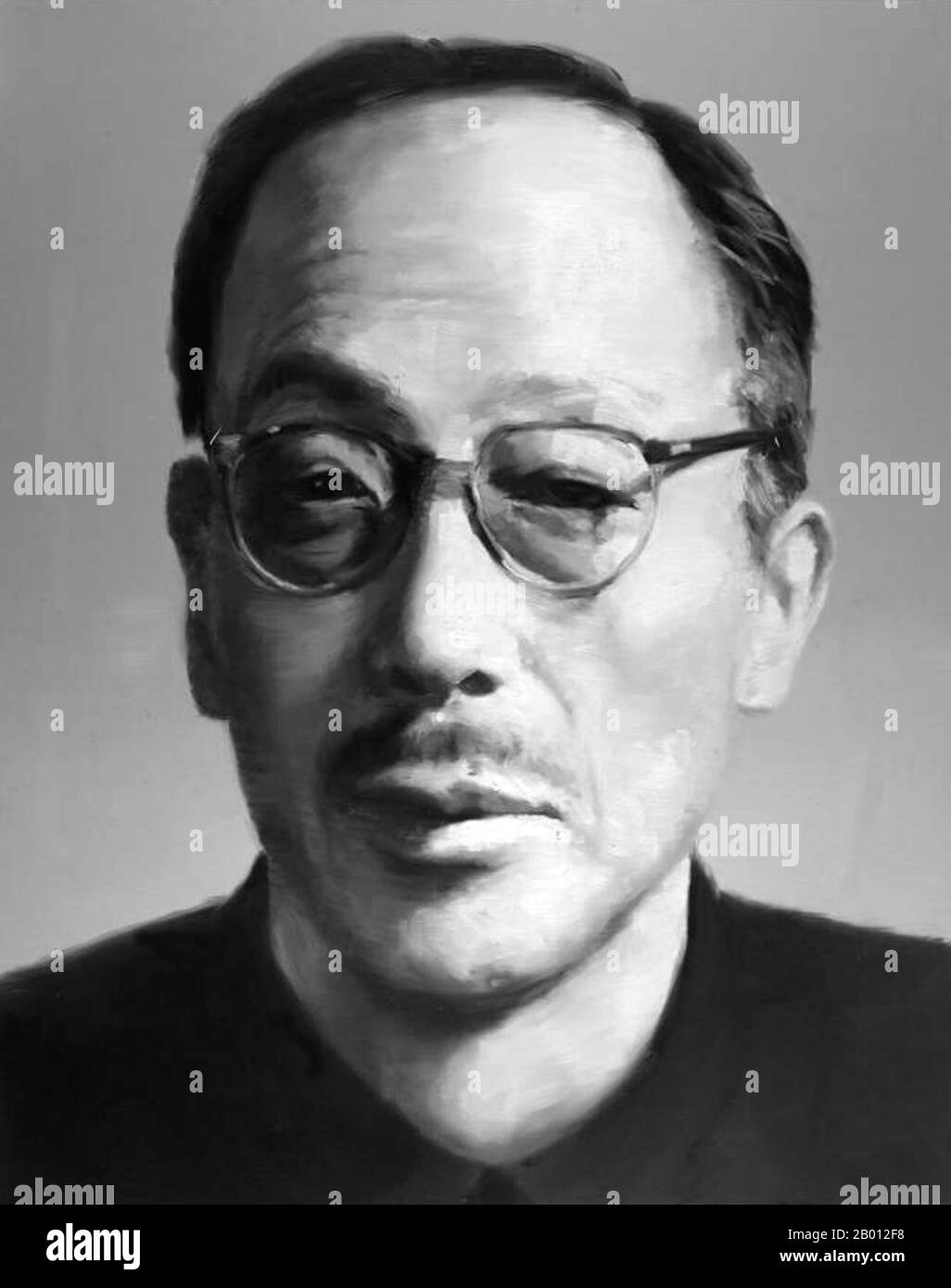
Kang Sheng
 China
ChinaBirthday
1898-01-01
Birth Sign
Capricorn
Birthplace
Zhucheng, Shandong, China
Age
Died at 77
About
Kang Sheng was a senior Chinese Communist Party official, politician, and calligrapher, remembered as one of the most feared figures in the party's security apparatus. Born Zhang Zongke around 1898 in Zhucheng, Shandong, he rose to become a close confidant of Mao Zedong, wielding immense power over internal security and intelligence. His name is synonymous with the repressive mechanisms of the Cultural Revolution, earning him titles like the "creator of the Chinese Gulag" and the "Godfather of the Cultural Revolution."
Kang Sheng's influence spanned decades, from his early days in the party to his death in 1975. He was a master of political maneuvering, aligning himself with Mao at crucial moments and becoming an indispensable ally. Yet his legacy is deeply tainted by his role in the persecution of countless individuals, leading to his posthumous expulsion from the party in 1980. For historians and students of Chinese politics, Kang Sheng remains a chilling example of the dangers of unchecked power.
Early Life & Background
Kang Sheng was born Zhang Zongke in Zhucheng, a county in Shandong province, around 1898. Little is known about his early life, but he joined the Chinese Communist Party in the early 1920s, during the party's formative years. His intelligence and organizational skills quickly brought him to the attention of senior leaders.
In the 1930s, Kang Sheng was sent to Moscow, where he studied the methods of the Soviet NKVD, the secret police. This training would shape his future career. Initially, he aligned himself with Wang Ming, a rival of Mao Zedong for party leadership. However, upon returning to China in the late 1930s, Kang Sheng shrewdly switched his allegiance to Mao, recognizing where the power lay. This decision proved pivotal, as he became one of Mao's most trusted and ruthless enforcers.
Career Growth
Kang Sheng's career took off in the early 1940s when he took charge of the CCP's internal security and intelligence departments. He was instrumental in running the party's spy networks and rooting out internal enemies, earning a reputation for paranoia and brutality. During the Second Sino-Japanese War and the Chinese Civil War, he served as Mao's right hand in matters of state security.
After the founding of the People's Republic in 1949, Kang Sheng remained a powerful behind-the-scenes figure. His influence peaked during the Cultural Revolution (1966-1976), when he acted as an adviser to the Gang of Four and oversaw the persecution of numerous officials and intellectuals. He was a key architect of the terror that defined the period. However, his downfall came posthumously: in 1980, the party officially blamed him for the excesses of the Cultural Revolution, expelling him from the CCP and tarnishing his name forever.
Career Timeline
Public Image & Style
Kang Sheng's public image is that of a shadowy, sinister figure, a master of intrigue who operated behind the scenes. He was rarely seen in public, preferring to work through his security apparatus. In official narratives, he is portrayed as a villain, responsible for the deaths of many innocent people during the Cultural Revolution. Among historians, he is studied as a case study in the abuse of power, a man who used ideology as a weapon for personal vendettas.
Fame & Fandom (iFAMOUS Rankings)
Kang Sheng never courted fans. His legacy is defined by fear rather than affection, leaving no organized fanbase or formal collective name to rally around his memory. He operated in the shadows of the Chinese Communist Party, a figure whose influence was exerted through secret police mechanisms and political purges rather than public adoration. There are no birthday billboards, no streaming campaigns, and no charity drives bearing his name. The audience for his story remains strictly historical, consisting of scholars and readers examining the mechanics of power rather than devotees celebrating a personality. This absence of fandom stands in stark contrast to modern celebrity culture where even controversial figures often cultivate dedicated followings. Kang Sheng is currently evaluated by the iFANN Global Fame Engine but holds no placement in the published rankings. He does not appear on the Global Top 1,000 list nor does he occupy any Top-100 scope category. The system has assessed his profile yet found no data sufficient to assign him a numerical rank among living or deceased global figures. His fame exists only as a dark footnote in political history, devoid of the metrics that drive contemporary fame algorithms. While the world tracks the rise and fall of pop stars with obsessive precision, the shadowy architect of China's security apparatus remains unranked by the engines that measure cultural saturation. The lack of a numeric score reflects the reality that his notoriety is categorical rather than quantitative. He is a subject of study, not a subject of fandom.
Interesting Facts and Legends
Kang Sheng was a skilled calligrapher whose works continue to circulate in the art market. A piece titled "草书律己" (Calligraphy) from 1968 was listed at an auction in April 2026, proving his artistic output survives decades after his death. Despite wielding immense power within the party, he maintained spartan personal habits and reportedly avoided luxury. Historians describe him as a cultured man deeply interested in classical Chinese art and literature. His nickname, "Godfather of the Cultural Revolution," encapsulates his role in guiding the movement's purges from behind the scenes. Historical accounts detail his creation of the "Chinese Gulag," a system of forced labor camps used to purge political opponents. They also detail his pivotal role in the persecution of hundreds of thousands of individuals, including high-ranking officials. He served as a key adviser to the Gang of Four, cementing his reputation as a central enforcer during the chaos of the late Mao era. These stories are not folklore but verified historical facts documented in encyclopedic sources and analyses of the period. His death on December 16, 1975, marked the end of an era of intense internal security control within the party.
Family & Personal Life
Very little is known about Kang Sheng's family. He was born Zhang Zongke, but he adopted the name Kang Sheng as his revolutionary alias. There are no public records of his parents, siblings, or any children. He kept his personal life intensely private, a trait common among high-ranking CCP officials of his era.
Notable Connections
Kang Sheng was closely associated with Mao Zedong, serving as his confidant and security chief. He also had ties to the Gang of Four, acting as an adviser to the radical group during the Cultural Revolution. Earlier in his career, he was aligned with Wang Ming, a rival of Mao, but later switched loyalties.
Relationships & Dating History
Death & Aftermath
Died
1975-12-16 (aged 77)
Death Place
Unknown
Cause of Death
Unknown
Net Worth (Estate Value)
$0
iFANN Editorial Team estimate
iFANN currently estimates Kang Sheng's net worth at $0. As a high-ranking party official, he had access to state resources, but his personal wealth was never documented. After his death, his estate has not been a focus of financial reporting, and no posthumous earnings have been noted. Given the lack of data, any net worth figure would be speculative. For historical figures like Kang Sheng, financial details are often obscured by the political context. The editorial analysis confirms that no reliable estimates exist regarding his personal fortune.
Awards & Accolades
Known For
Internal Security Chief
1940s · Head of CCP intelligence
Cultural Revolution
1966 · Adviser to Gang of Four
Calligraphy
1968 · Artist
Keywords
Sources
Quick Facts
- Profession
- politician
- Born
- 1898-01-01
- Birthplace
- Zhucheng, Shandong, China
- Died
- 1975-12-16
- Death Place
- Beijing
- Gender
- Male
- Birth Sign
- Capricorn
Personal Details
- Full Name
- Zhang Zongke
Frequently Asked Questions
Who was Kang Sheng?
What was Kang Sheng known for?
When was Kang Sheng born and when did he die?
What was Kang Sheng's role in the Cultural Revolution?
What was Kang Sheng's relationship with Mao Zedong?
Join the community
fans discussing