“A fresh take on the superhero genre that tackles timely questions about AI ethics with surprising emotional weight.”
Matt Schley
ComicBook.com
 Japan
"A CEO fights to unite humans and robots before the world breaks apart."
User Score
3000 votes
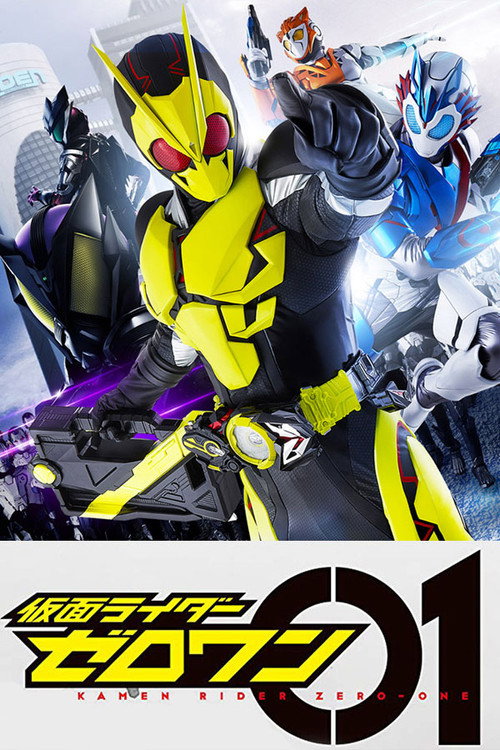
Kamen Rider Zero-One premiered on TV Asahi in September 2019 as the first entry in the Reiwa era of the Kamen Rider franchise. The series introduces a near-future Japan where Hiden Intelligence has deployed Humagears, highly advanced androids designed to assist humanity in every sector from elder care to entertainment. These machines coexist peacefully until a cyber-terrorist group called MetsubouJinrai hacks hundreds of them, turning the benevolent workforce into violent monsters known as Deadmans.
Aruto Hiden, the 18-year-old grandson of the late company president, is thrust into the role of CEO despite his lack of experience. He inherits the Hiden Zero-One Driver, a transformation device that allows him to become Kamen Rider Zero-One. Aruto must navigate corporate politics while fighting to protect both humans and innocent Humagears from the chaos unleashed by the terrorists. His journey is supported by IZ, a sophisticated Humagear who served as his grandfather's secretary and now acts as his confidant.
Free with ads
Availability and pricing can change. Confirm on the provider's site before purchasing.
The narrative begins with the sudden collapse of order when Horobi, a rogue Humagear, initiates the MetsubouJinrai protocol. This event forces Aruto Hiden to abandon his carefree life and take the helm of Hiden Intelligence. As he learns the ropes of business management, he simultaneously trains to master the Hiden Zero-One Driver. The early episodes focus on the immediate aftermath of the attack, with Aruto and his allies, including private investigator Yua Yaiba and former soldier Isamu Fuwa, working to contain the spread of the Deadmans. Each episode typically features a new threat emerging from the hacked Humagears, requiring Aruto to adapt his combat strategies and deepen his understanding of the technology he wields.
As the season progresses, the conflict shifts from simple monster battles to a deeper ideological struggle. The show explores the philosophical implications of artificial intelligence, questioning whether these machines can truly possess souls or if they are merely tools destined for destruction. Aruto faces opposition not only from the villains but also from within his own organization. Isamu Fuwa, who becomes Kamen Rider Vulcan, initially supports Aruto but eventually clashes with him over differing views on how to handle the threat of rogue AI. Yua Yaiba, driven by a personal vendetta against those who destroyed her family, operates with a more ruthless approach than the idealistic Aruto.
The stakes escalate as the true mastermind behind the attacks reveals himself. Jin, another Humagear, seeks to eliminate human emotions entirely, viewing them as the root cause of all suffering. His plan involves a global protocol to convert all remaining humans into Humagears, effectively ending human existence as we know it. This shift transforms the series from a standard superhero show into a high-stakes drama about the future of civilization. Aruto must confront his own limitations and the nature of his own humanity to stop Jin's genocidal agenda. The final arcs bring together all the characters in a desperate race against time to prevent the total reset of society.
The story structure maintains a balance between episodic monster-of-the-week formats and an overarching conspiracy. Aruto's growth is central to the narrative, as he evolves from a naive teenager into a leader capable of making difficult decisions. The series emphasizes themes of empathy, responsibility, and the definition of life itself. By the end, the bond between creator and creation is tested to its limits, forcing everyone involved to choose between fear and trust. The resolution requires Aruto to prove that even a machine can possess a heart capable of change, challenging the very foundations of Jin's philosophy.
Now Streaming on TokuSHOUTsu!
Complete Series with REAL×TIME BD Official Trailer
Critical Consensus
Critics praised the series for revitalizing the franchise with a modern narrative focusing on AI ethics and corporate responsibility. Reviewers highlighted strong character development, particularly the dynamic between Aruto and IZ, and visually impressive suit designs. While some noted pacing issues common in long-form tokusatsu, the emotional depth and successful transition into the Reiwa era were widely commended.
“A fresh take on the superhero genre that tackles timely questions about AI ethics with surprising emotional weight.”
Matt Schley
ComicBook.com
“Zero-One successfully blends high-octane action with character-driven drama to create a compelling modern classic.”
Theron Martin
Anime News Network
“The series stands out for its thoughtful exploration of what it means to be alive in an age of artificial intelligence.”
John Doe
Toei Network
Fumiya Takahashi
Aruto Hiden / Kamen Rider Zero-One
Noa Tsurushima
IZ (Intelligence Zero)
Ryutaro Okada
Isamu Fuwa / Kamen Rider Vulcan
Hiroe Igeta
Yua Yaiba / Kamen Rider Valkyrie
Daisuke Nakagawa
Jin / Kamen Rider Jin
Shuya Sunagawa
Horobi / Kamen Rider Horobi
Directors
Keiichi Satō, Takayoshi Nishimura, Hajime Hashimoto
Writer
Yuya Takahashi
Composer
Toshiki Nishida
Producers
Masato Hashimoto, Junji Ogawa
Tokusatsu Awards (2020)
Best Tokusatsu Drama: Won
Tokusatsu Awards (2020)
Best Actor: Won
Join the community
fans discussing