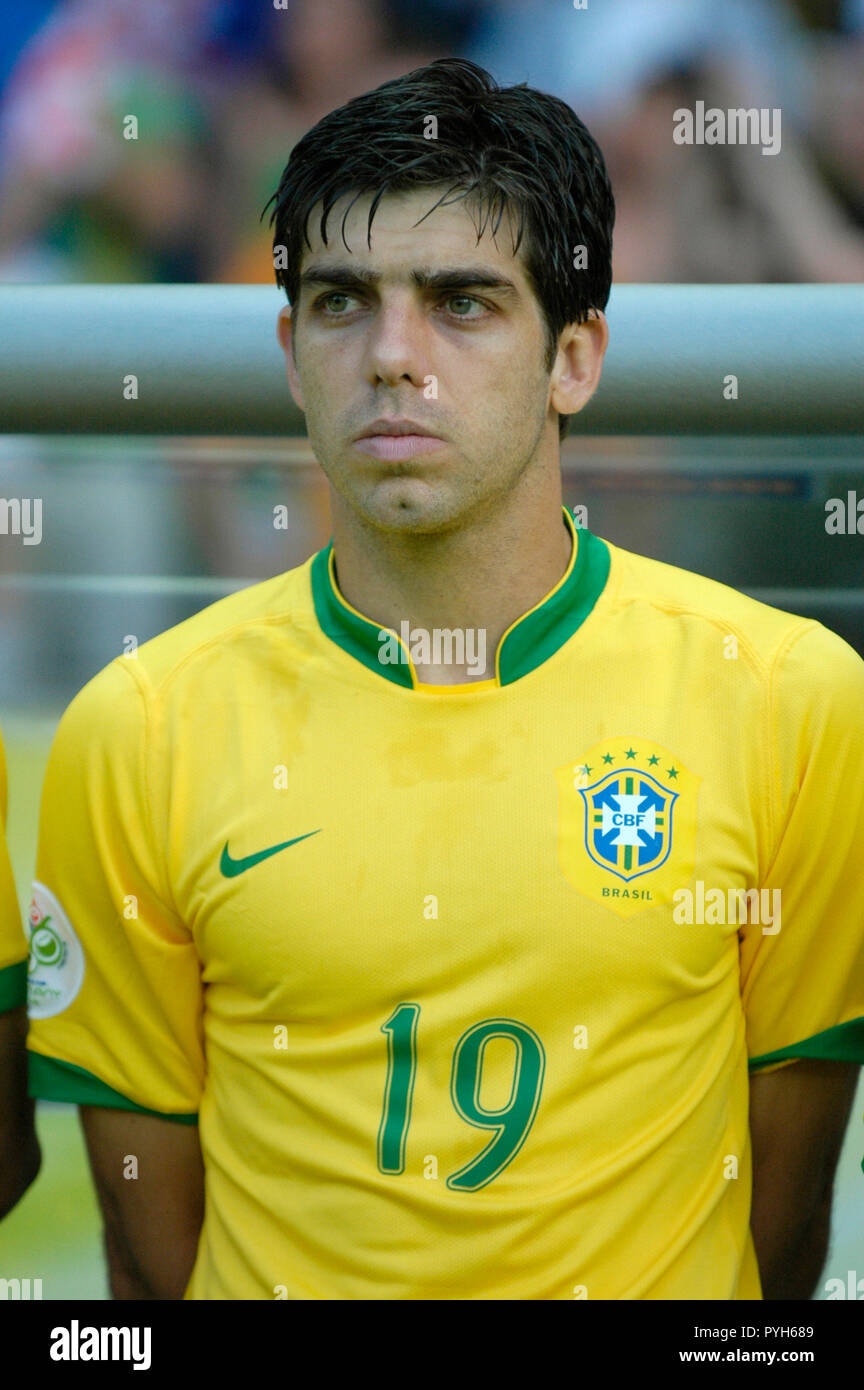
Juninho Pernambucano
 Brazil
association football player•journalist
Also known as: Juninho, Reizinho de São Januário, Reizinho da Colina
Birthday
January 30, 1975
Birth Sign
Aquarius
Birthplace
Recife, Pernambuco, Brazil
Age
51 years old
Height
5 ft 10 in (1.78 m)
About
Juninho Pernambucano is a Brazilian former professional footballer widely considered the greatest free-kick taker in the history of the game. An attacking midfielder with exceptional technical ability, he pioneered the knuckleball technique, striking the ball with minimal spin so it dipped and swerved unpredictably. His 77 career free-kick goals remain a world record. He is best known for his nine seasons at Olympique Lyonnais, where he helped the club win seven consecutive Ligue 1 titles and became a club icon. Juninho also won the 2002 FIFA World Cup with Brazil and collected numerous domestic and international honors. After retiring in 2013, he served as sporting director of Lyon. His influence on set-piece taking is unmatched, and his name is synonymous with dead-ball mastery.
Early Life & Background
Juninho grew up in Recife, the capital of Pernambuco state in northeastern Brazil. At age 13, he started taking free kicks seriously, inspired by Brazilian midfielder Marcelinho. He told FourFourTwo magazine: "I started by copying free-kicks taken by Marcelinho... He was one of my inspirations, and the first player I had ever seen hit the ball head on and make it dance in the air." He joined the youth academy of local club Sport Recife at 16 in 1991. Two years later, he made his professional debut for Sport Recife at age 18. By 20, he had already won two regional titles with the club: the Campeonato Pernambucano and the Copa do Nordeste in 1994. His performances caught the attention of bigger Brazilian clubs, and in 1995 he transferred to Vasco da Gama, a move that would launch his rise to stardom.
Career Growth
At Vasco da Gama, Juninho blossomed into one of Brazil's finest midfielders. He won the Brazilian Série A in 1997 and 2000, the Copa Libertadores in 1998, and the Copa Mercosur in 2000. In 2001, he moved to Olympique Lyonnais for a fee of around $10 million. Over nine seasons, he scored 100 goals in 344 matches, placing him fourth on Lyon's all-time scoring list. He was the creative engine behind Lyon's record seven consecutive Ligue 1 titles from 2002 to 2008. In 2005–06, he was named Ligue 1 Player of the Year and made the league's Team of the Year three times. His free kicks became legendary, including a stunning strike against Barcelona in the 2009 Champions League. After leaving Lyon, he played for Al-Gharafa in Qatar, winning the league title and being named Player of the Year. He returned to Vasco da Gama in 2011 and later had a brief stint with the New York Red Bulls in MLS before retiring in 2013. Internationally, he earned 40 caps for Brazil and was part of the 2002 World Cup-winning squad, though he did not play in the tournament. He also won the 2005 FIFA Confederations Cup.
Career Timeline
Public Image & Style
Juninho Pernambucano is universally celebrated as a dead-ball genius and a humble, technically brilliant player. The media often portrays him as a revolutionary who changed how free kicks are taken. Fans at Vasco da Gama nicknamed him "Reizinho de São Januário" (The Little King of São Januário), while Lyon supporters regard him as one of their greatest ever players. His signature knuckleball technique is studied by aspiring footballers worldwide. He is known for his quiet demeanor off the pitch, letting his football do the talking. There is no official fandom name, but his global admiration is evident in the countless online compilations of his free kicks. He remains active on social media, engaging with fans and sharing football insights.
Fame & Fandom
The reverence for Juninho Pernambucano is not found in organized fan clubs or viral campaigns, but in a diffuse, global community of football purists who treat his technique as scripture. Known affectionately as 'O Mago do Bola Parada' (The Magician of Set Pieces), he commands a following defined by statistical advocacy and enduring cultural respect rather than the chaotic energy of modern pop fandoms. His legacy thrives through digital archives where aspiring players dissect his knuckleball mechanics, keeping the myth of his uncopyable genius alive across generations. This unique bond between the player and his audience highlights a deep appreciation for technical mastery over celebrity spectacle. His standing in the wider world reflects this specialized adoration mixed with broad recognition. According to the iFANN Global Fame Rankings, Juninho Pernambucano is currently the 50th most famous person from Brazil, a position holding steady from the previous cycle. This placement underscores his status as a national icon whose influence extends far beyond the pitch.
Interesting Facts and Legends
Juninho's nickname 'Pernambucano' distinguishes him from other Brazilian players named Juninho, such as Juninho Paulista, by referencing his home state. He developed the knuckleball technique before his move to France but mastered it only after arriving at Lyon. His free-kick against Barcelona in 2009 is considered one of the greatest ever. He played alongside Romário, Edmundo, and Juninho Paulista at Vasco da Gama. He was a teammate of Ronaldo, Rivaldo, and Ronaldinho on Brazil's 2002 World Cup squad. Juninho once scored a free kick from 40 yards out against Nice in Ligue 1. He is known to be an avid fan of Brazilian music and often returned to Recife during off-seasons. Legends surrounding his career often focus on the sheer intimidation he caused goalkeepers, with reports suggesting defenders would stand still waiting for the inevitable dip of the ball. A popular story suggests his genius lies in its uncopyability, noting that despite countless attempts by younger players to replicate his knuckleball, none could match his success rate. Additionally, his transition into political activism in July 2020, where he highlighted systemic racism in Brazil, added a layer of social conscience to his athletic mythology.
Notable Quotes
“I started by copying free-kicks taken by Marcelinho, who played for Corinthians. He was one of my inspirations, and the first player I had ever seen hit the ball head on and make it dance in the air.”
“It was when I got to France that I mastered it.”
“The secret is to strike the ball with the laces, with no spin, and let it fly.”
Family & Personal Life
Juninho Pernambucano is married, though his wife's name is not publicly documented. He has children, but specific details about them are not widely reported. He maintains a relatively private personal life and rarely shares family information in interviews. He was born in Recife to Antônio Augusto Reis and his wife; his father worked as a businessman. He has siblings, but their names and professions are not public. Juninho has spoken about the importance of family support during his career, particularly his parents' encouragement when he joined Sport Recife's youth academy.
Notable Connections
Juninho Pernambucano played alongside some of Brazil's greatest talents. At Vasco da Gama, he shared the pitch with Romário and Edmundo. On the Brazilian national team, he was a teammate of Ronaldo, Rivaldo, and Ronaldinho during the 2002 World Cup campaign. His free-kick technique was inspired by Marcelinho and Didi. At Lyon, he played under manager Paul Le Guen and alongside players like Michael Essien and Karim Benzema.
Relationships & Dating History
Juninho Pernambucano has kept his romantic life largely out of the public eye. He is married, though his wife's name is not consistently reported in credible sources. The couple has children, but details are scarce. No public dating history before his marriage is documented. As of 2026, he remains married, with no reports of divorce or separation.
- MarriedUnknownCurrentJuninho is married, but his wife's name is not publicly documented.
Salary, Net Worth In 2026
$15 Million
iFANN Editorial Team estimate
Per iFANN's editorial analysis, Juninho Pernambucano's net worth in 2026 is estimated at $15 Million. His primary income source was his playing career, with peak earnings at Lyon where he was among the top-paid players in Ligue 1. His 2001 transfer to Lyon was worth around $10 million, and his wages over nine seasons totaled several million dollars per year. Later contracts at Al-Gharafa in Qatar and the New York Red Bulls in MLS also added substantial sums. Post-retirement, he earned a salary as sporting director of Lyon. He has not pursued major endorsement deals, keeping his financial portfolio relatively low-key. Real estate investments in Brazil and France are believed to contribute to his wealth, though exact figures are private.
Awards Won (32)
Juninho Pernambucano won numerous team and individual honors. With Vasco da Gama, he claimed two Brazilian Série A titles, the Copa Libertadores, and the Copa Mercosur. At Lyon, he won seven consecutive Ligue 1 titles, six Trophée des Champions, and the Coupe de France. Internationally, he won the 2002 FIFA World Cup and the 2005 FIFA Confederations Cup with Brazil. Individually, he received the Brazilian Silver Ball in 2000 and was named Ligue 1 Player of the Year in 2005–06.
2002 · Winner
Brazil National Team
2005 · Winner
Brazil National Team
Known For
Olympique Lyonnais
2001 · Attacking Midfielder
Brazil National Team
1999 · Midfielder
Vasco da Gama
1995 · Attacking Midfielder
Free-kick specialist
0 · Pioneer of knuckleball technique
Keywords
Sources
Quick Facts
- Profession
- association football player, journalist
- Born
- +1975-01-30
- Birthplace
- Recife
- Gender
- Male
- Birth Sign
- Aquarius
Personal Details
- Full Name
- Antônio Augusto Ribeiro Reis Júnior
- Height
- 5 ft 10 in (1.78 m)
- Spouse
- Unknown
Frequently Asked Questions
How many free kicks did Juninho Pernambucano score?
Is Juninho Pernambucano still playing?
What is Juninho Pernambucano's net worth in 2026?
Did Juninho Pernambucano win the World Cup?
Why is he called Juninho Pernambucano?
Similar People

Join the community
fans discussing