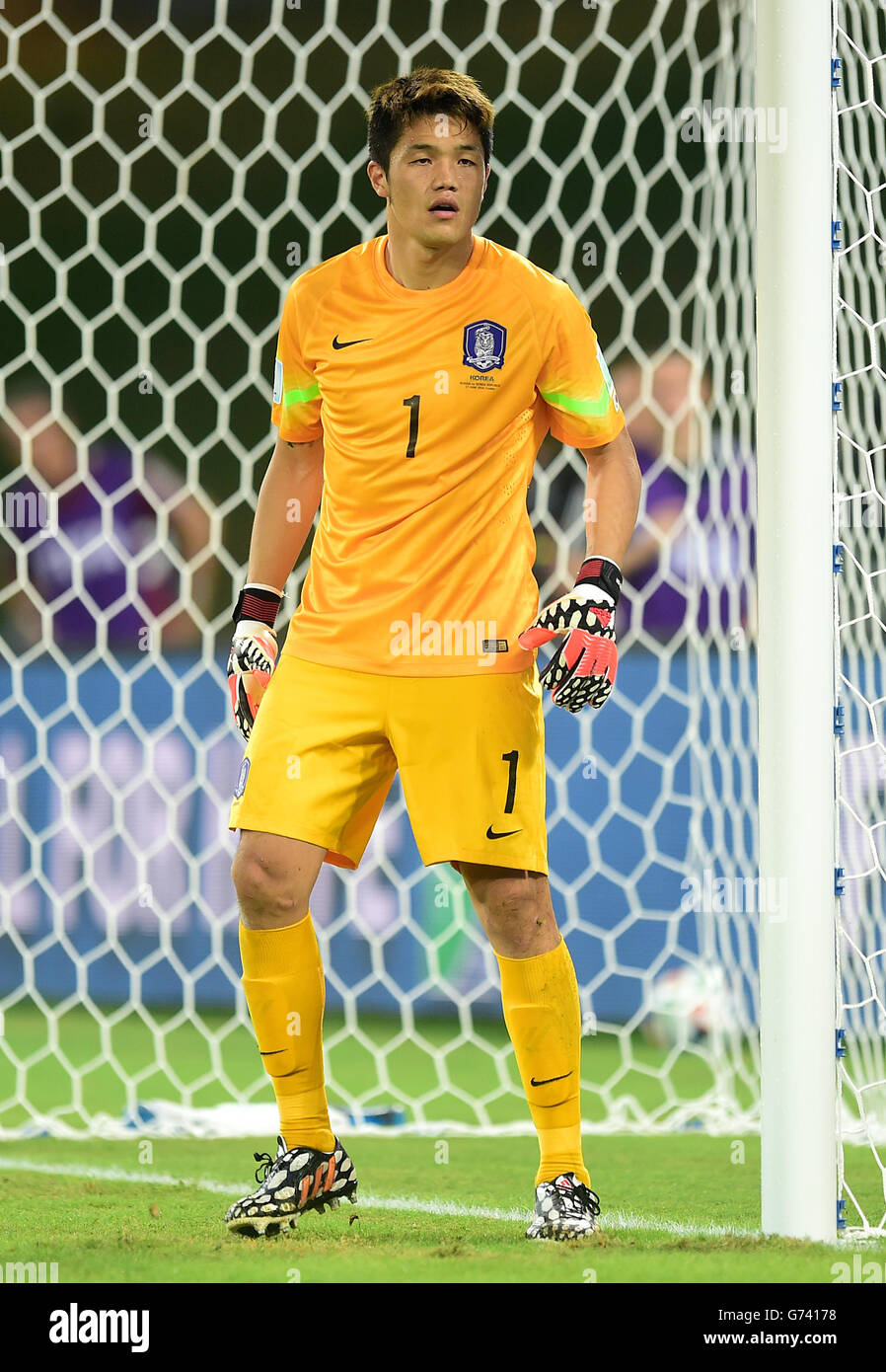
Jung Sung-ryong
 South Korea
Also known as: Sung-ryong Jung
Birthday
January 4, 1985
Birth Sign
Capricorn
Birthplace
Seongnam, South Korea
Age
41 years old
Height
6 ft 1 in (186 cm)
About
Jung Sung-ryong is a South Korean professional footballer who has spent over two decades as a goalkeeper, most notably with Kawasaki Frontale in Japan's J1 League. Known for his calm presence and reliable shot-stopping, he has won multiple domestic titles and earned more than 60 caps for South Korea, appearing at two World Cups.
As of 2026, the 41-year-old continues to play professionally for Fukushima United in Japan's J3 League, demonstrating remarkable longevity. His career has spanned three countries and three decades, making him one of the most experienced goalkeepers in Asian football.
Early Life & Background
Jung Sung-ryong was born on January 4, 1985, in Seongnam, South Korea. Details of his early life are scarce, but his football journey began in the youth ranks before he made his professional debut with Pohang Steelers in 2003 at age 18.
At Pohang, he developed into a top-tier shot-stopper, quickly earning a reputation for his excellent positioning and reliable handling. His early years in the K League laid the foundation for a career that would take him to the highest levels of Asian football.
Career Growth
Jung Sung-ryong's breakthrough came in 2009 when he helped Pohang Steelers win the AFC Champions League, earning the tournament's Best Goalkeeper award. That same year, he won his second K League 1 title with the club.
In 2010, he was South Korea's starting goalkeeper at the FIFA World Cup in South Africa, a career-defining moment on the international stage. After a move to Suwon Samsung Bluewings in 2011, he joined Kawasaki Frontale in 2016, where he would spend nearly a decade. With Kawasaki, he won four J1 League titles and two Emperor's Cups, playing 363 games for the club. He briefly moved to Al-Hilal in Saudi Arabia in 2023 before returning to Japan with Fukushima United.
Career Timeline
Public Image & Style
Jung Sung-ryong is widely regarded as a quiet, dependable professional, often described as a 'Quiet Giant' who redefined Kawasaki Frontale through stability and consistency. His playing style is characterized by excellent positioning, calm judgment, and reliable ball distribution.
Media portrayals consistently emphasize his professionalism and longevity. He maintains a low-key social media presence, with an understated and professional tone.
Fame & Fandom (iFAMOUS Rankings)
The story of Jung Sung-ryong is one of quiet endurance rather than viral frenzy. Unlike the pop idols or actors who dominate headlines with organized fan clubs and campaign-driven milestones, his support base is built on a decade of unshakeable reliability at Kawasaki Frontale. Fans do not chant for him in the same way they might for a K-pop star; instead, they revere him as a 'Quiet Giant' whose presence alone stabilized an entire defensive line for ten years. This organic bond, forged through 363 appearances and countless clean sheets, defines his relationship with the public without a formal collective moniker or structured fan campaigns to organize birthday billboards or subway ads. His reputation rests entirely on the pitch, where he was the starter for South Korea during the 2010 World Cup and later anchored the J-League's most dominant team. In August 2026, iFANN evaluated Jung Sung-ryong's global standing and found that he does not currently hold a placement in the published rankings. He remains outside the Global Top 1,000 and any scope-specific top lists, reflecting his status as a highly respected veteran athlete rather than a mainstream celebrity figure with broad international consumption signals. While his fame is deep within the specific circles of Asian football and Japanese sports fans, it has not translated into a ranked position among the world's most famous individuals. The data confirms his lack of a documented fandom name, distinguishing him from entertainers who have cultivated massive, named followings. His legacy is defined by the absence of errors and the calm under pressure that earned him his nickname, proving that true legend can exist without the machinery of modern celebrity culture.
Interesting Facts and Legends
Jung Sung-ryong has played professionally in three countries: South Korea, Japan, and Saudi Arabia. His career has spanned over 23 years, from 2003 to the present. He was part of South Korea's 2008 Olympic team. In 2024, at age 39, he ranked fifth in the J1 League for clean sheets. Known for his kicking ability, he has also served as a mentor to younger goalkeepers throughout his career. A defining chapter of his legend occurred during his decade-long tenure at Kawasaki Frontale from 2016 to 2025, where he made 363 appearances and became synonymous with the club's defensive stability. Fans often recount his 2010 World Cup selection as the peak of his international career, cementing his status as South Korea's number one goalkeeper. Another iconic moment involved facing Lionel Messi and Paris Saint-Germain in July 2022, where Jung held his ground against global superstars during a Japan tour match. Unlike some peers, his folklore is defined by the absence of errors and the presence of calm under pressure, earning him the moniker of a 'Quiet Giant.' There are no stories of viral parodies or comedic stunts associated with him, distinguishing him clearly from other entertainers with similar names.
Family & Personal Life
Jung Sung-ryong keeps his family life private, and little is publicly known about his parents, siblings, or household. He has not shared details about a spouse or children in interviews or on social media.
His focus has remained on football, and he has not publicly discussed family stories or values.
Notable Connections
Jung Sung-ryong has been associated with several prominent figures in Asian football. At Fukushima United, he shares the squad with legendary striker Kazuyoshi Miura, who at 59 remains the oldest professional footballer. During his decade at Kawasaki Frontale, he played alongside numerous Japanese internationals. With the South Korea national team, he was a contemporary of stars like Park Ji-sung and Son Heung-min.
Relationships & Dating History
Jung Sung-ryong has kept his personal life out of the public eye. There are no confirmed reports of romantic relationships, marriage, or children. He has not been linked to any partner in the media, and he has not shared details about his dating history.
As of 2026, his relationship status remains not publicly documented.
Salary, Net Worth In 2026
$2 Million
iFANN Editorial Team estimate
iFANN currently estimates Jung Sung-ryong's net worth at $2 Million as of 2026. His earnings have primarily come from club salaries across the K League, J1 League, and a brief stint in Saudi Arabia. His peak earning years were with Kawasaki Frontale, where he was a key player for nearly a decade. While exact figures are not public, his long career and multiple championships suggest a steady accumulation of wealth.
Awards Won (9)
Jung Sung-ryong has won numerous team honors, including the AFC Champions League in 2009 with Pohang Steelers and four J1 League titles with Kawasaki Frontale. Individually, he was named the AFC Champions League Best Goalkeeper in 2009.
2009 · Best Goalkeeper
Pohang Steelers
2009 · Champion
Pohang Steelers
2007 · Champion
Pohang Steelers
Known For
AFC Champions League
2009 · Goalkeeper for Pohang Steelers
FIFA World Cup
2010 · Starting goalkeeper for South Korea
J1 League
2017-2021 · Goalkeeper for Kawasaki Frontale
Keywords
Sources
Quick Facts
- Profession
- Professional footballer
- Born
- January 4, 1985
- Birthplace
- Seongnam, South Korea
- Height
- 6 ft 1 in (186 cm)
- Position
- Goalkeeper
Personal Details
- Full Name
- Jung Sung-ryong
- Height
- 6 ft 1 in (186 cm)
Frequently Asked Questions
How old is Jung Sung-ryong?
What team does Jung Sung-ryong play for?
What is Jung Sung-ryong's net worth?
Is Jung Sung-ryong married?
How many caps does Jung Sung-ryong have for South Korea?
Social Media
Similar People

Join the community
fans discussing