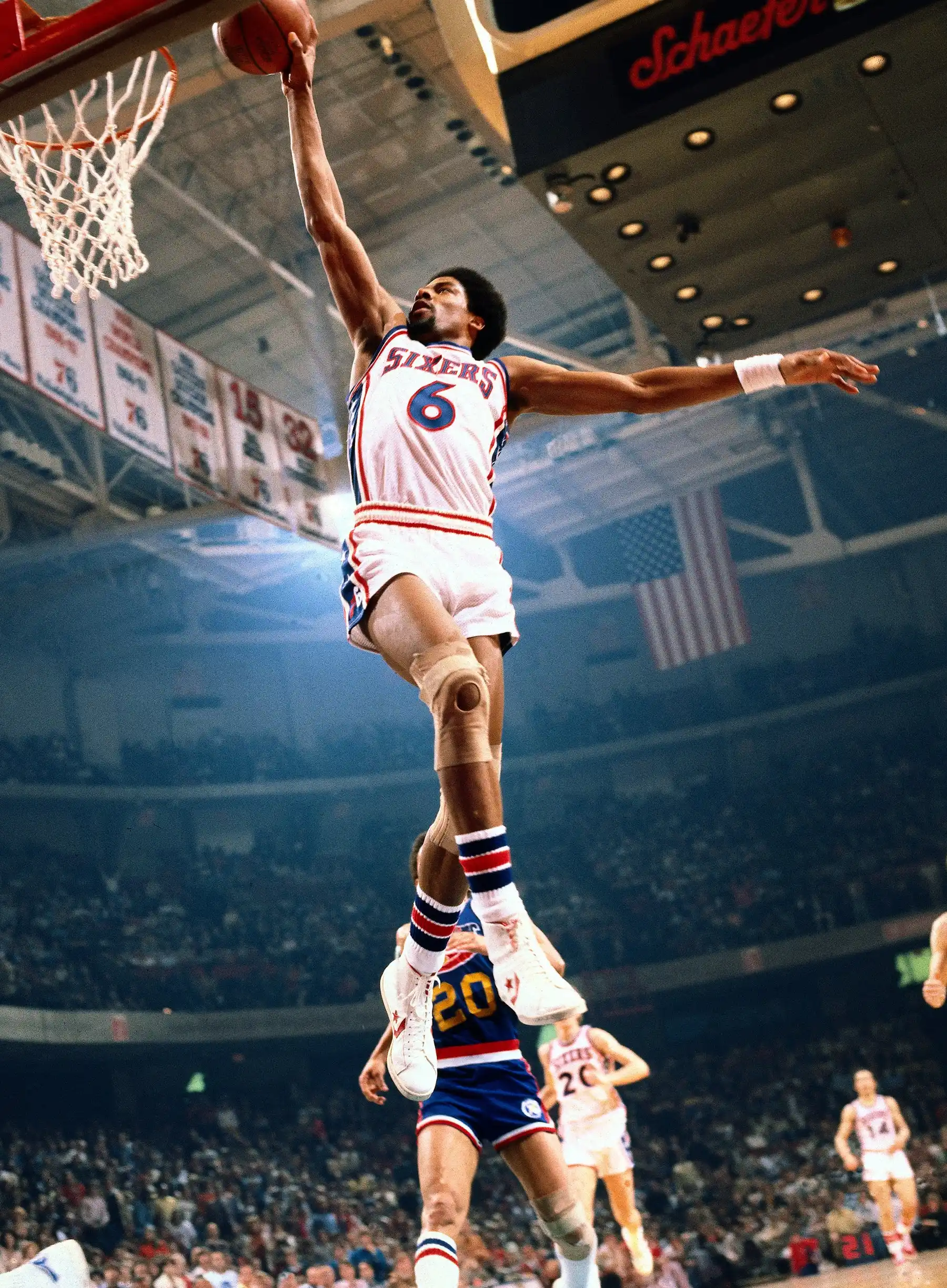
Julius Erving
 United States
Also known as: Dr. J
Birthday
February 22, 1950
Birth Sign
Pisces
Birthplace
East Meadow, New York, USA
Age
76 years old
Height
6 ft 7 in (1.98 m)
About
Julius Erving is an American former professional basketball player who redefined the game with his aerial artistry. Known worldwide as Dr. J, he was the face of the ABA and later a superstar for the Philadelphia 76ers in the NBA. Across 16 professional seasons, Erving scored over 30,000 points, won three championships, and collected four MVP awards. He is credited with popularizing the slam dunk, turning it from a simple score into a canvas for creativity and power. In 2026, his legacy endures as a Hall of Famer and a member of the NBA's 75th Anniversary Team. He was one of the first players to make extemporaneous individual expression an integral part of the game, setting the style of play that would prevail in subsequent decades. His height is 6 feet 7 inches.
Early Life & Background
Julius Winfield Erving II was born on February 22, 1950, in East Meadow, New York, on Long Island. He was the middle of three children, with an older sister and a younger brother. His father, Julius Winfield Erving Sr., abandoned the family when Julius was three years old, and his mother, Callie Mae Erving, worked as a house cleaner to support the family. When Erving was seven, his father was hit and killed by a car, permanently removing any possibility of reconciliation. Erving was raised from age 13 in Roosevelt, New York, after living earlier in Hempstead, New York. He attended Roosevelt High School, where he played for the basketball team and received the nickname "Doctor" from a high school friend named Leon Saunders. Erving explained: "I started calling [Saunders] 'the professor' and he started calling me 'the doctor.' So it was just between us...we were buddies, we had our nicknames and we would roll with the nicknames. And that's where it came from." He was named All-Conference at Roosevelt High in 1967. Erving picked up basketball at age nine and was immediately successful on the court. At age ten, he led his team to the Inter-County Basketball Association championship. He enrolled at the University of Massachusetts in 1968, where he averaged 26.3 points and 20.2 rebounds per game over two seasons. He was named All-America and All-Yankee Conference in 1970. In 1971, he decided to turn professional, signing as an undergraduate free agent with the Virginia Squires of the ABA.
Career Growth
Erving's rookie season with the Virginia Squires was electric: he played 84 games, averaged 27.3 points and 15.7 rebounds per game, and led the team deep into the playoffs. He led the ABA in playoff scoring with a 33-point average per game in 1971. He was named to the league's All-Rookie Team and the All-Star Second Team. In 1973, the Squires traded him to the New York Nets. There, he won three straight ABA MVP awards (1974-1976) and led the Nets to championships in 1974 and 1976. He also won the ABA's first Slam Dunk Championship in 1976. In 1975, he scored a career-high 63 points in a single game for the Nets. When the ABA merged with the NBA, the Nets sold Erving's contract to the Philadelphia 76ers. He led the 76ers to four NBA Finals in seven years (1977, 1980, 1982, 1983), finally winning the title in 1983 alongside Moses Malone. Erving was named NBA MVP in 1981 and played in 11 NBA All-Star Games, winning All-Star Game MVP twice (1977, 1983). He was named to the All-NBA Team seven times. He retired in 1987 at age 37, having scored more than 30,000 points in his combined ABA and NBA career (30,026 points). After playing, he worked as a television basketball analyst for NBC from 1993 to 1997 and served as executive vice president for the Orlando Magic from 1997 to 2003. He was inducted into the Naismith Memorial Basketball Hall of Fame in 1993, named one of the 50 greatest players in NBA history in 1996, and named to the NBA's 75th Anniversary Team in 2021.
Career Timeline
Public Image & Style
Dr. J was known for his grace and dignity on and off the court. His playing style was revolutionary: midair spins, whirls, and powerful dunks that seemed to defy physics. He was the epitome of cool, with a calm demeanor that contrasted with his explosive game. Media and fans alike respected him as a class act. He was an ambassador for the sport, bridging the ABA and NBA eras. His signature afro and high-flying moves made him an icon of 1970s basketball culture. Even today, he is remembered as one of the most influential players in the game's history. He was described as "the dominant player of his era and an innovator who changed the way the game was played." The media portrayed him as "the epitome of class" and noted that "no other player was more respected." His style and grace on and off the court set him apart.
Fame & Fandom
Julius Erving remains a towering figure in sports history, currently holding the position of the 55th most famous person in Basketball according to the iFANN Global Fame Rankings. This standing reflects a sustained global attention that tracks media coverage and cultural consumption worldwide. While his fanbase lacks a formal moniker distinct from the broader basketball community, reverence for Dr. J spans generations of historians, collectors, and casual viewers who view him as the primary architect of modern aerial play. The legend is anchored in verified moments like the 1976 ABA All-Star Game, where he launched a layup from behind the free-throw line, an act so extraordinary it became the visual shorthand for his entire career. Another pivotal chapter involves his 1983 NBA Championship run with the Philadelphia 76ers against the Los Angeles Lakers, marking his transition from ABA star to NBA champion. Though stories often circulate about crowds fainting or streets shutting down simply because he was in town, the documented reality is that his presence at venues like the Omni Coliseum caused significant media frenzies and heightened attendance. In 2026, this mythology evolves with new reflections placing him as the No. 21 best player in NBA history, while the annual Julius Erving Award keeps his name attached to the highest level of amateur talent. He remains active in commentary and charity, ensuring the stories fans tell newcomers remain relevant without needing organized grassroots campaigns.
Interesting Facts and Legends
Erving's first major endorsement deal was with Converse, worth $20,000 at the time, making him the first athlete to sign a major endorsement deal with the brand. He appeared in the 1979 film The Fish That Saved Pittsburgh. Once, he scored 63 points in a single game for the Nets in 1975. Erving is one of only three players in professional basketball history to score over 30,000 career points at the time of his retirement. His jersey number 6 is retired by the Philadelphia 76ers, and he is the franchise's all-time leader in blocked shots. He told Esquire magazine he never felt unique, saying he just played the game the way he always had. The 'J' in Dr. J was added by Virginia Squires teammate Fatty Taylor during Erving's rookie season. Erving was drafted 12th overall by the Milwaukee Bucks in the 1972 NBA Draft but remained in the ABA. Fans still retell the story of his 1976 free-throw line dunk, an event so iconic it birthed the term 'slam dunk' into popular consciousness. Another enduring tale describes how his presence at the Spectrum in Philadelphia created such a media frenzy that attendance surged, cementing his status as a transcendent athlete before he even joined the NBA.
Notable Quotes
“I've never felt particularly unique. Even within the context of basketball, I honestly never imagined myself as anything special.”
“I started calling [Saunders] 'the professor' and he started calling me 'the doctor.' So it was just between us.”
“My mom is one of 14 children. She's a great lady. She's a Taurus. Has been a profound influence in my life, still is to this day.”
Family & Personal Life
Erving's mother, Callie Mae Erving, was one of 14 children, born in rural South Carolina. She migrated to New York with her husband and raised Julius and his two siblings alone after her husband left. Erving described her as "a great lady" and "a very, very strong-willed person" who "made her family her priority." He married Turquoise in 1972; they had four children: Cheo, Julius III, Jazmin, and Cory. The marriage ended in divorce in 2003. Erving also has a daughter, Alexandra Stevenson, from a relationship outside his marriage. Alexandra became a professional tennis player. As of 2026, Erving has not remarried and is reportedly single.
Notable Connections
Relationships & Dating History
Erving married Turquoise in 1972. The couple had four children together: Cheo, Julius III, Jazmin, and Cory. Their marriage lasted 31 years before ending in divorce in 2003. During his marriage, Erving fathered a daughter, Alexandra Stevenson, with another woman. Alexandra went on to become a professional tennis player. As of 2026, Erving has not remarried and is reportedly single.
- MarriedTurquoise Erving1972 - 2003Married for 31 years; had four children together.
Salary, Net Worth In 2026
$60 Million
iFANN Editorial Team estimate
iFANN currently estimates Julius Erving's net worth in 2026 at $60 Million. His wealth comes from his NBA and ABA salaries, endorsement deals with Converse and other brands, and business ventures including ownership of a Coca-Cola bottling plant in Philadelphia and cable television stations in New York and New Jersey. After retiring, he earned income as a television analyst for NBC and as an executive vice president for the Orlando Magic. His net worth has grown steadily through smart investments and continued public appearances.
Awards Won (10)
Julius Erving won three ABA MVP awards (1974-1976) and the NBA MVP in 1981. He captured two ABA championships (1974, 1976) and one NBA championship (1983). He was a 16-time All-Star across both leagues and won the NBA All-Star Game MVP twice. He also won the ABA Slam Dunk Championship in 1976.
1981 · MVP
Philadelphia 76ers
1983 · All-Star
NBA All-Star Game
1977 · All-Star
NBA All-Star Game
Known For
Philadelphia 76ers
1976 · Forward
New York Nets
1973 · Forward
Virginia Squires
1971 · Forward
Keywords
Sources
Quick Facts
- Profession
- basketball player
- Born
- February 22, 1950
- Birthplace
- East Meadow, New York
- Gender
- Male
- Birth Sign
- Pisces
Personal Details
- Full Name
- Julius Winfield Erving II
- Height
- 6 ft 7 in (1.98 m)
- Children
- 5
- Education
- University of Massachusetts
Filmography
1
Total
1
Film
0
TV
Frequently Asked Questions
What is Julius Erving's net worth in 2026?
How tall is Julius Erving?
Why is Julius Erving called Dr. J?
Is Julius Erving still alive?
How many championships did Julius Erving win?
Join the community
fans discussing