 Spain
Spain“Using blindness as a plot device, a metaphor for social awareness and as a numinous experience that romantically links minds, it's a fascinating, unsettling piece of work.”
Peter Bradshaw
The Guardian
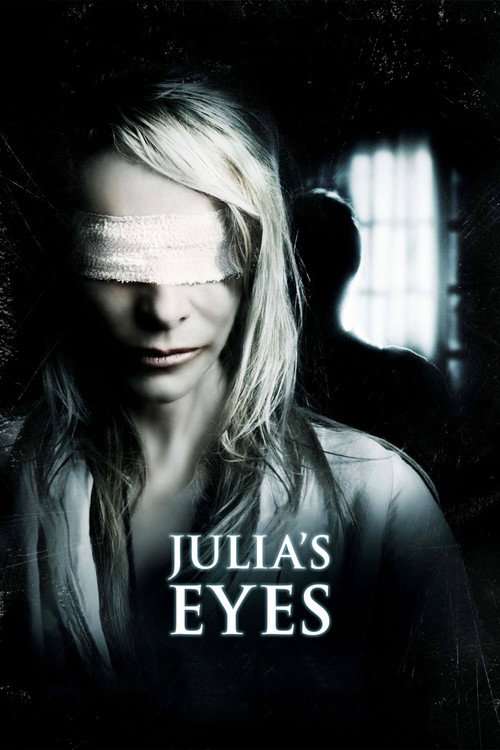
Spanish cinema has a knack for turning primal fears into elegant nightmares, and Julia's Eyes is a prime example. The 2010 psychological thriller, directed by Guillem Morales and co-written with Oriol Paulo, drops us into the life of Julia Levin, a woman slowly losing her sight to a degenerative disease. When her blind twin sister Sara is found hanged in the basement of her rural home, the authorities call it suicide. Julia refuses to believe it. With her own vision failing, she begins a desperate investigation that peels back layers of secrets, lies, and a killer who seems to know her every move.
The film stars Belén Rueda in a tour-de-force dual performance as both Julia and Sara. Rueda, who previously starred in The Orphanage, brings a raw vulnerability and steely determination to the roles. She's supported by Lluís Homar as Isaac, a man with unsettling ties to the sisters, and Pablo Derqui as Ángel, whose behavior raises red flags. Behind the scenes, Guillermo del Toro's production label Double Dare You lent its name, and the film's Hitchcockian DNA is unmistakable, from voyeuristic camera work to the unreliable perception that keeps you guessing.
Released in Spain on August 16, 2010, Julia's Eyes earned around $12.9 million worldwide against a modest €5 million budget. It won Best Director at the Fantasporto festival and earned Goya nominations for Best New Director and Best Original Score. The film's legacy extends beyond its initial run: a South Korean remake titled The Eyes, starring Shin Min-a, is set for release in 2026. For fans of smart, atmospheric horror-thrillers, this is a must-watch.
Stream
Rent
Availability and pricing can change. Confirm on the provider's site before purchasing.
Julia Levin is losing her sight. A degenerative eye disease, the same one that took her twin sister Sara's vision years ago, is slowly stealing the world from her. She's already undergone surgery to slow the process, but her vision remains dangerously unstable, flickering in and out like a faulty light bulb. When Julia arrives at Sara's remote rural home, she finds her sister hanged in the basement, a silk scarf around her neck. Inspector Dimas, the local police officer, quickly rules it a suicide, citing Sara's blindness and depression as motive. But Julia, who shared an almost supernatural bond with her twin, knows better. She can feel it in her bones: Sara was murdered.
Her investigation begins with the fragments of Sara's life. She discovers that Sara had been seeing a secret lover, a man whose identity remains frustratingly out of reach. She finds threatening notes, photographs that suggest someone had been watching the house, and a neighbor, Créspulo, who seems to know more than he lets on. As Julia digs, she encounters Isaac, a quiet, sympathetic man who claims to have been a friend to Sara, and Ángel, whose nervous demeanor makes him a suspect. But with her eyesight failing at the worst moments, Julia can't trust what she sees. Shadows shift, faces blur, and the line between reality and hallucination blurs.
The film's tension ratchets up as Julia realizes the killer may still be active, and that she herself has become the next target. She starts to piece together a pattern: Sara had been frightened in her final days, had received a series of unsettling phone calls, and had been spotted arguing with a mystery man. Julia's search leads her to a blind woman, Soledad, who claims to have heard Sara's cries for help on the night of her death. But Soledad's testimony is dismissed by the police, who see only a lonely, frightened woman. With her vision deteriorating and her trust in others eroding, Julia must rely on her other senses, her instincts, and the bond she shared with her sister to uncover the truth. The story builds through a series of nerve-wracking set pieces, from a nighttime chase through a darkened forest to a confrontation in a house where every shadow hides a potential threat. As the investigation deepens, Julia uncovers secrets about her family's past that suggest the killer's obsession goes back further than she ever imagined.
Official Trailer [Subtitled]
Critical Consensus
Smart, suspenseful, and visually distinctive, Julia's Eyes marks another modern Spanish thriller that quickens the pulse while engaging the mind. Critics praised its Hitchcockian structure, strong central performance from Belén Rueda, and inventive use of visual impairment as a narrative device, though some found the plot's twists convoluted and the pacing uneven in its second half.
“Using blindness as a plot device, a metaphor for social awareness and as a numinous experience that romantically links minds, it's a fascinating, unsettling piece of work.”
Peter Bradshaw
The Guardian
“Taut, atmospheric direction and Rueda's committed dual performance position the film as a standout in the modern Spanish thriller renaissance.”
Variety Staff
Variety
“A gripping thriller that plays on the fear of losing one's sight, with a stunning performance from Belén Rueda.”
Kim Newman
Empire
Belén Rueda
Julia Levin / Sara
Lluís Homar
Isaac
Pablo Derqui
Ángel
Francesc Orella
Inspector Dimas
Joan Dalmau
Créspulo
Julia Gutiérrez Caba
Soledad
Boris Ruiz
Blasco
Dani Codina
Iván
Andrea Hermosa
Lía Blasco
Daniel Grao
Dr. Román
Director
Guillem Morales
Writers
Oriol Paulo, Guillem Morales
Composer
Fernando Velázquez
Cinematographer
Óscar Faura
Producers
Joaquín Padró, Mar Targarona, Guillermo del Toro
Fantasporto International Fantasy Film Award (2011)
Best Director: Won
Goya Awards (2011)
Best New Director: Nominated
Goya Awards (2011)
Best Original Score: Nominated
Gaudí Awards (2011)
Best Film: Nominated
Gaudí Awards (2011)
Best Director: Nominated
Gaudí Awards (2011)
Best Actress: Nominated
Gaudí Awards (2011)
Best Original Score: Nominated
Join the community
fans discussing