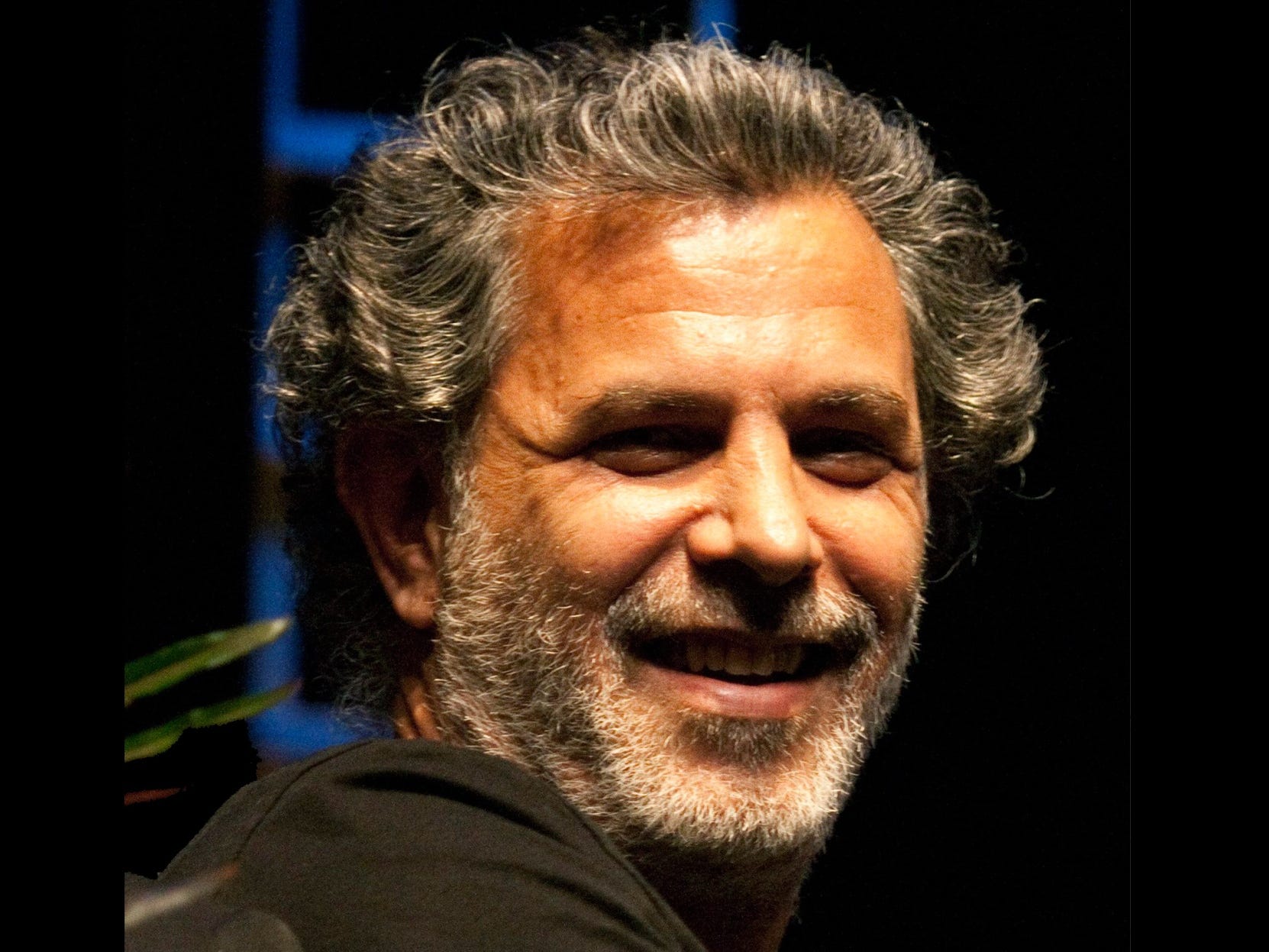
Juliano Mer-Khamis
 Israel
Actor•Director•Filmmaker•Political Activist
Also known as: Juliano Mer-Chamis, Juliano Mer
Birthday
May 29, 1958
Birth Sign
Gemini
Birthplace
Nazareth, Israel
Age
Died at 52
About
Juliano Mer-Khamis was an Israeli-Palestinian actor, director, filmmaker, and political activist. Born in Nazareth to a Jewish mother and a Palestinian Christian father, he devoted his life to bridging the two cultures he carried within him. He is remembered for his work on stage and screen, including a role in the 1985 film Rambo III, and above all for co-founding The Freedom Theatre in the Jenin refugee camp, where he used drama to empower young Palestinians. Mer-Khamis was assassinated on April 4, 2011, outside that very theatre, a site that had become both his life's work and the scene of his death.
Early Life & Background
Juliano Mer-Khamis was born on May 29, 1958, in Nazareth, a city in northern Israel with a large Arab population. His mother, Arna Mer, was an Israeli Jewish activist and a member of the Communist Party; his father, Saliba Khamis, was a Palestinian Christian from a prominent Nazareth family. This mixed heritage was central to his identity. Growing up, he experienced both sides of the conflict, living in a Jewish household that embraced Palestinian culture. He often described himself as '100 percent Palestinian and 100 percent Jewish.' As a young man, he studied acting and began performing in Israeli theatre, but he also felt a pull toward political activism, influenced by his mother's work with Palestinian refugees. He served in the Israeli army, a decision that later troubled him, and after his service he moved to Paris for a time, where he studied film. His early career included roles in Israeli films and television, but he remained restless, searching for a way to combine art and politics. That search eventually led him to Jenin.
Career Growth
Juliano Mer-Khamis's breakthrough came in the mid-1980s when he appeared in the Hollywood action film Rambo III, playing a Russian officer alongside Sylvester Stallone. The role brought him international recognition and opened doors in Israeli and European cinema. He went on to act in more than 20 films and television shows, including the 2000 Israeli war drama Kippur and Julian Schnabel's 2011 film Miral. But his most significant work was in theatre. In 2006, he co-founded The Freedom Theatre in the Jenin refugee camp, building on the work his mother had started there decades earlier. As General Director, he ran drama workshops and productions that gave Palestinian youth a voice, often staging bold, politically charged plays. The theatre became a cultural landmark, though it also drew criticism from conservative elements in the camp and from Israeli authorities. Mer-Khamis continued to act and direct until his death in 2011, and his legacy lives on through the theatre, which still operates today.
Career Timeline
Public Image & Style
Juliano Mer-Khamis was a charismatic and polarizing figure. To his supporters, he was a symbol of reconciliation, a man who refused to choose between his Jewish and Palestinian identities. To his detractors, he was a provocateur who pushed too hard against the norms of both societies. He was known for his theatrical flair, both on stage and off, and for his willingness to speak uncomfortable truths. The media often portrayed him as a bridge builder, but he rejected that label, insisting that he was simply 'a human being.' His murder in 2011 turned him into a martyr for some and a cautionary tale for others. Today, The Freedom Theatre continues to honor his vision, and his name remains a touchstone in discussions about art, activism, and the Israeli-Palestinian conflict.
Fame & Fandom (iFAMOUS Rankings)
Juliano Mer-Khamis commands a distinct place in cultural memory, not through the ephemeral adulation of pop stardom, but via the enduring reverence of activists, theater professionals, and the communities he served. His audience consists of those who view art as a weapon for peace and identity as a bridge rather than a wall; they are the students of Jenin, the human rights advocates, and the historians of conflict zones who keep his story alive long after his death. Unlike celebrity figures with organized fan clubs, his legacy is sustained by political solidarity and the ongoing work of The Freedom Theatre, which operates as both a memorial and a living institution. There is no formal fandom name documented for his supporters, reflecting a movement defined by shared purpose rather than collective worship of a personality. His legend grew from the tragic certainty of his assassination outside the theatre he built, transforming him into a symbol of resistance where every retelling reinforces the cost of his conviction. While global media coverage surged following his murder in 2011, his fame remains rooted in specific historical impact rather than viral trends or commercial consumption metrics. Per iFANN's August 2026 evaluation, Juliano Mer-Khamis is currently unranked. Global Top 1,000 placement is currently unassigned to him. Top 100 Scope List does not include this individual. The iFANN Global Fame Engine has evaluated this person, but they do not currently hold a placement in the published rankings.
Interesting Facts and Legends
Juliano Mer-Khamis was a man of many layers who spoke Hebrew and Arabic fluently while moving between Israeli and Palestinian worlds with ease. He reportedly predicted his own death years before it happened, telling an Israeli television interviewer that he would be killed because of his work in Jenin. Known for his sharp wit and love of punk rock, which he sometimes played loudly at the theatre, he also bore a tattoo of the word 'freedom' on his arm as a constant reminder of his mission. Friends remember him as a heavy smoker and chain coffee drinker who never stopped talking, arguing, or dreaming. A central part of his legend is the widely retold story of his identity as a man who was '100 percent Palestinian and 100 percent Jewish,' a phrase popularized in tributes to highlight his dual heritage. This narrative cemented his status as a martyr after he was shot dead at age 52 outside the Freedom Theatre in Jenin on April 4, 2011. The mystery surrounding his killer, with reports noting that no one knew who committed the act as early as 2012, added an enigmatic quality to his mythos. On the tenth anniversary of his assassination in 2021, commemorations titled 'We Remember - Juliano Mer Khamis' were held, reinforcing his standing as a cultural icon whose influence extends far beyond his film roles in projects like Rambo III and Miral.
Notable Quotes
“I am 100 percent Palestinian and 100 percent Jewish.”
“The theatre is a weapon of mass instruction.”
“We are freedom fighters, not terrorists.”
Family & Personal Life
Juliano Mer-Khamis was the son of Arna Mer, an Israeli Jewish activist who founded a cultural center in Jenin, and Saliba Khamis, a Palestinian Christian. His mother was a central influence, instilling in him a commitment to social justice. He had a sister, who became an actress in Berlin. Mer-Khamis was married twice and had two children, but he kept his family life largely private. His son, Yonatan, was born in 1988 and later became a musician. At the time of his death, he was not married. He lived simply in Jenin, in a small apartment near the theatre, where he often hosted actors and activists from around the world.
Notable Connections
Juliano Mer-Khamis worked with a number of notable figures. His mother, Arna Mer, was a key influence and collaborator in Jenin. He acted alongside Sylvester Stallone in Rambo III and co-starred with Liron Levo and Tomer Russo in Kippur. Director Julian Schnabel cast him in Miral. He also counted journalist Amira Hass among his friends and supporters.
Relationships & Dating History
Juliano Mer-Khamis was married twice. His first marriage was to an Israeli woman, with whom he had his son Yonatan. The marriage ended in divorce in the early 1990s. He later married a Palestinian woman, but that relationship also ended. In his later years, he was reportedly involved with a German actress, but he never remarried. At the time of his death, he was single. His relationships were often complicated by his dual identity and his intense commitment to his work in Jenin, which placed strain on his personal life.
- Married1987 - 1993First marriage, mother of his son Yonatan.
- Married1998 - 2005Second marriage, ended in divorce.
Death & Aftermath
Died
April 4, 2011 (aged 52)
Death Place
Jenin Refugee Camp, West Bank
Cause of Death
Gunshot wounds
Juliano Mer-Khamis was assassinated on April 4, 2011, at approximately 4:00 PM outside the entrance to the Freedom Theatre in the Jenin Refugee Camp. A masked gunman approached him as he arrived for work and shot him multiple times, ending the life of the 52-year-old actor and activist who had publicly warned of such a fate years earlier. The attack left him dead from gunshot wounds, though no individual has ever been identified, arrested, or tried for the crime despite investigations spanning over a decade. Tributes poured in immediately from international film institutions and political figures who recognized his unique role bridging Israeli and Palestinian communities. Colleagues like Udi Aloni described him as a beloved friend and comrade, while vigils were held globally to honor the man who used drama to empower youth in one of the world's most difficult environments.
His films, including Kippur, saw renewed attention in memorial contexts, and obituaries in major publications highlighted his lifelong commitment to peace through art. The funeral shortly after his death served as both a private mourning and a public demonstration of solidarity, attended by hundreds of mourners carrying signs calling for justice. While specific burial details remain less documented, the service included performances and speeches that celebrated his legacy. Today, the Freedom Theatre continues to operate as a living memorial, hosting workshops and productions that keep his mission alive for the next generation of Palestinian artists.
Net Worth (Estate Value)
$5 Million
iFANN Editorial Team estimate
Juliano Mer-Khamis's net worth at the time of his death was modest, estimated at around $1 million, primarily derived from his acting work and his salary at The Freedom Theatre. Since his passing, his estate has continued to earn royalties from his film and television appearances, while The Freedom Theatre has received numerous donations and grants established in his name. Per iFANN's editorial analysis, the value of his estate stands at $5 Million as of 2026, reflecting the ongoing legacy and the commercial value of his work. The Freedom Theatre remains the primary beneficiary of his artistic and financial legacy.
Awards & Accolades
View 2 records, honours and achievementsKnown For
Rambo III
1985 · Russian Officer
Kippur
2000 · Actor
The Freedom Theatre
2006 · Co-founder and General Director
Miral
2011 · Actor
Keywords
Sources
Quick Facts
- Profession
- Actor, Director, Filmmaker, Political Activist
- Born
- May 29, 1958
- Birthplace
- Nazareth, Israel
- Died
- April 4, 2011
- Death Place
- Jenin, West Bank
- Gender
- Male
- Birth Sign
- Gemini
Personal Details
- Full Name
- Juliano Mer-Khamis
Filmography
20
Total
15
Film
5
TV
Frequently Asked Questions
Who was Juliano Mer-Khamis?
How did Juliano Mer-Khamis die?
What was The Freedom Theatre?
What was Juliano Mer-Khamis's background?
Is the murder of Juliano Mer-Khamis solved?
Join the community
fans discussing