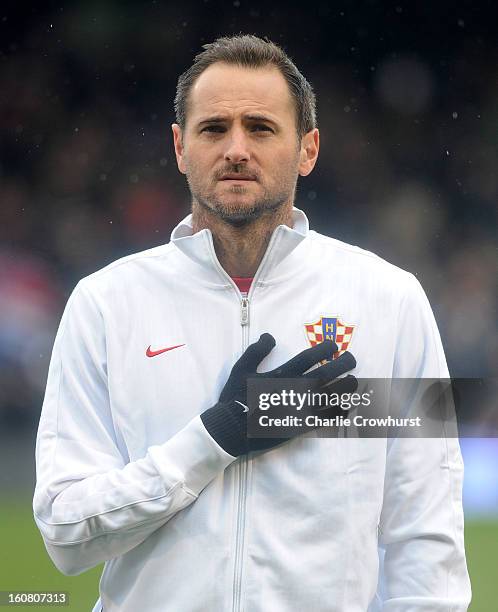
Josip Šimunić
 Australia
association football player•association football coach
Birthday
February 18, 1978
Birth Sign
Aquarius
Birthplace
Canberra, Australia
Age
48 years old
About
Josip Šimunić is an Australian-born former professional footballer who represented Croatia internationally. Known for his imposing presence and no-nonsense defending, he spent the bulk of his club career in Germany's Bundesliga, where he became a familiar face at Hamburger SV. Over a career spanning nearly two decades, he earned a reputation as a tough, reliable centre-back who could be counted on in big matches.
Šimunić's international career with Croatia was equally distinguished. He earned over 100 caps and appeared at five major tournaments, including two World Cups and three European Championships. His defensive leadership was a cornerstone of the Croatian side during the 2000s and early 2010s. Since hanging up his boots in 2014, he has moved into coaching, staying connected to the game he loves.
Off the pitch, Šimunić's legacy is complicated by a controversial moment at the end of his playing days. A chant he led after a World Cup qualifier in 2013 led to a lengthy ban and legal battles that followed him into retirement. Despite this, he remains a respected figure in Croatian football circles, particularly for his work with young players.
Early Life & Background
Josip Šimunić was born on February 18, 1978, in Canberra, Australia, to Bosnian Croat parents. Growing up in the Australian capital, football was a family passion, and he started playing at a young age. The local Croatian community was tight-knit, and clubs like Melbourne Knights served as a cultural hub for immigrants from the former Yugoslavia.
In 1995, at the age of 17, Šimunić joined Melbourne Knights, then known as Melbourne Croatia, in the Australian National Soccer League. His performances there quickly drew attention from European scouts. His powerful frame and aggressive style of defending stood out even in a league that was not then known for producing top-level talent. The move to Europe came in 1998, when he signed with Hamburger SV in Germany's Bundesliga.
Leaving Australia at 20 was a significant step. Šimunić adapted quickly to the demands of German football, learning the language and embracing the physicality of the Bundesliga. His early years at Hamburg were marked by steady development, as he transitioned from a raw prospect into a dependable first-team defender.
Career Growth
Šimunić's breakthrough came at Hamburger SV, where he became a mainstay in defence over 11 seasons. He made over 200 Bundesliga appearances for the club, earning a reputation as one of the league's most formidable centre-backs. In 2009, he moved to TSG 1899 Hoffenheim, where he spent two seasons before finishing his club career with Dinamo Zagreb in Croatia.
On the international stage, Šimunić made his debut for Croatia in 2001 and went on to earn 105 caps. He was part of the squad at the 2002 and 2006 World Cups, as well as the European Championships in 2004, 2008, and 2012. His most memorable moment came at the 2006 World Cup against Australia, when referee Graham Poll mistakenly showed him three yellow cards before finally sending him off. The incident became one of the most discussed refereeing errors in tournament history and remains a record that can never be broken.
After retiring in 2014, Šimunić transitioned into coaching. In recent years, he has been involved with the Croatian Football Federation, working with youth teams. In 2026, he was instrumental in convincing Australian-Croatian talent Adrian Segecic to commit to Croatia's under-21 setup, showcasing his continued influence in the game.
Career Timeline
Public Image & Style
Šimunić was respected on the pitch for his physical, uncompromising style. Fans admired his commitment and leadership, while opponents often found him a difficult opponent to face. His image, however, was significantly tarnished by the 2013 chant controversy, which led to his ban and drew widespread criticism. Media portrayals of him are mixed, with some focusing on his defensive achievements and others on the political implications of his actions. Despite this, he maintains a modest social media presence, with an official Instagram account that has around 1,000 followers.
Fame & Fandom (iFAMOUS Rankings)
Josip Šimunić remains a figure of distinct notoriety within global football history, though his standing in broader celebrity metrics reflects the complex nature of his public legacy. As of August 2026, iFANN's Global Fame Engine has evaluated this person, but they do not currently hold a placement in the published rankings, meaning no specific ordinal position or score is assigned to him within the Global Top 1,000 or any specialized scope list. This absence of a numerical rank underscores that while his name triggers recognition among sports historians and those familiar with disciplinary anomalies, he lacks the sustained commercial or cultural momentum required for a top-tier placement in contemporary fame hierarchies. His profile is defined less by active fan engagement and more by the enduring resonance of two specific historical incidents that serve as cautionary tales in sporting lore. There is no documented formal fandom name associated with his supporters; research confirms that organized campaigns, charitable initiatives, or ritualistic gatherings dedicated to him are non-existent. Unlike athletes who command vibrant online communities or fan-funded projects, Šimunić's audience interaction is characterized by the retrospective analysis of his career rather than active devotion. The narrative surrounding him is dominated by negative milestones, specifically the 2006 World Cup refereeing blunder and the 2013 chant controversy, which have cemented his reputation as a figure of controversy rather than a beloved icon. While media coverage occasionally revisits his defensive prowess from his time in the Bundesliga, the dominant discourse focuses on the political and disciplinary implications of his actions. Consequently, the public perception of Josip Šimunić exists in a unique space where fame is derived entirely from infamy, leaving him without the structured support base typical of modern sports stars.
Interesting Facts and Legends
Born in Canberra, Josip Šimunić stands as one of the rare Australian-born players to represent a European nation at a World Cup, having transitioned from local club football to over a decade in Germany's Bundesliga. His defensive career was marked by a physical, uncompromising style that made him a difficult opponent to face, earning him respect for his leadership despite occasional friction. Off the pitch, he is known for an extensive tattoo collection, including a large piece on his back dedicated to his Croatian heritage. Two specific events have cemented his place in football lore. The first involves the 2006 World Cup match against Australia, where referee Graham Poll mistakenly issued Šimunić three yellow cards before finally sending him off, creating a record that rules were subsequently changed to prevent. The second defining moment occurred in September 2013 at Maksimir Stadium, where Šimunić led a crowd in a chant involving Nazi salutes and references to the Ustaše regime. This action resulted in a ten-match ban from FIFA, causing him to miss the 2014 World Cup and effectively ending his international career at its peak. Both incidents remain verified facts rather than mere anecdotes, serving as the primary pillars of his complex legacy.
Notable Quotes
“I am not a fascist. I am a man who loves his country and his people.”
“The chant is not a political statement. It is a greeting that has been used for centuries.”
“I have always given everything for my country, and I will continue to do so.”
Family & Personal Life
Details about Šimunić's family life are scarce, as he has kept his personal affairs largely private. He was born to Bosnian Croat parents, and his upbringing in Canberra's Croatian community played a significant role in shaping his identity. He is known to have a close relationship with his family, and his Instagram account occasionally features moments with relatives, though he rarely shares specifics. As of 2026, there is no public information about a spouse or children.
Notable Connections
Relationships & Dating History
Publicly available information about Šimunić's romantic relationships is extremely limited. Unlike many high-profile footballers, he has kept his personal life out of the spotlight. There are no verifiable reports of past girlfriends, marriages, or current partners. As of 2026, his relationship status remains unknown, as he has not publicly shared details about his private life.
Salary, Net Worth In 2026
$10 Million
iFANN Editorial Team estimate
iFANN currently estimates Josip Šimunić's net worth at $10 Million as of 2026. This financial standing was accumulated primarily through his long tenure in the Bundesliga, where he commanded substantial salaries as a top-flight defender. During his peak years at Hamburger SV, he ranked among the club's highest earners, securing a significant portion of his wealth during this era. His subsequent stints at Hoffenheim and Dinamo Zagreb further contributed to his earnings, rounding out a lucrative career in one of Europe's premier leagues. Since retiring, Šimunić has likely generated income through various coaching roles and public appearances. His potential involvement with the Croatian Football Federation may provide additional salary, though specific details regarding such compensation remain private. He has also participated in football-related media projects and events, adding to his revenue streams. While not positioned among the wealthiest former players globally, his financial portfolio reflects a successful professional journey in high-level European competition.
Awards Won (1)
Šimunić's career was more notable for his longevity and consistency than for individual trophies. As a defender, his contributions were often overlooked in award ceremonies. He did, however, receive recognition for his services to Croatian football, including a special award from the Croatian Football Federation for reaching 100 caps. His legacy is defined more by his performances than by silverware.
2006 · Player of the Year
Croatia national team
Known For
Croatia national team
2001-2013 · Defender
Hamburger SV
1998-2009 · Centre-back
2006 World Cup three-yellow-card incident
2006 · Player
Keywords
Sources
Quick Facts
- Profession
- association football player, association football coach
- Born
- February 18, 1978
- Birthplace
- Canberra, Australia
- Gender
- Male
- Birth Sign
- Aquarius
- Nationality
- Croatian
Frequently Asked Questions
Why did Josip Šimunić get three yellow cards in one match?
Why was Josip Šimunić banned from the 2014 World Cup?
What nationality is Josip Šimunić?
Which clubs did Josip Šimunić play for?
How old is Josip Šimunić?
Social Media
Join the community
fans discussing