“The movie is a cheerful, hyperactive satire of the pop-music industry, and it has a surprisingly sharp edge beneath its candy-colored surface.”
A.O. Scott
The New York Times
 United States
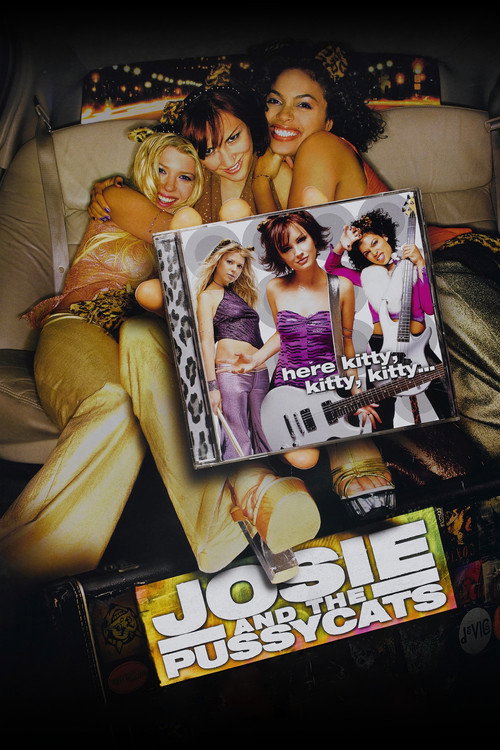
"Here kitty, kitty, kitty..."
Three small-town friends with a shared dream of rock stardom get more than they bargained for when a record deal catapults them into the spotlight. Josie McCoy (Rachael Leigh Cook), Valerie Brown (Rosario Dawson), and Melody Valentine (Tara Reid) form the band Josie and the Pussycats, only to discover their sudden fame is part of a sinister plot by music executives Wyatt Frame (Alan Cumming) and Fiona (Parker Posey) to manipulate America's youth through subliminal messages. Directed by Deborah Kaplan and Harry Elfont, this 2001 satire blends comedy and music with sharp commentary on the pop industry's manufactured nature. Despite a modest $22 million budget, the film earned just under $15 million at the box office, but has since gained a cult following for its prescient critique of consumer culture. With a PG-13 rating and a runtime of 98 minutes, it's a witty, colorful ride that skewers everything from product placement to teen idol worship.
The film's soundtrack, featuring original songs performed by the cast, became a cult favorite in its own right. Tracks like "Pretend to Be Nice" and "3 Small Words" showcase the actresses' vocal chops, with professional songwriting that captures the glossy pop sound of the era. The fictional boy band DuJour, a parody of late-90s groups like *NSYNC and Backstreet Boys, adds another layer of meta-humor. Directors Kaplan and Elfont, known for their work on Can't Hardly Wait, infused the film with a knowing wink that rewards repeat viewings. The leopard-print costumes, designed by Isis Mussenden, became instantly iconic, while the film's self-aware product placement, featuring McDonald's, Coca-Cola, and Motorola, was so over-the-top it sparked genuine debate about commercialism in cinema.
Stream
Availability and pricing can change. Confirm on the provider's site before purchasing.
In the quiet town of Riverdale, three best friends, Josie McCoy, Valerie Brown, and Melody Valentine, spend their days dreaming of escape. Josie, the driven lead singer and guitarist, pours her heart into songwriting while working at a local diner. Valerie, the bassist, keeps the group grounded with her practical wisdom, and Melody, the drummer, floats through life with a sunny, scatterbrained charm that somehow keeps everyone smiling. They perform at a talent show, and their raw energy catches the eye of Wyatt Frame, a fast-talking A&R man from MegaRecords. Before they know it, the trio signs a contract and leaves Riverdale for Los Angeles.
The girls arrive in LA to find a world of glittering excess. Fiona, the icy head of MegaRecords, immediately puts them through a makeover: new clothes, new hairstyles, and a heavily produced sound. Their first single, "Pretend to Be Nice," rockets up the charts, and suddenly the Pussycats are everywhere, magazine covers, TV interviews, mall appearances. But strange things start happening. Josie hears faint whispers in the music. Melody has bizarre nightmares. And they keep running into DuJour, a boy band whose members seem almost robotic in their obedience. A mysterious musician named Alan M. warns them that MegaRecords isn't what it seems. Meanwhile, their overeager manager Alexander Cabot and his snobbish sister Alexandra create chaos behind the scenes.
As the band's fame explodes, Josie becomes increasingly paranoid. She notices that fans who listen to their album exhibit trance-like behavior, buying products they'd never normally want. Digging deeper, she finds evidence of subliminal messages embedded in the recordings. The girls realize they've been pawns in a scheme to brainwash teenagers into corporate consumerism. With Alan's help, they piece together the conspiracy: Fiona and Wyatt are using the Pussycats' music as a delivery system for high-frequency signals that only young ears can hear, turning listeners into obedient shoppers. The band must decide whether to play along and stay famous or fight back and risk everything.
Josie and the Pussycats Trailer (2001)
Critical Consensus
The film's satirical take on pop culture and corporate manipulation is clever in concept but uneven in execution. Some critics praised its sharp, prescient humor while others found it too chaotic and shallow. Its cult status has grown over time, with many now appreciating its ahead-of-its-time critique of consumerism.
“The movie is a cheerful, hyperactive satire of the pop-music industry, and it has a surprisingly sharp edge beneath its candy-colored surface.”
A.O. Scott
The New York Times
“The movie is a bright, cheerful, mindless entertainment that doesn't have a mean bone in its body, but it also doesn't have much on its mind.”
Roger Ebert
RogerEbert.com
“A slick, high-energy, thoroughly synthetic concoction that gleefully bites the hand that feeds it, with plenty of product placement and self-aware humor.”
Todd McCarthy
Variety
“The movie is a fizzy, funny, and surprisingly smart satire that knows exactly what it's doing, even if its target audience might not.”
Lisa Schwarzbaum
Entertainment Weekly
“A knowing, postmodern pop-culture critique that is both a product of the system it mocks and a genuinely entertaining piece of fluff.”
Peter Bradshaw
The Guardian
Rachael Leigh Cook
Josie McCoy
Rosario Dawson
Valerie Brown
Tara Reid
Melody Valentine
Alan Cumming
Wyatt Frame
Parker Posey
Fiona
Gabriel Mann
Alan M.
Paulo Costanzo
Alexander Cabot
Missi Pyle
Alexandra Cabot
Alexander Martin
Les (DuJour)
Donald Faison
D.J. (DuJour)
Seth Green
Travis (DuJour)
Breckin Meyer
Marco (DuJour)
Directors
Deborah Kaplan, Harry Elfont
Writers
Deborah Kaplan, Harry Elfont, Dan DeCarlo, Richard Goldwater, John L. Goldwater
Composer
John Frizzell
Cinematographer
Matthew Libatique
Producers
Tracey Edmonds, Marc Platt, Tony DeRosa-Grund, Chuck Grimes
MTV Movie Awards (2002)
Best Musical Sequence: Nominated
Teen Choice Awards (2002)
Choice Movie: Comedy: Nominated
Golden Trailer Awards (2002)
Best Comedy Trailer: Nominated
Join the community
fans discussing