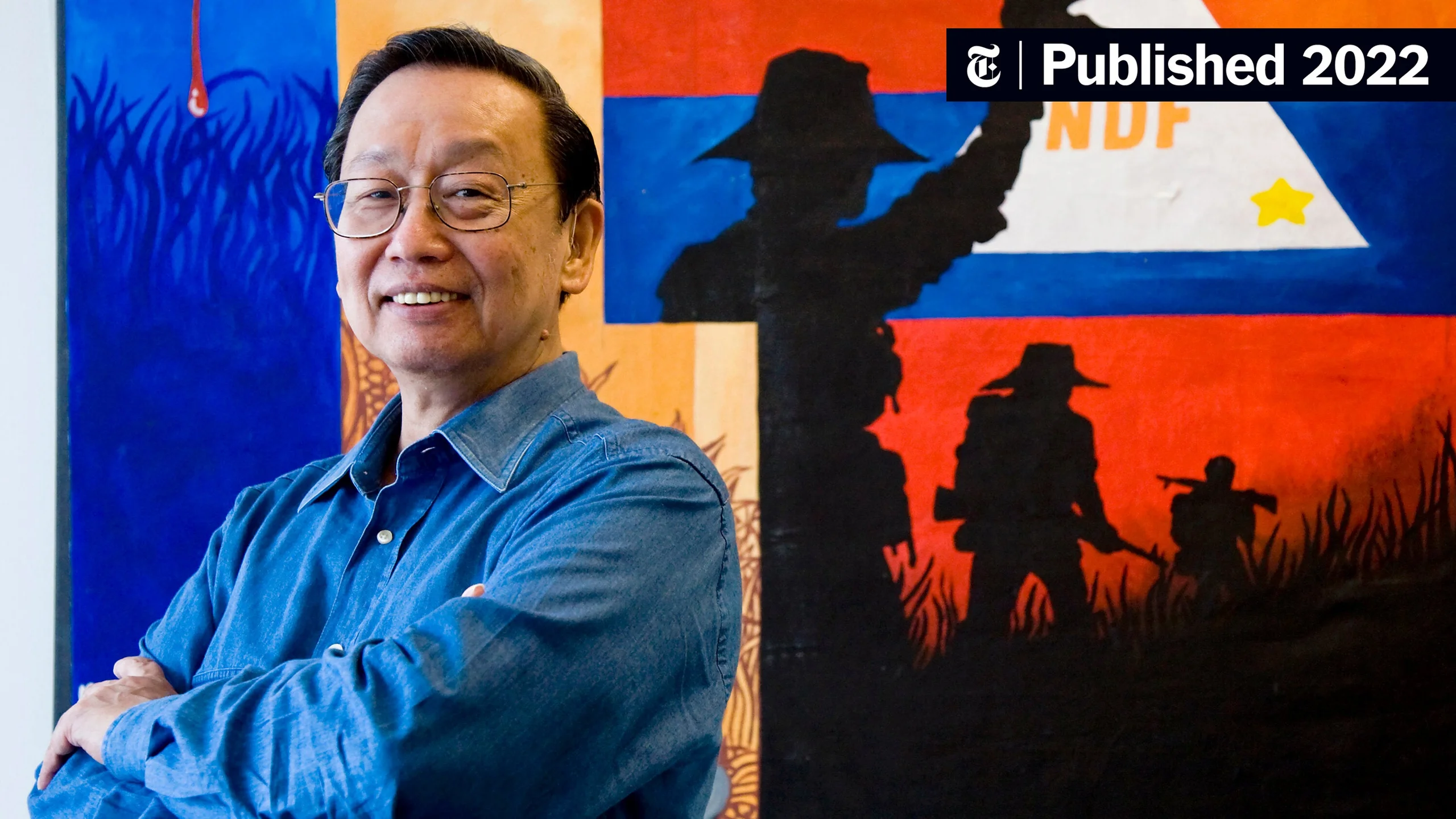
Jose Maria Sison
 Philippines
writer•politician•revolutionary
Also known as: Joma, Ka Joma, Amado Guerrero, Armando Liwanag
Birthday
February 8, 1939
Birth Sign
Aquarius
Birthplace
Cabugao, Ilocos Sur, Philippines
Age
Died at 83
About
Jose Maria Canlas Sison was a Filipino writer, poet, and political theorist who founded the Communist Party of the Philippines (CPP) and led its armed wing, the New People's Army. Born in 1939 to a wealthy landowning family, he transformed from an academic professor into the architect of a decades-long Maoist insurgency. His ideological framework, known as National Democracy, fused Marxism-Leninism with local conditions to guide the revolution. He spent nearly a decade in solitary confinement under the Marcos regime before gaining asylum in the Netherlands following the 1986 People Power Revolution.
Sison lived in exile in Utrecht for over thirty years, continuing to direct the CPP and write prolifically despite being designated a terrorist by the United States. He remained a polarizing figure until his death in December 2022 at age 83. His legacy endures through the organizations he established and the vast body of theoretical work he produced during his imprisonment and exile.
Early Life & Background
Jose Maria Sison entered the world on February 8, 1939, in Cabugao, a municipality in the province of Ilocos Sur. He was born into privilege; his father served as the president of a local cooperative bank, and his mother worked as a teacher. This affluent background stood in stark contrast to the rural poverty that would later fuel his revolutionary zeal. Sison completed his early education at Colegio de San Juan de Letran in Manila, where he developed a strong foundation in the liberal arts.
He pursued higher education at the University of the Philippines Diliman, earning a Bachelor of Arts degree in English Literature in 1959. During these formative university years, he became deeply immersed in the leftist movements of the era, particularly the Hukbalahap rebellion. Following graduation, he returned to the academic sphere, teaching literature, political science, and Rizal studies at Ateneo de Manila University. It was within these halls that his political consciousness crystallized, leading him to join the Partido Komunista ng Pilipinas (PKP) in 1962. His early career was defined by intellectual debates and a growing dissatisfaction with the existing communist leadership, which he viewed as revisionist.
Career Growth
The trajectory of Jose Maria Sison shifted dramatically in late 1968 when he broke away from the old PKP to establish the Communist Party of the Philippines on December 26. This split marked the beginning of the Second Great Rectification Movement and set the stage for a new revolutionary strategy. Just three months later, on March 29, 1969, he co-founded the New People's Army with Bernabe Buscayno, initiating an armed struggle based on Maoist protracted people's war theory.
Throughout the 1970s, Sison authored seminal texts like Philippine Society and Revolution, which became the foundational manual for the CPP. His life took a harrowing turn in 1977 when the Marcos regime captured him. He endured nearly ten years in solitary confinement, surviving severe torture and isolation. His release came in 1986 after the People Power Revolution ousted Ferdinand Marcos. The government immediately granted him asylum in the Netherlands due to safety concerns. While in exile, he faced legal challenges, including a designation as a Specially Designated Global Terrorist by the US in 2002. Although detained in the Netherlands on terrorism charges, he was released in 2007 due to insufficient evidence. He continued his work as Chair Emeritus of the International League of Peoples' Struggle until his death.
Career Timeline
Public Image & Style
To his supporters, Jose Maria Sison was "Ka Joma," a title blending elder-brother warmth with revolutionary discipline. They viewed him as an intellectual giant whose writings provided the roadmap for national liberation. To his detractors, however, he was a terrorist responsible for decades of violence and thousands of deaths. Media coverage has ranged from sympathetic profiles highlighting his academic background to critical investigations into the human rights abuses committed by the NPA. His image remains one of the most polarizing in modern Philippine history, symbolizing both anti-imperialist resistance and armed insurrection depending on the observer.
Fame & Fandom (iFAMOUS Rankings)
Jose Maria Sison never cultivated a fandom in the pop culture sense. There were no fan clubs, birthday campaigns, or chart pushes designed to boost his popularity. Instead, his followers were comrades, party members, and international solidarity groups who knew him as Ka Joma. These supporters organized not around his personal life but around his ideas, distributing his writings, commemorating his death anniversary, and carrying forward the struggle he had codified in the Communist Party of the Philippines. The closest equivalent to a fan ritual was the study circle, where his essays on national democracy were read aloud and debated with the seriousness of scripture.
His iconic moments were political rather than performative. The founding of the CPP in 1968, the decades-long insurgency of the New People's Army, his imprisonment, and his long exile in the Netherlands formed the chapters that built his legend. When he died in December 2022, the response was not mourning but a declaration: "Long live Ka Joma!" Vigils were held, statements issued, and his final chapter, cremated in exile, became part of the revolutionary lore. By the iFANN Global Fame Rankings, Jose Maria Sison is evaluated but does not currently hold a placement in the published rankings, reflecting his niche status outside of specific political circles.
Interesting Facts and Legends
Jose Maria Sison wrote under several pseudonyms, most notably Amado Guerrero, the pen name used for his influential book Philippine Society and Revolution. Another alias he adopted was Armando Liwanag. Even while imprisoned or in exile, he maintained a prolific literary output, writing hundreds of articles, poems, and books that are now archived in institutions like the Marxists Internet Archive. His poetry often reflected the struggles of the Filipino peasantry and workers.
A significant part of his story involves his final days in the Netherlands. After his death, his remains were cremated rather than repatriated to the Philippines. This decision was strategic, intended to prevent potential desecration or political exploitation of his body by opponents. The ashes were kept by his family or disposed of privately, leaving no public burial site in his home country. Supporters still retell stories of his resilience, highlighting how he survived decades of flight, imprisonment, and constant threats to his life.
Notable Quotes
“The people's war is the only way to liberate the Filipino people from the yoke of imperialism and feudalism.”
“We must base our strategy on the concrete analysis of concrete conditions.”
“Long live the Communist Party of the Philippines! Long live the New People's Army!”
Family & Personal Life
Sison came from a prominent landowning family in Ilocos Sur. His father was a former president of the local cooperative bank, and his mother was a teacher. Despite this privileged upbringing, he dedicated his entire life to the revolutionary cause, prioritizing political activism over personal relationships. There are no publicly documented records of marriages, romantic partners, or children. Unlike many public figures, he kept his private life entirely separate from his political persona. His legacy is carried forward by the organizations he founded rather than by a familial line.
Notable Connections
Relationships & Dating History
Jose Maria Sison maintained a strictly private personal life, typical of many revolutionaries who placed their political cause above all else. There are no publicly documented romantic relationships, marriages, or dating histories associated with him. Unlike celebrity figures who navigate the public eye regarding their love lives, Sison did not have a "fandom" in the traditional sense; his supporters were referred to as comrades or members of the party and international solidarity groups. He never married, and there are no records of children or spouses. His life was dedicated entirely to the revolutionary movement, and his legacy is carried forward by the organizations he founded rather than a familial line. As of 2026, he is remembered as having been single throughout his life.
Death & Aftermath
Died
December 16, 2022 (aged 83)
Death Place
Utrecht, Netherlands
Cause of Death
Illness (specific cause undisclosed)
Jose Maria Sison, the founding chairman of the Communist Party of the Philippines, died on December 16, 2022, at approximately 8:40 p.m. local time in Utrecht, Netherlands. He was 83 years old, having been born on February 8, 1939. The cause of death was reported as cancer; specifically, he had been confined to a hospital in Utrecht for two weeks prior to his passing due to complications from the illness. The confirmation of his death was issued by his family and the CPP through official statements released shortly after the event. His final days were spent in this hospital confinement, and there are no reports of a specific last public appearance during this terminal period, as he had been living in self-exile in the Netherlands since 2007 following the revocation of his asylum status in various countries and his inability to return to the Philippines.
While the CPP has historically faced legal challenges in the Philippines regarding its status as a terrorist organization, these did not extend to post-mortem inquiries into Sison's death itself. Public reaction to his death was immediate and polarized, characterized largely by tributes from leftist organizations, revolutionary groups, and international solidarity movements. On December 17, 2022, the Associated Press reported that the CPP and its allied groups mourned the loss of their "founding father". The International League of Peoples' Struggle (ILPS) and other Marxist-Leninist-Maoist organizations issued statements honoring his contributions to the global anti-imperialist struggle. In contrast, critics and former allies offered sharp critiques; notably, spouses Carlo and Maya Butalid later published a book titled Unmasking the Myths of the CPP and Its Leader Joma Sison, which served as an unsparing critique of his legacy and the party's history.
The funeral or memorial arrangements for Jose Maria Sison were handled privately by his family and the Communist Party of the Philippines. While specific details regarding the exact date of burial, the location of the gravesite, or whether the body was cremated were not widely publicized in major international news sources, the CPP confirmed his death and expressed condolences to his family. The party described him as a pioneer of the New People's Army and a key figure in the Philippine revolution. In terms of posthumous developments, the immediate aftermath saw the circulation of tributes from the Party for Socialism and Liberation and the ILPS, reaffirming his ideological legacy.
A significant posthumous publication emerged in the form of the book Unmasking the Myths of the CPP and Its Leader Joma Sison by Carlo and Maya Butalid, which was reviewed and discussed in subsequent years.
Net Worth (Estate Value)
$0
iFANN Editorial Team estimate
As a revolutionary leader and political theorist, Jose Maria Sison did not accumulate wealth through commercial ventures or corporate salaries. His life was dedicated to the movement, and there is no record of personal assets, real estate holdings, or business investments that contributed to a net worth. He lived in relative obscurity during his exile, relying on the support of the party and international solidarity networks. Upon his death in 2022, his estate consisted primarily of his literary archives and personal effects. The iFANN Editorial Team estimates his financial standing at $0, consistent with the lifestyle of a political activist who rejected material accumulation in favor of ideological struggle.
Awards & Accolades
View 2 records, honours and achievementsKnown For
Communist Party of the Philippines
1968 · Founder
New People's Army
1969 · Organizer
Philippine Society and Revolution
1970 · Author
Keywords
Sources
Quick Facts
- Profession
- writer, politician, revolutionary
- Born
- February 8, 1939
- Birthplace
- Cabugao, Ilocos Sur
- Died
- December 16, 2022
- Death Place
- Utrecht, Netherlands
- Gender
- Male
- Birth Sign
- Aquarius
Personal Details
- Full Name
- Jose Maria Canlas Sison
- Children
- Education
- University of the Philippines (BA English Literature), Ateneo de Manila University
Frequently Asked Questions
Who was Jose Maria Sison?
When did Jose Maria Sison die?
Was Jose Maria Sison married?
Why was Jose Maria Sison in exile?
What is the CPP?
Similar People
Join the community
fans discussing