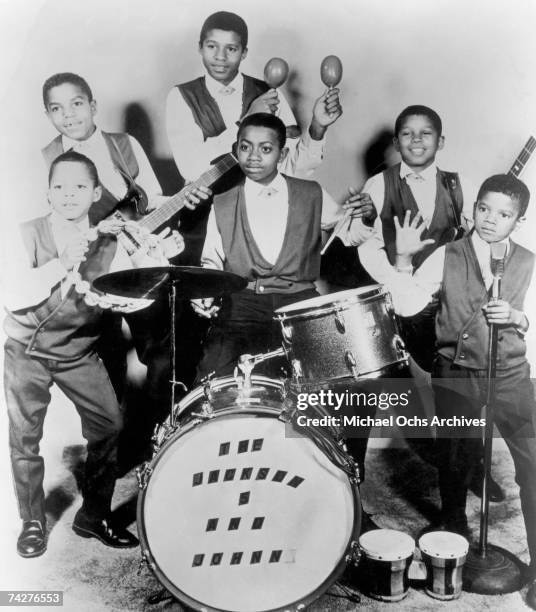
Johnny Jackson
 United States
Member of The Jackson 5
Birthday
March 3, 1951
Birth Sign
Pisces
Birthplace
Gary, Indiana, United States
Age
Died at 54
About
Johnny Jackson was an American drummer best known as the drummer for the Jackson 5, the Motown group that launched Michael Jackson and his brothers to international stardom. He played on the group's early recordings and live performances, providing the rhythmic backbone during their most celebrated period. Though not a Jackson family member, his drumming was integral to the sound that produced four consecutive number-one singles: "I Want You Back," "ABC," "The Love You Save," and "I'll Be There." His drum set, emblazoned with the iconic J5 heart logo, became a visual symbol of the group's brand, licensed for merchandise from album covers to a Saturday morning cartoon. Jackson's legacy is tied to that golden era of the Jackson 5, from their talent show days in Gary, Indiana, through their meteoric rise at Motown. He remains a footnote in pop history, but an essential one: a session drummer who helped power one of the best-selling groups of all time.
Early Life & Background
Johnny Jackson grew up in Gary, Indiana, a steel-mill city near Chicago where Joe Jackson worked as a crane operator. Little is recorded about his family or schooling, but by the mid-1960s he had become a drummer in the local music scene. When the Jackson 5 needed to replace their original musicians Hite and Jones, Jackson and keyboardist Ronnie Rancifer stepped in. This was his first step toward a professional music career. He began playing with the group at talent shows, schools, and community halls in Gary and the Chicago area, honing his skills as a live drummer. In August 1967, he performed with the group at Chicago's Regal Theater and Harlem's Apollo Theater, where they won talent competitions at both venues. Those victories caught the attention of Motown scouts and set the stage for the group's breakthrough.
Career Growth
In 1968, Johnny Jackson played drums on the Jackson 5's first single, "Big Boy," released on Steeltown Records. The following year, after Bobby Taylor brought the group to Motown, the family relocated to Los Angeles. Diana Ross introduced them at a press conference in August 1969, and they made their television debut at the Miss Black America pageant. Jackson was behind the drum kit for all of it. In January 1970, "I Want You Back" hit number one on the Billboard Hot 100, the first of four consecutive chart-toppers. "ABC," "The Love You Save," and "I'll Be There" followed, making the Jackson 5 the first act ever to have their first four charted singles reach number one. Jackson's drumming anchored these recordings and the high-energy live shows that followed. During this period, his drum set featuring the J5 heart logo became an iconic prop, used in promotional materials and licensed for merchandise. The group appeared on the covers of Rolling Stone, Life, and Ebony. Jackson remained with the group through 1975, playing on albums like "Maybe Tomorrow" and "Dancing Machine." When the group left Motown for Epic Records in 1976 and became the Jacksons, his tenure ended.
Career Timeline
Public Image & Style
Johnny Jackson had virtually no public image as an individual. He was a behind-the-scenes session musician, never a front-facing celebrity. In historical accounts, he is consistently referred to as "the drummer for the Jackson 5" with little personal detail. No signature style, media portrayal, fandom name, or fan culture has been documented. His drum set, with its J5 heart logo, became more famous than he did, appearing in promotional materials and on merchandise. For fans of the group, he is a footnote, essential but anonymous, remembered only through the music he helped create.
Fame & Fandom
Johnny Jackson commands a global legacy defined by his foundational role in one of the most celebrated groups in music history, yet his individual profile remains that of a revered but elusive figure. The iFANN Global Fame Engine has evaluated this person, but they do not currently hold a placement in the published rankings (Global Top 1,000 or a Top-100 scope list). While his name appears in countless biographies and documentaries discussing the Jackson 5, he does not currently rank as an independent entity within the world's top tier of famous individuals. Fans generally identify as part of the larger Jackson 5 or Jackson Family fanbases rather than a group dedicated to the drummer. There is no official or widely recognized formal fandom name dedicated solely to him. Discussions about Johnny Jackson often center on the lack of information available about him rather than organized fan projects. Because Johnny Jackson died in 2006 and was not a primary frontman, he did not engage in direct fan interactions during his lifetime in the way the Jackson brothers did. Consequently, there are no recorded fan rituals, inside jokes, or specific fan-funded projects attributed to him. The interaction that exists today is largely retrospective, consisting of fans lamenting the scarcity of biographical data and seeking to restore his visibility through digital discussion.
Interesting Facts and Legends
Johnny Porter Jackson was not related to the Jackson family despite sharing the surname. His drum set's J5 heart logo was so iconic that Motown licensed it for products including a board game and the Saturday morning cartoon "Jackson 5ive." Along with Ronnie Rancifer, he replaced the group's original musicians Hite and Jones. He played on the Jackson 5's first single "Big Boy" in 1968. Jackson died on March 1, 2006, just two days before his 55th birthday. He was inducted into the Rock and Roll Hall of Fame alongside the Jackson 5 in 1997, though as a backing musician his individual role was not separately recognized. Historical records confirm that following his arrival around 1967, the group was officially billed as "The Jackson 5 and Johnny," a detail where the label explicitly promoted Jackson as the cousin of the band to integrate him into the family narrative. This rebranding marked the solidification of their lineup before their move to Motown. A persistent story among historians suggests that despite being the only non-family member in the core lineup for years, his name was systematically minimized in promotional materials after the group moved to Los Angeles and dropped the "and Johnny" moniker. This narrative highlights the frustration regarding the scarcity of photos and interviews for the man credited with providing the rhythmic drive for their explosive rise.
Family & Personal Life
Information about Johnny Jackson's family is scarce. He was born in Gary, Indiana, but no details about his parents, siblings, or his own household have been documented in credible sources. He was not related to the Jackson family; his role with the group was purely professional. No records mention a spouse, children, or pets. He lived a private life away from the spotlight and remains a largely unknown figure outside his connection to the Jackson 5.
Notable Connections
Johnny Jackson is primarily associated with the Jackson 5, the Motown group he drummed for during their rise to fame. He worked closely with the Jackson brothers, Jackie, Tito, Jermaine, Marlon, and Michael, as well as keyboardist Ronnie Rancifer, who joined the group alongside him. Other key figures in his professional orbit include Joe Jackson (the group's manager), Berry Gordy (Motown founder), Bobby Taylor (who brought the group to Motown), and Diana Ross (who introduced them to the public).
Relationships & Dating History
Death & Aftermath
Died
March 1, 2006 (aged 54)
Death Place
Gary, Indiana
Cause of Death
Stabbing
Johnny Jackson, the drummer for the Jackson 5 during their formative years in Gary, Indiana, died on Wednesday, March 1, 2006. He was 54 years old at the time of his death. According to reports from local authorities and Billboard, Jackson was stabbed to death inside a home in Gary, Indiana, and his body was discovered on that date. The cause of death is definitively reported as a stabbing based on the physical evidence found at the scene. While specific medical examiner rulings or autopsy details are not explicitly detailed in available sources, the location of the incident and the method of death remain established facts from news reporting.
The investigation into the murder did not result in publicly documented charges, trials, or settlements connected to the case within the provided records. Regarding the handling of remains, there is no information regarding the date, location, or nature of any funeral service, burial site, or cremation details in the available texts. Similarly, no statements from the family clarifying the immediate circumstances prior to discovery were made public.
Public reaction has been limited to commemorative social media posts rather than official institutional memorials. An Instagram post commemorates him as the powerhouse drummer for the Jackson 5, noting his birth date of March 3, 1951, and death date of March 1, 2006. His legacy is maintained through retrospective mentions on platforms like Spotify and biographical overviews of Motown history. Details concerning the handling of his estate or personal effects remain unrecorded in public documents.
Net Worth (Estate Value)
No credible net worth estimates exist for Johnny Jackson. As a session and touring drummer for the Jackson 5, he would have earned performance fees and possibly session pay, but specific financial details are not publicly documented. He died in 2006. His income was likely modest compared to the Jackson brothers, who were the face of the group.
Awards & Accolades
Known For
Drummer for the Jackson 5
1966 · Drummer
Keywords
Sources
Quick Facts
- Profession
- musician
- Born
- +1951-03-03
- Birthplace
- Gary
- Died
- +2006-03-01
- Gender
- Male
- Birth Sign
- Pisces
Frequently Asked Questions
Was Johnny Jackson related to Michael Jackson?
How old was Johnny Jackson when he died?
What happened to Johnny Jackson (drummer for the Jackson 5)?
Did Johnny Jackson play on Jackson 5 recordings?
What was Johnny Jackson's net worth?

Join the community
fans discussing