“Johnny Bravo was one of the most ridiculously entertaining shows Cartoon Network ever produced, a show that understood that the joke was always on its hero.”
Oliver VanDervoort
Inquisitr
 United States
"He's a hunk. He's a hunk. He's a hunk of burning love."
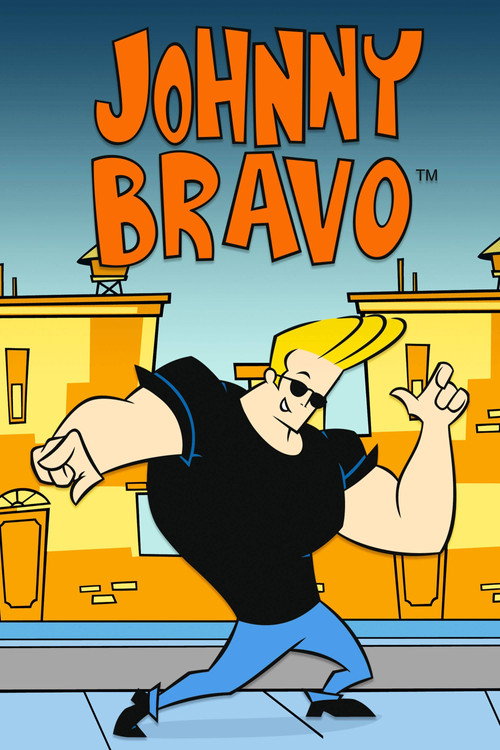
In 1997, Cartoon Network unveiled a new kind of cartoon hero: a muscle-bound, Elvis-obsessed himbo named Johnny Bravo. Created by Van Partible, the show ran for four seasons and 181 episodes, becoming a cornerstone of the network's original programming. Johnny, voiced by Jeff Bennett, struts through life with a pompadour, sunglasses, and an unshakable belief that he is irresistible to women. Reality, however, never agrees.
The series is a loving parody of hyper-masculinity, wrapped in slapstick and pop-culture references. Johnny lives with his sweet, patient mother Bunny (Brenda Vaccaro), is constantly outsmarted by the precocious Little Suzy (Mae Whitman), and relies on his nerdy best friend Carl (Tom Kenny) for brains he lacks. Each episode sends Johnny on a new quest, usually romantic, that ends in spectacular failure, yet he never loses his confidence.
What made Johnny Bravo endure is its self-awareness. The show never lets Johnny win, and that's the joke. It's a satire of the 1950s greaser and the cartoon tough guy, delivered with a wink. The series helped define the Cartoon Cartoons era alongside Dexter's Laboratory and The Powerpuff Girls, and its influence is still felt in animation today.
Availability and pricing can change. Confirm on the provider's site before purchasing.
Johnny Bravo is an American animated sitcom that aired on Cartoon Network from July 14, 1997, to August 27, 2004. The show is set in the fictional town of Aron City, a sun-soaked, vaguely Southern California-esque world where absurdity is the norm. The series centers on Johnny Bravo, a muscular, blond, Elvis-obsessed young man who believes he is God's gift to women. His defining traits are shallow vanity, boorish pickup lines delivered with rapid-fire pelvic thrusts and whip-crack sound effects, and a profound lack of self-awareness. He is a parody of the 1950s greaser archetype and the hyper-masculine cartoon hero, rendered as a lovable fool who never learns his lesson.
The central conflict is simple and eternal: Johnny wants to be admired, loved, and considered a ladies' man, but reality consistently refuses to cooperate. Every episode presents him with a new opportunity to prove his manliness, whether by wooing a beautiful woman, competing in a contest, or saving the day. He fails spectacularly every time, often through his own vanity, stupidity, or both. The humor derives from the gap between Johnny's inflated self-image and the world's perception of him as a dim-witted buffoon.
Johnny lives with his long-suffering mother, Bunny Bravo, a sweet-voiced elderly woman who is endlessly patient and frequently dispenses homespun, often unhelpful, advice. The household is also frequently visited by Little Suzy, a precocious, pigtailed young girl who is far smarter than Johnny and delights in outwitting him. Suzy often serves as the voice of reason, dragging Johnny into adventures that expose his incompetence. Johnny's best friend and polar opposite is Carl Chryniszzswics, a nerdy, bespectacled, science-loving boy who is the butt of Johnny's casual cruelty but remains loyal, often providing the technical know-how Johnny lacks.
The series is structured as a gag-driven sitcom rather than a serialized narrative. Each episode typically contains two or three self-contained segments in which Johnny pursues some goal, usually romantic, and fails through his own fault. The tone is slapstick and absurdist, heavily indebted to classic Hanna-Barbera cartoons and Warner Bros. animation, with a thick layer of pop-culture parody. Johnny frequently breaks the fourth wall, addresses the audience, and interacts with celebrity guest stars, including Adam West, reinforcing the show's self-aware comedic sensibility.
Season 1 (1997–1998) established the core formula: Johnny's failed romantic pursuits, his clashes with Suzy and Carl, and his mother's gentle exasperation. The animation was produced by Hanna-Barbera, and episodes leaned heavily on classic cartoon slapstick. Season 2 (1999–2000) expanded the show's scope, introducing more elaborate parodies of films, TV shows, and pop-culture phenomena, and refining Johnny into a more sympathetic, if still hopeless, figure. Season 3 (2000–2002) continued this trend, becoming increasingly meta and self-referential. Season 4 (2004) marked a significant visual and tonal shift, with production moving to Cartoon Network Studios and adopting a new, more angular animation style. The final season leaned harder into Johnny's interactions with a broader cast and parodies of contemporary media. Throughout its run, the show remained a spoof of masculine vanity, using Johnny's perpetual failure as a vehicle for gentle, occasionally pointed, social satire.
Johnny Bravo | Cartoon Network | Promo | 2001
Critical Consensus
Johnny Bravo is a sharp, self-aware parody of hyper-masculinity that became a defining Cartoon Network original. Jeff Bennett's vocal performance and the show's dense pop-culture references earned praise, though some found Johnny's schtick repetitive. Its willingness to make its protagonist the perpetual butt of the joke has ensured its enduring cult status.
“Johnny Bravo was one of the most ridiculously entertaining shows Cartoon Network ever produced, a show that understood that the joke was always on its hero.”
Oliver VanDervoort
Inquisitr
“His pickup lines were the stuff of legend, usually delivered while doing a rapid-fire series of pelvic thrusts and whip-crack sound effects. Who could forget the show's genius in making stupidity this entertaining?”
Entertainment Inquirer Staff
Philippine Daily Inquirer
“Our favourite musclehead romeo. The show taught valuable lessons about boundaries, consent and social intelligence to young kids.”
Economic Times Staff
The Economic Times
“Johnny Bravo is a blond egomaniac who just loves pretty women. With spoofs of 'Schoolhouse Rock!', 'The Twilight Zone,' and more, the show is a nonstop parody of American pop culture.”
IMDb User Review Summary
IMDb
Jeff Bennett
Johnny Bravo (voice)
Brenda Vaccaro
Bunny Bravo (voice)
Mae Whitman
Little Suzy (voice)
Tom Kenny
Carl Chryniszzswics (voice)
Director
Van Partible
Writer
Van Partible
Composer
Guy Moon
Join the community
fans discussing