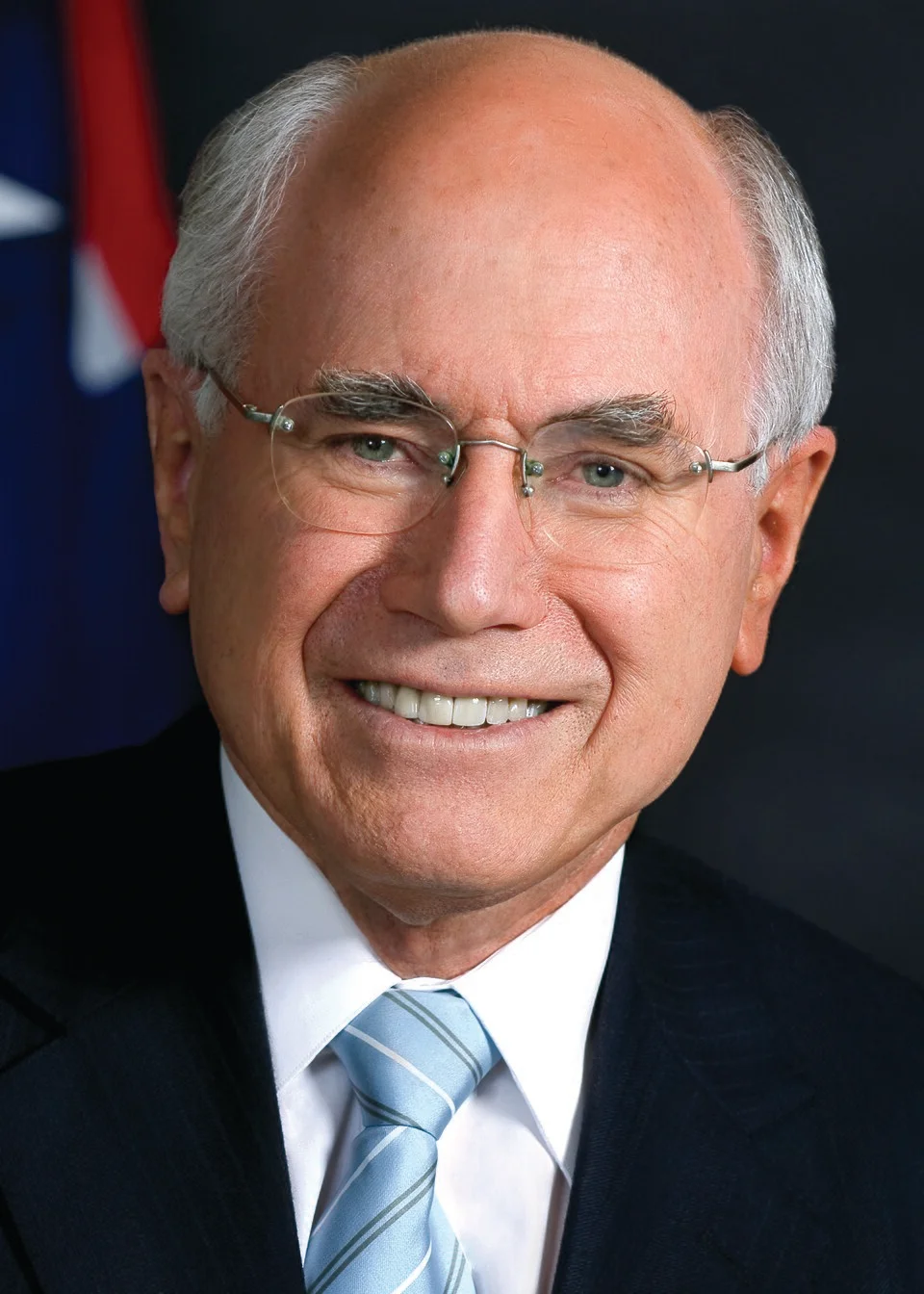
John Howard
 Australia
Also known as: John Winston Howard
Birthday
July 26, 1939
Birth Sign
Leo
Birthplace
Earlwood, Sydney, Australia
Age
87 years old
About
John Howard is an Australian lawyer and former politician who served as the 25th Prime Minister of Australia from March 1996 to December 2007. His eleven-year tenure stands as the second-longest in the country's history, behind only Robert Menzies. Since the death of Bob Hawke in 2019, Howard has been the oldest living Australian Prime Minister.
Howard entered federal parliament in 1974 as the Member for Bennelong. He rose to become Treasurer in the Fraser government, then led the Liberal Party from 1985 to 1989, and again from 1995. His leadership in the 1996 election brought a decisive victory for the Liberal-National Coalition, beginning a period of sustained economic growth and significant policy reform.
Today, Howard remains an active voice in public debate. He continues to comment on national issues, offering his perspective on topics like immigration and Australian identity. His legacy is defined by landmark decisions on gun control, tax reform, and national security, as well as his role in shaping modern Australia's economic landscape.
Early Life & Background
John Winston Howard was born on July 26, 1939, in Earlwood, a working-class suburb in Sydney's south-west. He grew up in a modest household, attending the local government primary school. His interest in politics developed early, though his path to it ran through the law.
Howard studied law at the University of Sydney, where he earned his degree and qualified as a solicitor. For several years, he worked as a commercial lawyer, building a professional foundation that would later inform his economic conservatism. His legal career gave him a reputation for meticulousness and a pragmatic approach to problem-solving.
Politics called in the early 1970s. Howard joined the Liberal Party and worked his way up through its ranks. In 1974, he won the seat of Bennelong in New South Wales, entering the House of Representatives. He held that seat continuously for over three decades, through every election from 1974 to 2004. His early parliamentary years were marked by steady rise, culminating in his appointment as Treasurer in 1977, a role he held until the Liberal government fell in 1983.
Career Growth
Howard's first stint as Liberal Party leader began in 1985, but internal challenges led to his replacement in 1989. He staged a comeback in 1995, regaining the leadership and positioning the Coalition for the 1996 federal election. The campaign, run against a tired Labor government, delivered a landslide victory, and Howard became Prime Minister on March 11, 1996.
His first term saw one of his most defining acts: after the Port Arthur massacre in 1996, his government enacted strict national gun control laws, a move that remains a reference point in global firearms policy. The introduction of the Goods and Services Tax in 2000, a major tax reform, proved more controversial but reshaped Australia's fiscal system.
Internationally, Howard committed Australian troops to Afghanistan in 2001 and to the Iraq War in 2003, decisions that divided public opinion. Closer to home, Australia led the International Force for East Timor in 1999. The 2001 election, fought against the backdrop of the September 11 attacks, saw Howard narrowly re-elected, aided by his firm stance on border security.
The latter years of his premiership were dominated by the WorkChoices industrial relations reforms, introduced in 2005, which sparked widespread union opposition. In 2007, Howard's government was defeated by Kevin Rudd's Labor Party. In a rare event, Howard lost his own seat of Bennelong, becoming only the second sitting Prime Minister to do so.
Career Timeline
Public Image & Style
John Howard's public image is that of a pragmatic, sometimes stubborn, but deeply experienced political operator. He cultivated an everyman persona, often photographed in casual attire, which resonated with many Australians. His leadership style was marked by a firm hand and a willingness to make unpopular decisions, from gun control to industrial relations reform.
Media coverage of Howard has been polarized. Supporters praised his economic management and national security stance, while critics saw him as divisive, particularly on immigration and social issues. His government's legacy is still debated, but Howard himself remains a respected elder statesman, often sought for comment on current affairs.
Fans of Howard, particularly within the Liberal Party, admire his resilience and political longevity. His ability to bounce back from the 1989 leadership loss and lead his party to victory is often highlighted as a testament to his determination. In recent years, he has positioned himself as a voice of commonsense, urging moderation in debates over national identity.
Fame & Fandom
John Howard commands a legacy defined by political endurance rather than pop-culture adulation. Unlike entertainers who cultivate organized fanbases with specific names and rituals, the former Australian Prime Minister is supported by a constituency of political constituents and Liberal Party members. There is no formal or unofficial fandom name documented for his supporters, nor are there records of fan-funded projects, birthday billboards, or chart-pushing campaigns typical of celebrity culture. His public engagement was strictly confined to parliamentary debate and national campaigning over four consecutive terms. While some online discussions reference his political maneuvers, such as the neutralization of Pauline Hanson, these remain historical events rather than viral moments that generate a dedicated fan mythology. The iFANN Global Fame Engine evaluated John Howard in August 2026 and determined that he currently holds no placement in the published rankings. He is not listed among the Global Top 1,000 individuals, nor does he appear on any Top-100 scope list. This absence of a numeric rank reflects his status as a statesman whose influence is measured in legislative history and governance rather than global media consumption signals. While his name appears frequently in historical texts regarding the War on Terror and gun control legislation, these contributions do not translate into the fame metrics used to rank contemporary cultural icons. The scale of his recognition remains deeply rooted in Australian domestic history without extending to the worldwide celebrity sphere where iFANN conducts its primary evaluations.
Interesting Facts and Legends
John Winston Howard stands as one of only two sitting Australian Prime Ministers to lose their own seat during an election defeat, a distinction shared solely with Stanley Bruce in 1929. Born on July 26, his astrological sign is Leo, despite some online sources incorrectly listing him as Sagittarius. His middle name, Winston, serves as a direct homage to the British wartime leader. The University of New South Wales houses the John Howard Library, which preserves his extensive collection of political papers. A separate American actor named John Howard appeared in Frank Capra's Lost Horizon and the television series Police Woman, though the two men are unrelated. Howard's tenure as the 25th Prime Minister from 1996 to 2007 established him as the second-longest serving head of government in Australian history, trailing only Robert Menzies. During this period, he implemented nation-wide gun control legislation following the Port Arthur massacre, a move that fundamentally altered Australian firearm laws. His leadership also saw Australia navigate the initial years of the War on Terror while maintaining economic stability through significant industrial reforms.
Notable Quotes
“While diversity strengthens Australia, we must resist importing cultures of hatred and division.”
“I think the Australian people are the best judges of what is in their national interest.”
Family & Personal Life
John Howard has been married to Janette Howard (née Parker) since 1971. The couple met in the 1960s and married in a quiet ceremony. Janette has been a constant presence throughout his political career, often campaigning alongside him and providing support during the turbulent years of leadership challenges and election defeats. Their marriage is widely regarded as one of the most stable among Australian political figures, lasting over five decades.
The Howards have three children together. Their family life has been kept largely private, with Janette occasionally speaking publicly about the demands of political life. The couple resides in Sydney, where they have lived for most of their married life. Their enduring partnership is often cited as a contrast to the more publicized personal lives of some of Howard's contemporaries.
Notable Connections
John Howard's political career was intertwined with several key figures. His wife, Janette Howard, has been a constant companion and support. He is often compared to Robert Menzies, the longest-serving Australian Prime Minister, whose record he approached. Bob Hawke's death in 2019 made Howard the oldest living former Prime Minister. Kevin Rudd, the Labor leader who defeated him in 2007, represents the political opposition that ended his tenure.
Relationships & Dating History
John Howard has been married to Janette Howard for over five decades. The couple married in 1971, and Janette has been his partner throughout his entire political career. They have three children together. Their marriage has been remarkably stable, with no public records of any other romantic relationships. Janette has played a significant role in his political life, often campaigning alongside him.
As of 2026, Howard remains married to Janette. There is no indication of separation or divorce. Their enduring partnership is one of the longest-lasting among Australian political figures.
- MarriedJanette Howard1971 - presentCurrentMarried since 1971; three children together.
Salary, Net Worth In 2026
$10 Million
iFANN Editorial Team estimate
iFANN currently estimates John Howard's net worth at $10 Million as of 2026. This figure accounts for his parliamentary pension, earnings derived from his autobiography, fees from speaking engagements, and various advisory roles undertaken since leaving office. As a former Prime Minister, he receives a substantial pension, and his book deals have contributed significantly to his financial standing. Howard has additionally held positions on corporate boards and delivered paid speeches, further bolstering his economic position. His wealth is modest when compared to business magnates but remains comfortable for a retired politician. The exact figure is not publicly disclosed, yet the assessment relies on his pension and post-political activities as the primary income streams. Over the years, his net worth has grown steadily, reflecting his continued involvement in public life.
Awards Won (1)
John Howard has received several honours for his public service. Most notably, he was appointed a Companion of the Order of Australia (AC), one of the nation's highest civilian awards. His tenure is also marked by the establishment of the John Howard Library at UNSW, which serves as a lasting institutional tribute.
2008 · National Honour
Public service
Known For
Prime Minister of Australia
1996-2007 · 25th Prime Minister
Gun Control Legislation
1996 · Enacted strict national gun laws
Goods and Services Tax (GST)
2000 · Introduced tax reform
Keywords
Sources
Quick Facts
- Full Name
- John Winston Howard
- Born
- July 26, 1939
- Birthplace
- Earlwood, Sydney, Australia
- Political Party
- Liberal Party of Australia
- Prime Minister Term
- 1996-2007
- Spouse
- Janette Howard
- Children
- 3
- Education
- University of Sydney (law)
Personal Details
- Full Name
- John Winston Howard
- Spouse
- Janette Howard
- Children
- 3
- Education
- University of Sydney (law degree)
Frequently Asked Questions
Is John Howard still alive?
How old is John Howard?
Who is John Howard's wife?
When was John Howard Prime Minister of Australia?
What is John Howard's net worth?
Similar People
Join the community
fans discussing