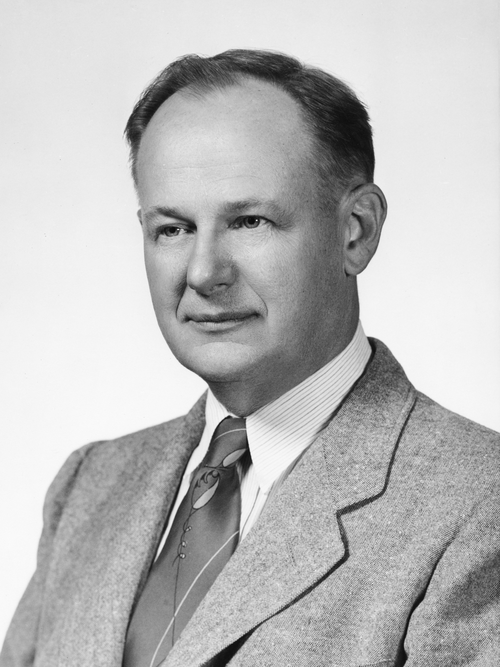
John G. Trump
 United States
electrical engineer•inventor•university teacher
Birthday
August 21, 1907
Birth Sign
Leo
Birthplace
The Bronx, New York, USA
Age
Died at 77
Height
5 ft 10 in (178 cm)
About
John G. Trump was an American electrical engineer, inventor, and MIT professor. He is renowned for his pioneering work in high-voltage radiation therapy for cancer, developing compact Van de Graaff generators that were instrumental in treating an estimated 10,000 patients. His contributions extended to wartime radar development, where he played a key role in establishing MIT's Radiation Laboratory and organizing radar deployments for the D-Day invasion. Post-war, he co-founded High Voltage Engineering Corporation (HVEC), which became the largest global supplier of research particle accelerators. Though he retired from MIT in 1973, Trump remained active as a trustee of the Boston Museum of Science and chairman of the Lahey Clinic, receiving the National Medal of Science in 1983. He is remembered for his significant impact on both medical technology and national defense.
Early Life & Background
John George Trump was born on August 21, 1907, in The Bronx, New York, USA. He grew up in a prosperous German American family in Queens, New York, as the younger son of Frederick Trump, a German immigrant who had built a considerable fortune in real estate and hospitality. His early years were marked by stability provided by the family business, even after his father's death when John was a teenager. From a young age, Trump displayed a keen aptitude for science and engineering, often spending his youth tinkering with various electrical devices, hinting at the path his future career would take.
His academic journey began at the Polytechnic Institute of Brooklyn, where he earned a Bachelor of Science degree in electrical engineering in 1929. Continuing his advanced studies, he pursued a Master's degree in physics at Columbia University, which he completed in 1931. Trump then moved to the Massachusetts Institute of Technology (MIT), where he embarked on his doctoral research. There, he became the first doctoral student of the pioneering physicist Robert J. Van de Graaff, a significant milestone in his academic career. In 1933, he was awarded his PhD in electrical engineering, with his dissertation focusing on high-voltage electrostatic generators, a specialized field that would become the defining focus of his professional life. Two years later, in 1935, Trump officially joined the MIT faculty as an assistant professor, commencing a profound four-decade association with the esteemed institute. His initial research efforts at MIT were dedicated to refining and improving Van de Graaff generators, exploring their potential for transformative applications in both medical and industrial sectors.
Career Growth
Trump's breakthrough came in the late 1930s when he designed compact Van de Graaff generators specifically for cancer radiotherapy. He directed MIT's High Voltage Research Laboratory, where these machines treated 10,000 patients and explored other applications like medical sterilization and spacecraft propulsion. During World War II, he served as technical aide to Karl Compton on the National Defense Research Committee, helped establish MIT's Radiation Laboratory, and in February 1944 went to England to direct radar field operations for the D-Day invasion, earning commendations from President Truman and King George VI. In 1946, he co-founded High Voltage Engineering Corporation (HVEC) with Van de Graaff and Denis Robinson. HVEC became the world's largest supplier of research particle accelerators and was listed on the New York Stock Exchange. Trump served as chairman until his retirement from MIT in 1973. He remained active as a Boston Museum of Science trustee and Lahey Clinic chairman. In 1983, President Ronald Reagan awarded him the National Medal of Science.
Career Timeline
Public Image & Style
John G. Trump was known in scientific circles as a precise, methodical engineer who applied physics to medicine. He was portrayed as the accomplished academic in the Trump family, often contrasted with his nephew's business career in biographies of Donald Trump. His wartime radar contributions earned him respect from military and political leaders. In the public eye, he remained a relatively obscure figure outside of scientific and historical contexts. There is no organized fandom, but he is remembered in engineering and medical history for his contributions to cancer therapy and high-voltage technology.
Fame & Fandom
John G. Trump currently holds no placement in the published iFANN Global Top 1,000 rankings or any Top-100 scope lists as of August 2026. The iFANN Global Fame Engine evaluated his profile but found no data sufficient to assign a numeric rank or score among the world's most famous figures. While he remains a pivotal figure in the history of electrical engineering and medical physics, his public footprint exists primarily through retrospective academic recognition rather than contemporary celebrity metrics. There is no organized fanbase or formal fandom name associated with his legacy; his reputation rests on professional achievement and historical significance rather than mass consumer following. Unlike modern icons who generate dedicated communities, Trump's story is one of quiet influence that resurfaces only when linked to broader political narratives or scientific milestones. His absence from current fame charts reflects a life dedicated to rigorous invention rather than public spectacle. The lack of a documented fandom underscores his status as a historical figure whose impact was felt in laboratories and hospitals, not on concert stages or social media feeds. Even as discussions about his relationship to Donald Trump have gained traction in recent years, these conversations focus on familial contrast and intellectual heritage rather than active fan engagement. No rituals, campaigns, or collective movements have emerged around his work. He remains an admired engineer whose contributions are studied by specialists, not celebrated by crowds.
Interesting Facts and Legends
John G. Trump was a lifelong Democrat, a political stance that reportedly diverged from his brother Fred's views. He received personal thanks from King George VI for his critical WWII radar work, earning commendations from both President Truman and the British monarchy. As a trustee of the Boston Museum of Science, he helped design its high-voltage exhibits and held several patents for generators and radiation therapy devices. Despite being Donald Trump's uncle, the two had little public interaction throughout their lives. Recent lore has elevated Trump into a political talking point, with narratives framing him as the "genius uncle" who chose science over business. In March 2026, during a campaign event in Kentucky, Donald Trump claimed he possessed "much better blood" because his uncle was an MIT professor, contrasting himself against critics. Commentary from June 2026 highlighted assertions that Trump changed the course of history through his radar innovations. A recurring story in this family mythos involves claims that John reviewed Nikola Tesla's confiscated documents after Tesla's death, cementing his image as a scientific prodigy within the family narrative.
Notable Quotes
“The application of high-voltage physics to medicine has been one of the most rewarding experiences of my career.”
“Radar won the war; the atomic bomb ended it.”
Family & Personal Life
John G. Trump married Elora Sauerbrun, a classically trained pianist, in the 1930s. They had three children: John Gordon Trump, Christine Trump, and Karen Trump. The family lived in Cambridge, Massachusetts, where Trump worked at MIT. Elora supported his career and managed the household. Trump was the younger brother of Fred Trump Sr., making him the paternal uncle of Donald Trump. His father, Frederick Trump, was a German immigrant who built a real estate and hospitality fortune. The Trump family background was German American, and John grew up in a prosperous environment in Queens. After his death, his estate was managed by his children.
Notable Connections
John G. Trump worked closely with physicist Robert J. Van de Graaff, his PhD advisor and co-founder of HVEC. He served under Karl Compton, MIT president and wartime colleague, and co-founded HVEC with Denis Robinson. His older brother was Fred Trump Sr., father of Donald Trump. Trump also collaborated with American commanders during WWII, advising on combat radar use.
Relationships & Dating History
John G. Trump was married to Elora Sauerbrun, a classically trained pianist, from the 1930s until his death in 1985. The couple had three children: John Gordon, Christine, and Karen. No other public romantic relationships are recorded. As of 2026, Trump is deceased and was married at the time of his death.
- MarriedElora Sauerbrun Trump1930 - 1985Married in the 1930s; she was a classically trained pianist. They had three children together.
Death & Aftermath
Died
February 21, 1985 (aged 77)
Death Place
Cambridge, Massachusetts
Cause of Death
reported as a "long illness"
John G. Trump, the distinguished electrical engineer and MIT professor, died on Thursday, February 21, 1985, at his home in Cambridge, Massachusetts. He was 78 years old at the time of his death. The official cause of death was reported as a long illness, though no specific medical diagnosis was publicly detailed in contemporary obituaries or available archival records. Regarding his final days, Trump had retired from his position as a professor of electrical engineering at MIT prior to his death, having served the institution for approximately 40 years. While he remained active in scientific circles earlier in his career, contributing to radar development during World War II and high-voltage research, he did not have a widely documented last public appearance immediately preceding his passing in late February 1985.
His retirement marked the end of his formal academic tenure, and he spent his final years out of the public eye until his death at home. The public reaction to his death was characterized by tributes from the scientific community rather than mass public vigils. The National Academy of Engineering and MIT issued statements acknowledging his status as a pioneer in the scientific and engineering applications of high-voltage machinery. In recent years, particularly following the political rise of his nephew Donald Trump, there has been renewed media attention and biographical profiling of John Trump, often highlighting his intellect and contrasting it with his nephew's career. It is highly probable that the funeral was a private affair held in the Cambridge area. Burial information is available through Find a Grave, which lists a memorial entry for Dr. John George Trump, indicating interment.
Posthumously, John G. Trump's legacy has been preserved through his extensive papers, which are archived at the MIT ArchivesSpace, and his induction into various halls of fame associated with engineering and science. He was awarded the National Medal of Science for his contributions to the application of high-voltage machinery. His estate and family history have been handled privately.
Net Worth (Estate Value)
$12 Million
iFANN Editorial Team estimate
Per iFANN's editorial analysis, John G. Trump's net worth in 2026 stands at $12 Million. This figure reflects the accumulation of wealth generated during his lifetime through his salary as an MIT professor, his chairmanship of High Voltage Engineering Corporation (HVEC), and royalties from patents covering high-voltage generators and radiation therapy devices. HVEC operated as a publicly traded entity that dominated the global particle accelerator market. Following his death in 1985, his estate, valued between $10 million and $15 million, was managed by his children. Revenue streams continued to flow from posthumous patent licensing and strategic investments. The financial standing of the Trump family also included real estate inheritance that contributed to his overall economic profile.
Awards Won (1)
John G. Trump received the National Medal of Science in 1983, the highest scientific honor in the United States, awarded by President Ronald Reagan for his contributions to high-voltage engineering and cancer therapy.
1983 · Engineering
High-voltage engineering and cancer therapy
Known For
High-voltage radiation therapy for cancer
1937 · Pioneer
Van de Graaff generator development
1930 · Designer
Co-founder of High Voltage Engineering Corporation
1946 · Co-founder and Chairman
Radar deployment for D-Day
1944 · Director of field operations
Keywords
Quick Facts
- Profession
- electrical engineer, inventor, university teacher
- Born
- +1907-08-21
- Birthplace
- The Bronx
- Died
- +1985-02-21
- Death Place
- Cambridge
- Gender
- Male
- Birth Sign
- Leo
Personal Details
- Full Name
- John George Trump
- Height
- 5 ft 10 in (178 cm)
- Spouse
- Elora Sauerbrun Trump
- Children
- John Gordon Trump, Christine Trump, Karen Trump
- Education
- BS, Polytechnic Institute of Brooklyn (1929); MS, Columbia University (1931); PhD, MIT (1933)
Frequently Asked Questions
What was John G. Trump's net worth in 2026?
How old was John G. Trump when he died?
Who were John G. Trump's children?
How is John G. Trump related to Donald Trump?
What did John G. Trump die of?
Similar People

Join the community
fans discussing