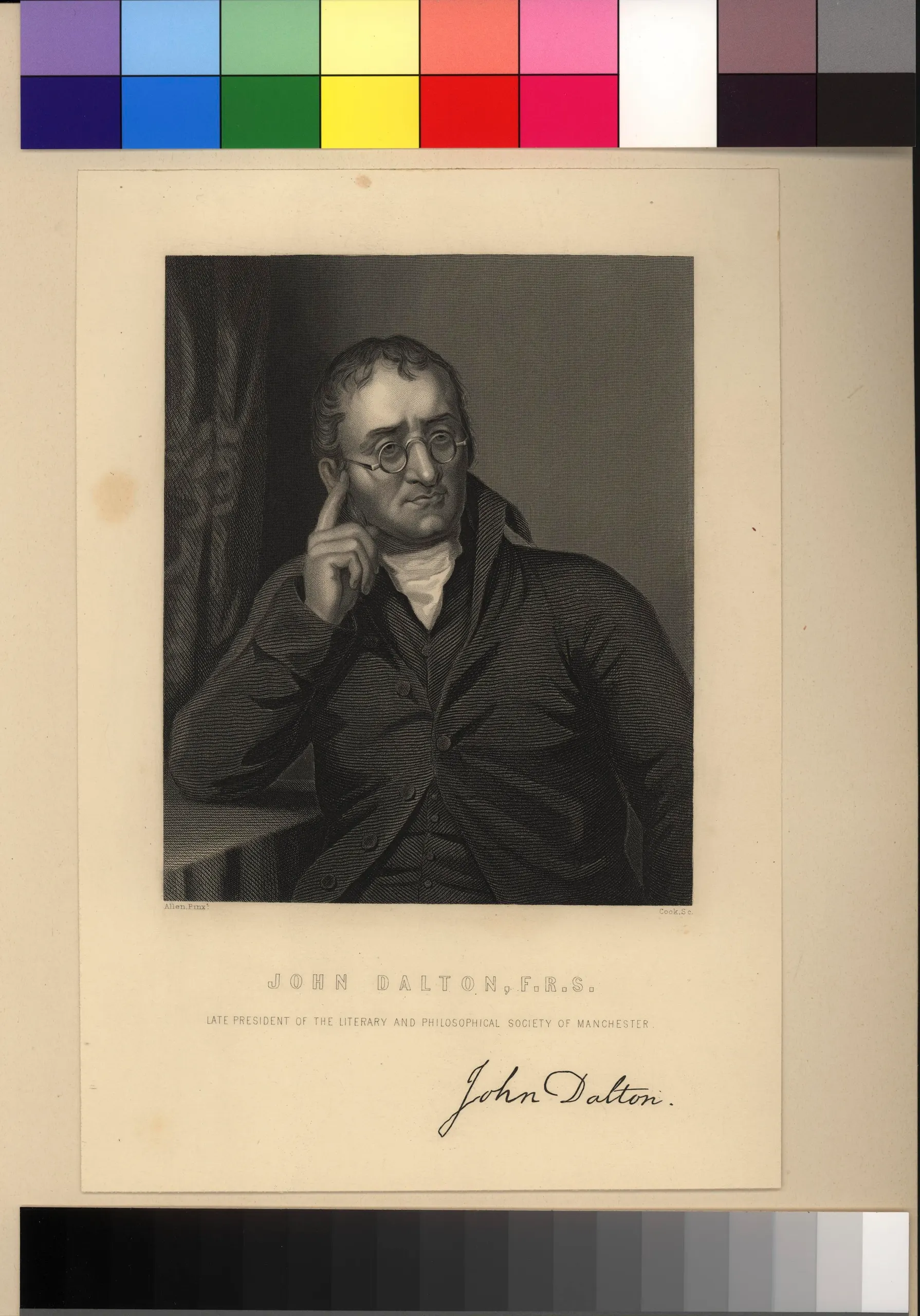
John Dalton
 United Kingdom
Chemist•physicist•meteorologist
Also known as: John Dalton, Dalton
Birthday
September 6, 1766
Birth Sign
Virgo
Birthplace
Eaglesfield, Cumberland, England
Age
Died at 77
About
John Dalton was an English chemist, physicist, and meteorologist who introduced atomic theory into chemistry in a quantitative form. He spent most of his working life in Manchester, where the Literary and Philosophical Society gave him a base for research he kept up for decades. His model gave chemists relative atomic weights and a symbolic notation, turning reactions into something you could calculate rather than just describe. Meteorology ran alongside the chemistry, and from that habit and his lab work on gases came the law of partial pressures, which states that the total pressure of a gas mixture equals the sum of the pressures each gas would exert alone.
Dalton's 1794 paper on colour blindness described his own red-green confusion, and the condition is still called Daltonism in some languages. He never married, lived frugally, and died in Manchester in 1844 after a stroke. His scientific reputation has proved durable: the atomic theory he built from weather and gas measurements is generally described as the foundation of the modern concept of the atom and a landmark in chemistry. He is remembered as the sober Quaker schoolmaster-turned-scientist whose insistence on measurement over speculation gave chemistry its first workable atomic framework, and whose name survives in Dalton's law and in the nomenclature of the science he helped reshape.
Early Life & Background
The exact birth date is conventionally given as 6 September 1766, though some sources say 5 September. Schooling came through the Society of Friends, and from childhood he kept weather observations, a habit that became a lifelong discipline. He stayed roughly a decade at the Quaker school in Kendal, where the blind philosopher John Gough encouraged his scientific reading, and the two men remained close. In 1793 Dalton moved to Manchester to tutor mathematics and natural philosophy at New College, a Dissenting academy. The Manchester Literary and Philosophical Society became his intellectual home. He was elected to it in 1794 and read his first major paper that year, on colour blindness, a condition he suffered from himself and described as a difficulty distinguishing red from green. He later served as the Society's president.
Career Growth
Dalton's chemistry grew out of his meteorological and gas work. He formulated the law of partial pressures, studied vapour pressure and the solubility of gases in water, and measured the weights of gases and the ratios in which they combined. He pictured atoms as small hard balls, built wooden models to show how they combined, and devised a symbolic notation for elements and compounds.
The full system appeared in A New System of Chemical Philosophy, part one in 1808 and part two in 1810. It gave chemistry a quantitative framework: relative atomic weights, fixed combining ratios, and a notation. Britannica notes that his explanation of gas atoms in mixtures was later found to be wrong, and his atomic weights were refined by later chemists, but the core model endured. He also became a corresponding member of the French Academy of Sciences. The standard biographies preserve his plain statement that he had "no wife, no children" and lived for science, and his documented remarks centre on his meteorological method and on his insistence that his atomic weights rested on measurement rather than speculation.
Career Timeline
Public Image & Style
Contemporaries described Dalton as tall and spare, plain in dress and manner, with a strong Quaker plainness of speech. He was colour-blind, which he documented himself. His public image is that of the sober Quaker founder of atomic chemistry, commemorated in statues, medals, and nomenclature. He has no modern social media presence or fan campaigns. No reliable modern height figure is recorded.
Fame & Fandom (iFAMOUS Rankings)
iFANN has not yet collected fame data for John Dalton, so no ranking is available. He does not appear on the September 2026 iFAMOUS Rankings flagship list. His audience today is scholarly rather than fannish: chemistry students, historians of science, and the Manchester institutions that keep his name alive. There is no formal fanbase name, no campaigns, and no social media presence. The closest thing to a fandom is the annual Dalton Medal and the Lit and Phil's care of his papers and apparatus.
Interesting Facts and Legends
The most retold Dalton story is that he was led to atomic theory by studying the weather, the weatherman who discovered the atom. He built wooden atomic models to demonstrate combination, and his self-experiment in colour blindness gave the condition its alternative name. His refusal of honours and his frugal bachelor life are part of the folklore of the absent-minded Quaker scientist. He never received a Nobel Prize, because the prize did not exist in his lifetime.
Notable Quotes
“No wife, no children.”
“A meteorologist first and a chemist afterwards.”
Family & Personal Life
Dalton's father was a hand-loom weaver in Eaglesfield, and the household was poor and Quaker. His brother Jonathan taught alongside him at the Quaker school in Kendal. Dalton never married and had no children. He lived simply and frugally, often boarding with friends in Manchester, notably with the Rev. William Johns and later with the family of his friend Peter Clare. No pets or family stories beyond this are documented in the standard record.
Notable Connections
Relationships & Dating History
Dalton never married and had no known children. There is no documented romantic relationship of any kind in the standard biographical record: no courtship, engagement, marriage, or rumoured attachment is reported by credible sources. His closest documented relationships were familial, with his brother Jonathan, who taught alongside him at Kendal, and professional, with John Gough, his Manchester colleagues, and the Lit and Phil circle. As of his death in 1844, he was unmarried and had no partner.
Death & Aftermath
Died
July 27, 1844 (aged 77)
Death Place
Manchester, England, United Kingdom
Cause of Death
Stroke
Dalton died at his home in Manchester on 27 July 1844, after a stroke in the spring of that year and a second, fatal one in July. He was 77. The Manchester Literary and Philosophical Society, where he had been a fixture for five decades, published an obituary memoir. His body lay in state, and contemporary accounts hold that tens of thousands of people filed past the coffin before a civic funeral and burial in the family vault at Ardwick Cemetery.
The city treated his death as a public event, and his scientific reputation has proved durable. The atomic theory he built from weather and gas measurements is generally described as the foundation of the modern concept of the atom. His name survives in Dalton's law, the Dalton Medal, and Daltonism, the old term for colour blindness that he documented in himself.
Net Worth (Estate Value)
$1 Million
iFANN Editorial Team estimate
Dalton died in 1844, so there is no modern net worth in any meaningful sense. His estate consisted of modest personal effects and his scientific papers and apparatus, which passed to the Manchester Literary and Philosophical Society rather than generating posthumous revenue. iFANN's editorial research puts the symbolic current value of his estate at roughly $1 million, a figure that reflects historical significance rather than market earnings. There were no posthumous releases, licensing deals, or merchandise. His financial trajectory was flat: a frugal bachelor's savings and the tools of his research.
Awards Won (1)
Dalton received the Royal Medal from the Royal Society in 1826 and was elected a Fellow in 1822. He was also a corresponding member of the French Academy of Sciences. The Dalton Medal is named in his honour.
1826 · Science
Atomic theory and gas laws
Known For
Atomic theory
1803 · Proposer
A New System of Chemical Philosophy
1808 · Author
Dalton's law of partial pressures
1801 · Formulator
Colour blindness (Daltonism)
1794 · Describer
Keywords
Sources
Quick Facts
- Profession
- physicist, mathematician, meteorologist
- Born
- September 6, 1766
- Birthplace
- Eaglesfield, Cumberland, England
- Died
- July 27, 1844
- Death Place
- Manchester, England
- Gender
- Male
- Birth Sign
- Virgo
Personal Details
- Full Name
- John Dalton
- Education
- Quaker schools; tutored by John Gough
Frequently Asked Questions
What led John Dalton to his discovery?
Who discovered atoms?
Did John Dalton receive the Nobel Prize?
What was John Dalton's atomic model?
What is Dalton's law?
Join the community
fans discussing