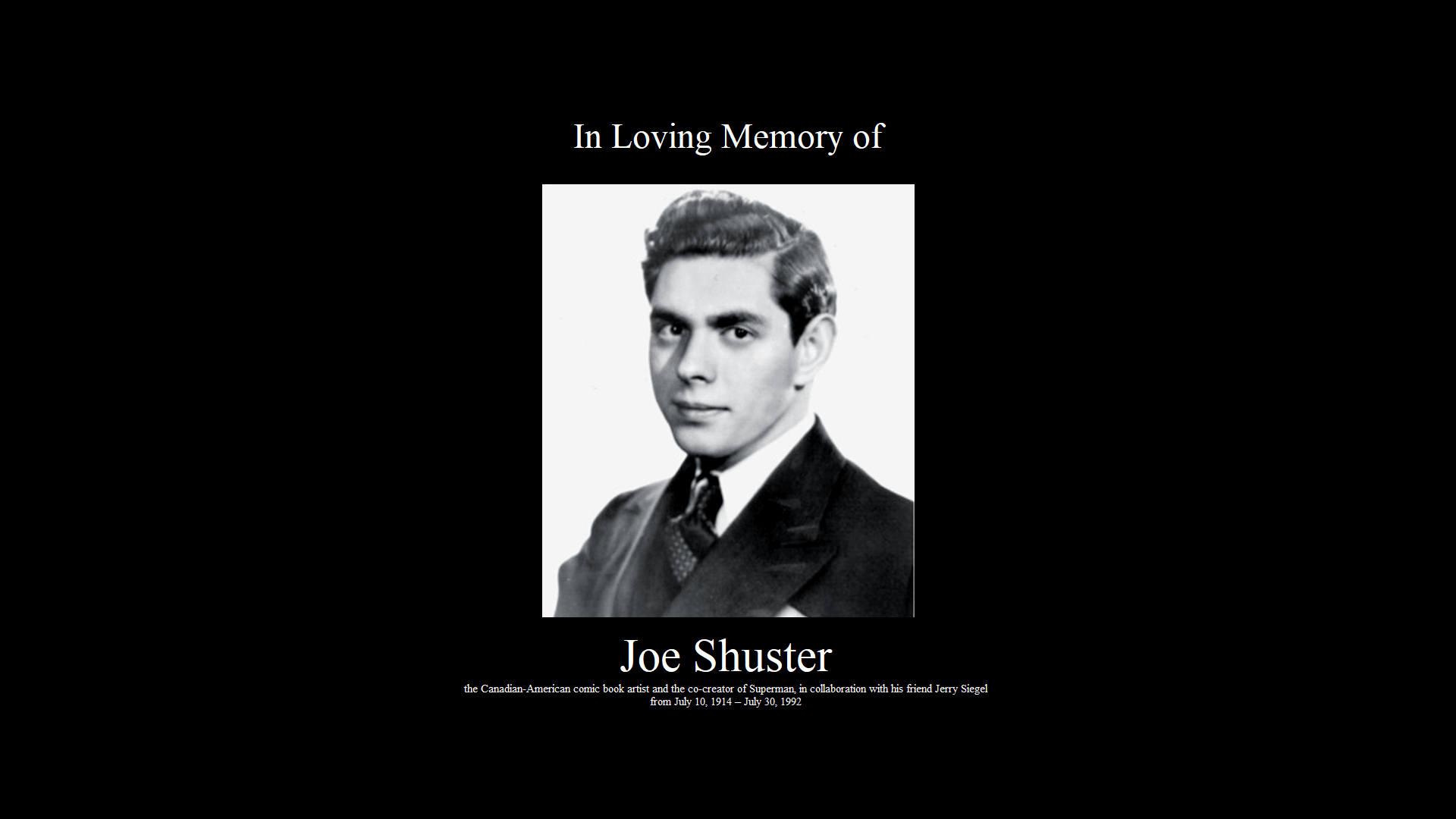
Joe Shuster
 Canada
comics artist•designer•screenwriter
Also known as: Joseph Shuster, Joe
Birthday
July 10, 1914
Birth Sign
Cancer
Birthplace
Toronto, Ontario, Canada
Age
Died at 78
About
Joseph Shuster was a Canadian-American comic book artist best known for co-creating the DC Comics character Superman with writer Jerry Siegel. Born in Toronto on July 10, 1914, he moved to Cleveland as a child where he met his lifelong collaborator. Their partnership produced Action Comics #1 in June 1938, introducing a hero that launched an entire genre of popular culture. Despite the massive success of his creation, Shuster faced significant financial hardship throughout his life due to the initial sale of rights for only $130. He spent decades fighting legal battles to regain ownership or receive fair compensation for the world's most famous superhero.
By the mid-1970s, deteriorating eyesight forced him to stop working in comics entirely. He lived quietly in Los Angeles until his death at age 78 on July 30, 1992, due to complications from heart disease and diabetes. Posthumous recognition eventually arrived, including inductions into the Will Eisner and Jack Kirby Halls of Fame. The Joe Shuster Awards were established in 2005 to honor Canadian comic creators, cementing his legacy as a foundational figure in the industry who changed the landscape of storytelling forever. He is universally acknowledged as one of the architects of the modern superhero genre, holding a position of immense influence in pop culture history.
Early Life & Background
Joseph Shuster entered the world on July 10, 1914, in Toronto, Ontario, Canada, into a Jewish family. When he was just nine years old in 1923, his family relocated to Cleveland, Ohio, settling in the Central Avenue neighborhood. It was in this city that the trajectory of pop culture shifted permanently. While attending Glenville High School, Shuster crossed paths with Jerry Siegel. The two boys bonded instantly over a shared obsession with science fiction pulp magazines and the emerging medium of comic strips.
Their high school collaboration began in earnest around 1933. They started drawing and writing stories together, heavily influenced by characters like The Shadow and Doc Savage. Early efforts included amateur comics and fanzines that showcased their developing styles. One of their first major attempts was a story titled "The Reign of the Superman," which featured a telepathic villain rather than a hero. Although rejected by publishers at the time, the concept evolved into the iconic figure we know today. To support his artistic ambitions before finding commercial success, Shuster worked various odd jobs. He sold drawings to local publications and created advertisements, honing his craft through practical application. This period of struggle defined his early years. He remained relatively unknown outside of Cleveland's small circle of comic enthusiasts until the moment he and Siegel refined their vision into the Man of Steel.
Career Growth
The breakthrough arrived in 1938 when Shuster and Siegel finally sold the rights to Superman to Detective Comics, Inc., now known as DC Comics. The deal transferred all ownership without royalties for a mere $130. That same year, Action Comics #1 hit newsstands in June, introducing the world to Superman. Shuster's dynamic artistic style, characterized by a unique blend of strength and grace, immediately defined the visual language of superhero comics for generations to come. Following the launch, Shuster continued to illustrate covers and stories throughout the Golden Age of Comic Books. His work appeared regularly in Action Comics and other titles during the late 1930s and 1940s. However, as the character exploded in popularity, Shuster saw little financial reward from the billion-dollar franchise he helped build. This disparity led to decades of legal battles over ownership and compensation.
In 1975, he reached a settlement with DC Comics that provided him with a pension and health insurance. By the mid-1970s, Shuster's eyesight had deteriorated to the point of partial blindness, forcing him to leave the comics industry altogether. Copyright termination rights were restored in 1986, offering some financial relief in his final years. In 1983, he drew a final sketch for editor Julius Schwartz to honor the character's 45th anniversary. Posthumously, his contributions have been consistently honored by major institutions, including the Will Eisner Comic Book Hall of Fame in 1992 and the Jack Kirby Hall of Fame in 1993.
Career Timeline
Public Image & Style
Joe Shuster is portrayed as a visionary artist whose work changed the world, yet whose personal life was overshadowed by the commercial success of his creation. Media portrayals emphasize his humility, his struggle with the corporate ownership of Superman, and his eventual recognition as a pioneer in the field. His image is one of a tragic hero, a man who gave the world hope but received little in return during his lifetime. He is remembered as a quiet, unassuming individual who preferred to stay out of the spotlight. Unlike many celebrities, he never sought fame for himself, focusing instead on his art. This contrast between the global icon he created and his own modest existence defines how he is viewed in historical accounts. Specific details regarding his height and physical appearance are not widely documented, but he is described as having a quiet demeanor.
Fame & Fandom (iFAMOUS Rankings)
The community surrounding Joe Shuster is defined by a unique blend of deep historical reverence and enduring legal advocacy. Unlike fandoms driven by current releases, this group operates as a custodial force, preserving the legacy of the man who drew the first superhero while championing the cause of creator rights. Fans often refer to themselves simply as Superman enthusiasts or comic book historians, united by the shared narrative of Siegel and Shuster's tragic struggle against corporate ownership. Their rituals are less about digital trends and more about tangible acts of remembrance, such as annual tributes on July 10th and organized efforts to maintain archives like those at the Maltz Museum of Jewish Heritage. The collective voice of these fans historically pressured publishers for recognition, culminating in landmark settlements that secured pensions and copyright terminations for the creators. This fanbase remains influential through academic institutions and conventions, keeping the story of the artist who died in relative poverty alive alongside the billion-dollar empire he helped build.
His stature in the annals of pop culture is quantified by global metrics that track attention across media coverage, search activity, and consumption signals worldwide. He holds the position of the 8th most famous person in Western Comics, a standing confirmed by the iFANN Global Fame Rankings. He was also featured prominently in lists of "Greatest of All Time" creators. Recent events in May and June 2026, including the "Icons in Ink" exhibit at the Maltz Museum and programs at the Wickliffe Public Library, continue to highlight his enduring relevance and the educational impact of his work.
Interesting Facts and Legends
One of the most poignant facts about Shuster is that one of his final pieces of Superman art was a sketch drawn in 1983 for editor Julius Schwartz to honor the character's 45th anniversary. This rare glimpse into his later years is often shared within the community as a testament to his enduring connection to the role. Another significant detail involves the declaration of April 18 as "Superman Day" by the City of Cleveland, honoring the specific location where Shuster and Siegel met in high school. Shuster's religious heritage as a Jew is a significant part of his identity, highlighted in recent exhibits like "Icons in Ink" at the Maltz Museum of Jewish Heritage. Original art from Action Comics covers remains highly prized in auctions, reflecting the immense value collectors place on his specific style. Fans frequently retell the tragedy of the "Man of Steel" created by a man who died in poverty, a narrative that fuels modern discussions about intellectual property and creator compensation. The Siegel & Shuster Society has hosted events featuring writers like Mariko Tamaki to discuss their legacy.
Notable Quotes
“I never thought I'd see Superman become what it is today.”
Family & Personal Life
Joe Shuster was married once to Edith Lowenthal in 1941. The couple remained together until Shuster's death in 1992, spanning over five decades of marriage. There are no widely documented public romantic relationships prior to his marriage, nor any reports of engagements or high-profile flings during his lifetime. Edith Lowenthal was a supportive partner who stood by Shuster through his financial struggles and health issues. The couple did not have any children together. Shuster lived out his later years in relative obscurity in Los Angeles, working odd jobs and living in assisted care facilities. His reclusive nature in his final years meant that his personal life remained largely private, with few public statements or interviews regarding his marital life beyond the basic facts of his union with Lowenthal. He died at the Jewish Home for the Aged in North Hills, a suburb of Los Angeles, and was interred there after a private funeral.
Notable Connections
Jerry Siegel, Edith Lowenthal, Julius Schwartz, DC Comics
Relationships & Dating History
Joe Shuster was married once to Edith Lowenthal in 1941. The couple remained together until Shuster's death in 1992, spanning over five decades of marriage. There are no widely documented public romantic relationships prior to his marriage, nor any reports of engagements or high-profile flings during his lifetime. Edith Lowenthal was a supportive partner who stood by Shuster through his financial struggles and health issues. The couple did not have any children together. Shuster lived out his later years in relative obscurity in Los Angeles, working odd jobs and living in assisted care facilities. His reclusive nature in his final years meant that his personal life remained largely private, with few public statements or interviews regarding his marital life beyond the basic facts of his union with Lowenthal. As of 2026, he is remembered as having been married to Edith Lowenthal at the time of his death. The funeral arrangements were private, reflecting his reclusive nature in later life.
- MarriedEdith Lowenthal1941 - 1992Remained married until his death; they had no children.
Death & Aftermath
Died
July 30, 1992 (aged 78)
Death Place
Los Angeles, California, USA
Cause of Death
Complications from heart disease and diabetes
Joe Shuster passed away on July 30, 1992, in Los Angeles, California, at the age of 78. His death followed a long decline marked by heart disease and diabetes, conditions that had plagued his final years. The comic book community offered immediate tributes to the man who co-created Superman, recognizing his pivotal role in launching an entire genre of popular culture even as he struggled financially for much of his life. While specific details regarding the funeral service or burial arrangements were not made public, the broader cultural response honored his legacy through institutions that celebrated his contributions.
Posthumously, Shuster received numerous accolades, including inductions into various halls of fame. The Joe Shuster Canadian Comic Book Creator Awards were established to honor creators like him, and Cleveland erected bronze statues of both Siegel and Shuster to commemorate their shared work. Ongoing tributes include exhibits like "Icons in Ink" at Cleveland's Maltz Museum and programs hosted by the Siegel & Shuster Society, ensuring his early works remain part of the conversation. A complex history of copyright disputes defined his later years, but the 1975 settlement with DC Comics provided financial support during his final days.
Net Worth (Estate Value)
$10 Million
iFANN Editorial Team estimate
Estimating Joe Shuster's net worth is complex due to the historical context of his life and the nature of his assets. During his lifetime, Shuster struggled financially, living in poverty despite the billion-dollar success of Superman. Lifetime earnings were modest, consisting mainly of a pension and health insurance following a 1975 settlement with DC Comics. Copyright termination rights were restored in 1986, providing some financial relief in his later years. The value of his estate is tied to the licensing and merchandising of Superman. While the character remains owned by DC, the creators' names were restored to the page. The estate continues to generate revenue through royalties, licensing deals, and merchandise, but these funds are distributed according to the terms of the 1975 settlement and subsequent legal agreements managed by his heirs and the Joe Shuster Foundation. There are no credible sources providing a specific dollar figure for Shuster's net worth as of 2026, as he has been deceased for over three decades; any figures found online regarding "net worth" are likely speculative or refer to the current value of his estate's IP rights.
Awards Won (2)
While Shuster did not win traditional entertainment awards like Oscars or Emmas during his lifetime, his posthumous honors are significant. He was inducted into the Will Eisner Comic Book Hall of Fame in 1992 and the Jack Kirby Hall of Fame in 1993. In 2005, Canada established the Joe Shuster Awards, an annual ceremony honoring Canadian comic book creators, named in his honor.
1992 · Hall of Fame
Superman
1993 · Hall of Fame
Superman
Known For
Action Comics #1
1938 · Co-creator of Superman
Superman
1938 · Character Designer
Keywords
Sources
Quick Facts
- Profession
- comics artist, designer, screenwriter
- Born
- July 10, 1914
- Birthplace
- Toronto, Ontario, Canada
- Died
- July 30, 1992
- Death Place
- Los Angeles, California, USA
- Gender
- Male
- Birth Sign
- Cancer
Personal Details
- Full Name
- Joseph Shuster
- Spouse
- Edith Lowenthal
- Children
- Education
- Glenville High School
Frequently Asked Questions
Where was Joe Shuster born?
How much did Joe Shuster sell Superman for?
When did Joe Shuster die?
What caused Joe Shuster's death?
Is there a foundation named after Joe Shuster?
Similar People
Join the community
fans discussing