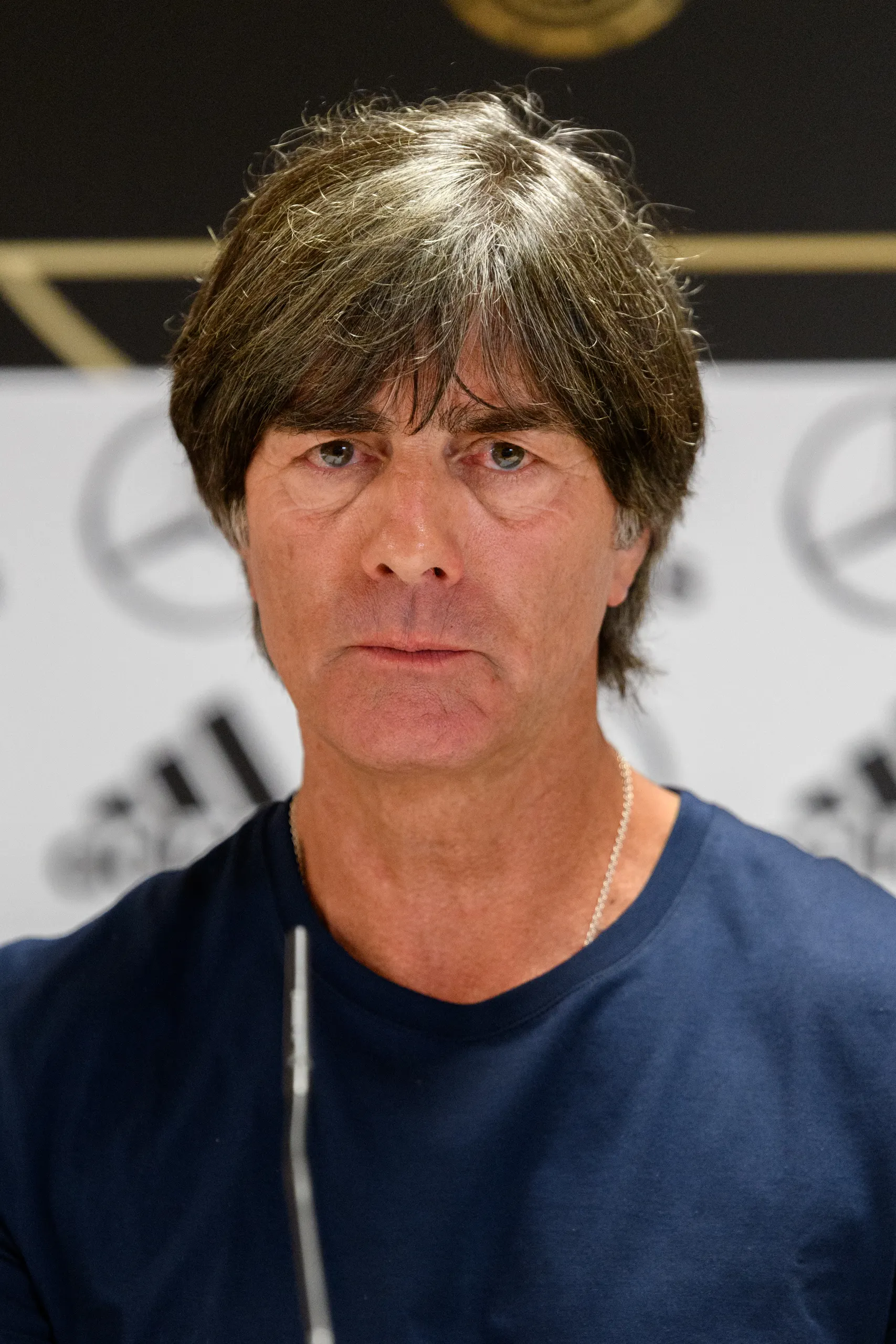
Joachim Löw
 Germany
association football player•association football coach
Also known as: Joachim Low, Joachim Loew
Birthday
February 3, 1960
Birth Sign
Aquarius
Birthplace
Schönau im Schwarzwald, Germany
Age
66 years old
Height
5 ft 11 in (181 cm)
About
Joachim Löw is a German football coach and former player, best known for leading the Germany national team to World Cup glory in 2014. As of 2026, he remains one of the most respected figures in the sport, celebrated for his tactical intelligence and his role in shaping a generation of technically gifted players. His 15-year tenure as head coach, from 2006 to 2021, produced 124 wins in 198 matches, a national record. Fans remember him for his calm demeanor, his sharp suits on the touchline, and his commitment to attacking, possession-based football. Since stepping down after Euro 2020, he has stayed involved in the game through analysis and ambassadorial work, though he has not returned to full-time coaching.
Early Life & Background
Joachim Löw grew up in the small Black Forest town of Schönau im Schwarzwald, where football was a constant presence from an early age. He played for local youth teams before turning professional with SC Freiburg in 1978. As a forward, he moved through several clubs, including VfB Stuttgart and Eintracht Frankfurt, and spent time in Switzerland and Turkey, experiences that broadened his tactical understanding. His playing career was solid rather than spectacular, but it gave him a deep feel for the game. After retiring in the early 1990s, he moved into coaching, starting with lower-league sides in Germany and Switzerland. By 1996 he had taken charge of VfB Stuttgart, where he won the DFB-Pokal in 1997, a sign of the managerial talent that would later define his career. In 2003 he managed FK Austria Wien, then took on the Austrian national team, before joining Jürgen Klinsmann's staff as assistant coach for Germany in 2004.
Career Growth
Löw's defining chapter began in 2006 when he took over as head coach of Germany after serving as Klinsmann's assistant at the World Cup. He immediately stamped his mark, guiding the team to the Euro 2008 final, where they lost to Spain. A third-place finish at the 2010 World Cup and a semi-final at Euro 2012 followed, but the crowning moment came in 2014. In Brazil, Germany played some of the most exhilarating football of the tournament, culminating in a 1-0 win over Argentina in the final at the Maracanã. That victory made Löw a national hero. He added the 2017 Confederations Cup with a young squad, showcasing his ability to develop talent. The 2018 World Cup brought a painful group-stage exit, but he rebuilt the team for Euro 2020. After Germany's Round of 16 loss to England in 2021, he stepped down, with Hansi Flick taking over. His record of 124 wins stands as the best in German national team history.
Career Timeline
Public Image & Style
Löw's public persona is that of a thoughtful, composed tactician. On the touchline he favored tailored casual wear, often dark suits with an open collar, and his signature scarf, a look that set him apart from the tracksuit-clad managers of his era. German media portrayed him as a cerebral figure who brought modern, possession-based football to the national team. Fans appreciated his calm, even in tense moments, though his later years drew criticism after early tournament exits. Still, the 2014 triumph cemented his status as a beloved figure. He has no official fandom name, but supporters across Germany and beyond remember him as the coach who delivered a fourth World Cup. His low-key social media absence only added to his air of quiet authority.
Fame & Fandom (iFAMOUS Rankings)
Joachim Löw stands as a defining architect of modern German football, a figure whose influence stretches far beyond the touchline into the global consciousness of the sport. In August 2026, his cultural footprint remains substantial enough to place him the 45th most famous person in Germany, a position he has held steady through cycles of national triumph and recalibration. This standing reflects a career that transformed how a nation views its own identity on the world stage, cementing his legacy alongside the tactical giants who came before him. While the public sphere often celebrates the players, Löw's specific brand of cerebral leadership earned him a unique tier of recognition among sports enthusiasts worldwide. His fanbase, however, does not operate under a singular, branded moniker like those found in pop culture; instead, support flows naturally through the collective identity of Die Mannschaft, where loyalty is tied to the team rather than an individual cult of personality. There are no documented rituals or organized campaigns dedicated solely to him, though the emotional resonance of his 2014 World Cup victory remains a shared national memory. The narrative surrounding him is one of professional respect mixed with the inevitable scrutiny of high-stakes management. Even as speculation about a potential return to coaching surfaces in recent years, his status as a revered former head coach remains unchallenged. The iFANN Global Fame Rankings capture this enduring relevance, tracking his prominence across media coverage and consumption signals without needing to dissect the mechanics of public attention. He is remembered not just for the trophy he lifted, but for the calm demeanor he maintained while steering a generation of talent through some of the sport's most volatile moments.
Interesting Facts and Legends
Löw's distinctive touchline style included wearing scarves so frequently that fans began gifting them to him during matches, turning the accessory into a personal trademark. His off-field quirks also entered internet lore when a clip of him picking his nose during the 2010 World Cup broadcast went viral, becoming a meme he never publicly addressed. Fluent in English, he transitioned smoothly into punditry for international broadcasts after retiring from active coaching. Before his managerial ascent, he spent a brief stint playing for Fenerbahçe in Turkey, which ended prematurely. An avid student of the game, he cites Dutch pioneer Rinus Michels as a major influence and keeps tactical literature close at hand. Perhaps surprisingly, he holds a pilot's license, a skill he acquired during his tenure with the national team. The most legendary moment associated with Löw is undoubtedly guiding Germany to their fourth World Cup title in Brazil in 2014, an event that redefined the country's sporting history. Stories of his strange benchside gestures have circulated since his early days, adding a layer of eccentric character to his otherwise composed public image. While rumors occasionally swirl about his potential return to the dugout, particularly regarding speculative links to Ghana in 2026, these remain unconfirmed and largely dismissed by the coach himself.
Notable Quotes
“This is the result of years of hard work. We have developed this team step by step, and this triumph belongs to the entire nation.”
“I believe in playing football that is attractive, that excites people, and that wins matches. These things are not mutually exclusive.”
“I have given everything for this team for 15 years, and I believe it is the right time to pass the baton to someone new. I leave with pride and gratitude.”
Family & Personal Life
Joachim Löw has been married to his wife Daniela since 1986. The couple met long before his coaching career took off, and she has remained a steady presence throughout his rise. They have no children. Daniela has mostly stayed out of the spotlight, though she has appeared beside him at official events, including the 2014 World Cup celebrations. Löw has spoken warmly about the support she gave him during the pressures of managing the national team, calling her his anchor. The couple splits time between their home in the Black Forest and a residence in Freiburg, where Löw enjoys the quiet of the region he grew up in.
Notable Connections
Löw's career is closely tied to several key figures. Jürgen Klinsmann brought him into the national team setup as assistant coach in 2004. Hansi Flick served as his assistant before succeeding him as head coach. Oliver Bierhoff was the team's director during most of Löw's tenure. On the pitch, players like Philipp Lahm, Bastian Schweinsteiger, Thomas Müller, Manuel Neuer, and Miroslav Klose were central to his success, especially in the 2014 World Cup campaign.
Relationships & Dating History
Joachim Löw's personal life has been remarkably stable. He married Daniela in 1986, when he was still a young player, and the couple has been together ever since. Their marriage has endured through his entire coaching career, including the pressures of managing the national team. They have no children. Daniela has kept a low profile, but she has appeared alongside him at major events, including the 2014 World Cup celebrations. As of 2026, Löw remains married to Daniela, with no reports of separation or any other relationships.
- MarriedDaniela Löw1986 - presentCurrentMarried since 1986, no children, she has been a constant support throughout his career.
Salary, Net Worth In 2026
$15 Million
iFANN Editorial Team estimate
Per iFANN's editorial analysis, Joachim Löw's net worth stands at $15 Million as of 2026. During his peak years leading the German national team, he commanded an annual salary between €3.5 million and €4 million from the German Football Association, placing him among the highest-paid coaches globally. His financial portfolio was bolstered by lucrative endorsement partnerships with major brands such as Adidas. Following his departure from the role in 2021, his revenue streams evolved to include ambassadorial duties, media commentary, and strategic consultancy work. Beyond his earnings, Löw maintains a significant property portfolio, including residences in the Black Forest region and Freiburg. These assets reflect a life built on decades of elite-level success and sustained public engagement.
Awards Won (4)
Joachim Löw's trophy cabinet is defined by his international success. He won the 2014 FIFA World Cup with Germany, the country's fourth title and first since reunification. He also lifted the 2017 FIFA Confederations Cup. Individually, he was named FIFA World Coach of the Year in 2015 and received the German Football Manager of the Year honor multiple times.
2015 · Men's Football
Germany national team
2014 · Tournament Winner
Germany national team
Known For
Germany national team
2006 · Head Coach
2014 FIFA World Cup
2014 · Winning Coach
2017 FIFA Confederations Cup
2017 · Winning Coach
Keywords
Sources
Quick Facts
- Profession
- association football player, association football coach
- Born
- February 3, 1960
- Birthplace
- Schönau im Schwarzwald, Germany
- Gender
- Male
- Birth Sign
- Aquarius
- Height
- 5 ft 11 in (181 cm)
- Spouse
- Daniela Löw
- Children
- None
Personal Details
- Full Name
- Joachim Löw
- Height
- 5 ft 11 in (181 cm)
- Spouse
- Daniela Löw
Frequently Asked Questions
Is Joachim Löw married?
How old is Joachim Löw?
What is Joachim Löw's net worth in 2026?
Does Joachim Löw have children?
Why did Joachim Löw leave the Germany national team?
Similar People
Join the community
fans discussing