“A dark, uncompromising meditation on what it means to be human in a world governed by wolves. The animation is breathtaking, the story haunting.”
Freddy Beans
Ain't It Cool News
 Japan
Japan"A man's humanity is tested in a city of wolves."
User Score
572 votes
Part of a Collection
Kerberos Saga Collection
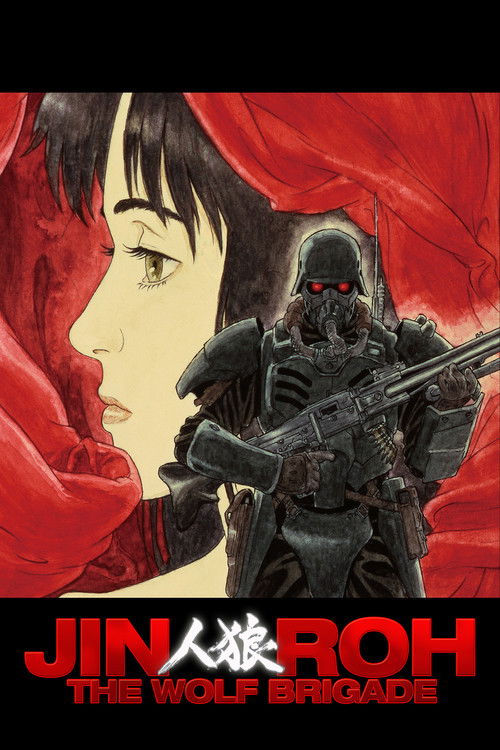
In an alternate 1990s Japan, a dystopian police state struggles to maintain order after reunification with a rebellious territory. Kazuki Fuse, a member of the elite special forces unit known as the Wolf Brigade, is haunted by a traumatic incident: he witnesses a young girl's suicide bombing and fails to prevent it. Forced into retraining, Fuse becomes a pawn in a bitter power struggle between rival police factions, all while forming a strange bond with the victim's sister. Directed by Hiroyuki Okiura, this 1999 animated thriller blends political intrigue with psychological drama, featuring voice performances from Yoshikatsu Fujiki and Sumi Mutoh. Produced by Production I.G and Bandai Visual, the film earned modest box office returns but has since gained a cult following for its mature themes and meticulous animation.
The film is the third installment in Mamoru Oshii's Kerberos Saga, a multimedia franchise that also includes manga and live-action works. Oshii, known for Ghost in the Shell, wrote the screenplay, with Satoshi Kon contributing. The animation is hand-drawn with extraordinary attention to detail, from the rain-soaked streets of Tokyo to the heavy powered armor of the Wolf Brigade. Composer Hajime Mizoguchi's haunting orchestral score amplifies the melancholic tone, making the film a sensory experience that lingers long after the credits roll.
Stream
Availability and pricing can change. Confirm on the provider's site before purchasing.
Set in an alternate-history Japan, the story unfolds in a dystopian 1990s where the nation has been reunified with a rebellious territory following a period of civil unrest. Kazuki Fuse is a member of the Wolf Brigade, an elite paramilitary unit of the Capital Police known for their black armored suits and ruthless efficiency. The film opens with the suppression of the Sect, a radical anti-government resistance group that uses young couriers to carry explosives through the labyrinthine sewer systems beneath Tokyo.
During a routine operation, Fuse corners a teenage girl, Kei Amamiya, who is carrying a bomb in a suitcase. Despite having her at gunpoint and being ordered to neutralize her, Fuse hesitates. That moment of human weakness proves catastrophic: the girl detonates the bomb, killing herself in a suicide explosion that leaves Fuse psychologically shattered. The incident becomes a public relations disaster, and Fuse is removed from active duty and relegated to a desk job while undergoing psychological evaluation.
The central conflict emerges from a bitter internal power struggle within the Capital Police. Two rival factions vie for control: the moderate Public Security Bureau and the hardline elements represented by the Wolf Brigade's leadership. Fuse becomes a pawn in this political chess game, manipulated by both sides. His former superior, Atsushi Henmi, and the enigmatic intelligence officer Bunmei Muroto each try to use Fuse's trauma for their own purposes, hoping to expose or protect corruption within the organization.
While struggling with his psychological wounds, Fuse meets Kei's older sister, also named Kei, a university student who bears a striking resemblance to the deceased girl. The two form an uneasy, melancholic bond. Kei is aware of Fuse's role in her sister's death, yet she continues to meet with him, creating a deeply ambiguous and emotionally charged relationship. Their encounters are marked by quiet conversations in cafes and city streets, where Fuse finds a strange solace and Kei seems to be probing him for reasons she keeps hidden.
As Fuse's relationship with Kei deepens, he becomes increasingly isolated from his former comrades and the rigid structure of the Capital Police. He is caught between his growing humanity and the dehumanizing demands of his institutional role. The Wolf Brigade's commander, Hajime Handa, views Fuse's emotional vulnerability as a liability, while political machinations intensify. Rumors circulate about the Sect's activities, and a planned major operation is in the works, one that Fuse's superiors intend to use him in regardless of his psychological state.
The film's atmosphere is one of constant tension, with heavy rain, gray concrete architecture, and the ever-present threat of violence defining the visual landscape. Fuse's story is interwoven with themes from the Brothers Grimm fairy tale 'Little Red Riding Hood,' with the Wolf Brigade serving as the predatory wolves and the girl couriers as the innocent victims. The narrative thrust involves Fuse's gradual awakening to the truth about the power structures that control his life, the manipulation he has endured, and the impossible choices that lie ahead. As the political factions close in and Kei's true motivations begin to surface, Fuse is forced toward a confrontation that will test whether he remains a wolf or reclaims his humanity.
Jin-Roh. The Wolf Brigade (1999) ORIGINAL TRAILER [HD 1080p]
Critical Consensus
Jin-Roh: The Wolf Brigade is a mature, politically sophisticated anime that transcends genre expectations. Critics praise its meticulous animation, atmospheric direction, and unflinching exploration of institutional violence and human psychology. The film's deliberate pacing and somber tone may not appeal to all viewers, but it has earned a devoted cult following for its artistic ambition and thematic depth.
“A dark, uncompromising meditation on what it means to be human in a world governed by wolves. The animation is breathtaking, the story haunting.”
Freddy Beans
Ain't It Cool News
“Jin-Roh is a rare anime that treats its audience with intelligence, offering a bleak and thought-provoking look at state power and individual conscience.”
Anime UK News
Anime UK News
“A cult classic from the director of Ghost in the Shell, restored in 4K for its 25th anniversary. Its themes of political manipulation remain strikingly relevant.”
Polygon Staff
Polygon
Yoshikatsu Fujiki
Kazuki Fuse (voice)
Sumi Mutoh
Kei Amamiya (voice)
Hiroyuki Kinoshita
Atsushi Henmi (voice)
Director
Hiroyuki Okiura
Writers
Mamoru Oshii, Satoshi Kon
Composer
Hajime Mizoguchi
Cinematographer
Hisao Shirai
Producers
Hidekazu Terakawa, Atsushi Sugita
Join the community
fans discussing