Jin Air
 South Korea
"Fly with a Smile"
About
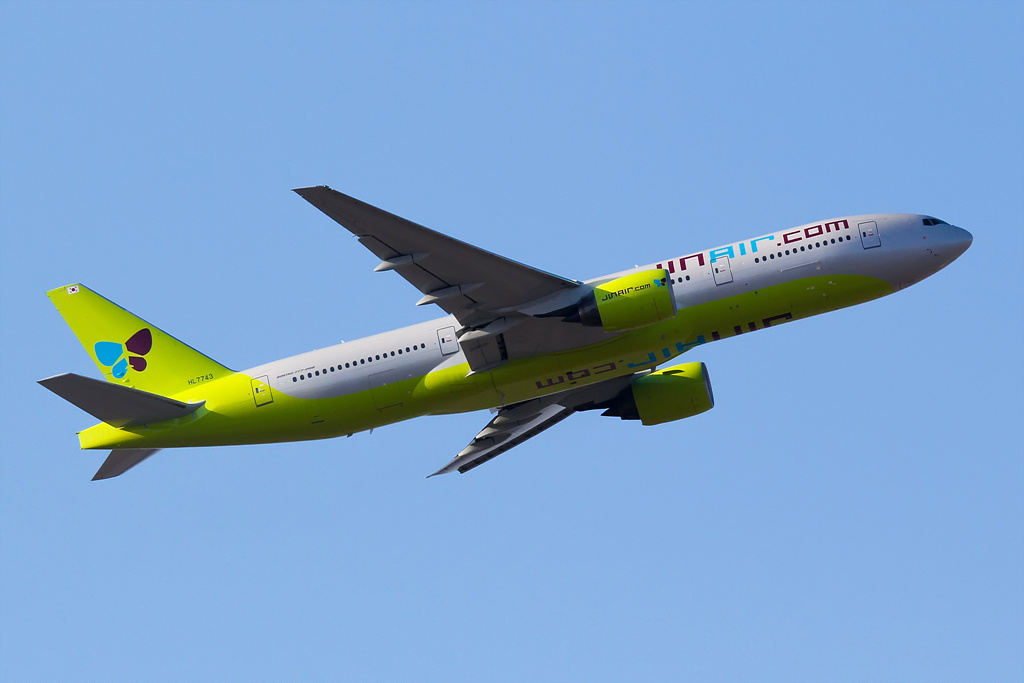
Jin Air Co., Ltd. (Korean: 진에어; RR: Jin E-eo) is a South Korean low-cost carrier that launched operations in July 2008 with a single Boeing 737-800, initially flying domestic routes between Seoul and Jeju and Seoul and Busan. It was established as a wholly owned subsidiary of Korean Air, part of the Hanjin Group, to compete in the country's rapidly growing budget airline market. The airline made history in December 2015 by becoming Korea's first widebody low-cost carrier, deploying a Boeing 777-200ER on the long-haul route from Incheon to Honolulu. Cargo services began in November 2013, and by 2018 the network spanned six domestic cities and 26 international destinations across Japan, China, Southeast Asia, Oceania, and the United States.
As of 2018, Jin Air carried 3.5 million domestic and 5.4 million international passengers, holding an 11% domestic market share and a 6% international share, making it South Korea's second-largest low-cost carrier after Jeju Air. Its fleet of Boeing 737-800s, 737-900s, and 777-200ERs allows it to serve both short-haul regional routes and longer destinations like Guam, Saipan, and Honolulu. The airline operates a classic unbundled LCC model: a single Economy class with add-on charges for baggage, meals, and seat selection. In-flight services include a buy-on-board menu called Jin Air Snack and a loyalty program, Jin Air Club, which offers mileage accrual and redemption. The brand's cheerful identity is reinforced by bright green and orange cabin crew uniforms and a tagline, 'Fly with a Smile,' targeting millennials and Gen Z through social media campaigns and influencer partnerships.
Jin Air has faced several controversies. In December 2018, a flight attendant forced a passenger to deplane for eating nuts purchased outside the aircraft, triggering public backlash reminiscent of Korean Air's 'Nut Rage' incident. That same year, Cho Hyun-min, a daughter of Hanjin Group's chairman and a former Jin Air executive, was investigated and later convicted for assaulting staff and smuggling luxury goods. In 2019, the airline was fined by South Korea's Ministry of Land, Infrastructure and Transport for operating aircraft with overdue maintenance checks and falsifying flight records, leading to a temporary ban on new routes. Labor disputes, including union strikes over wages and working conditions, have also occurred, particularly during the COVID-19 pandemic when the airline attempted layoffs. As of 2024, Jin Air is in the process of merging with Air Busan and Air Seoul under Korean Air's plan to consolidate its LCC subsidiaries into a single entity tentatively named Air Korea, a move approved by the Korea Fair Trade Commission in 2021.
Products & Sub-brands
Frequently Asked Questions
Who owns Jin Air?
Who is the CEO of Jin Air?
How much is Jin Air worth?
Jin Air vs Jeju Air: which is better?
Is Jin Air still in business?
Keywords
Company Info
- Founded
- 2008
- CEO
- Park Byung-ryul
- Headquarters
- Gangseo District, Seoul, South Korea
- Industry
- Aviation
- Parent Company
- Korean Air (Hanjin Group)
- Fleet Size
- Boeing 737-800, 737-900, 777-200ER
- Destinations
- 6 domestic, 26 international (as of 2018)
- Passengers (2018)
- 8.9 million (3.5M domestic, 5.4M international)
Official Website
www.jinair.com/
Join the community
fans discussing