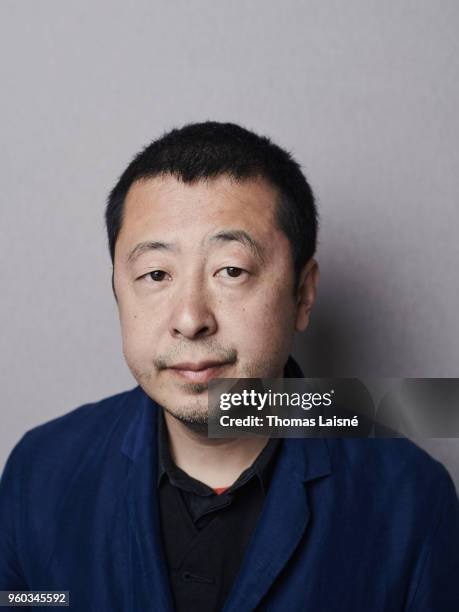
Jia Zhangke
 China
Chinafilm director•screenwriter•actor
Birthday
May 24, 1970
Birth Sign
Gemini
Birthplace
Fenyang, Shanxi Province, China
Age
56 years old
Height
5 ft 6 in (168 cm)
About
Jia Zhangke is a Chinese filmmaker widely regarded as a leading voice of the Sixth Generation directors. His work is known for its raw, socially conscious storytelling that captures the disorienting effects of China's rapid economic transformation on ordinary people. Jia's signature style includes long takes, non-professional actors, and a documentary-like realism, often focusing on marginalized lives. His early "Hometown Trilogy" established him as a major talent on the international festival circuit. His international breakthrough came with Still Life (2006), which won the Golden Lion at the Venice Film Festival. Other notable works include Mountains May Depart (2015), spanning 26 years of Chinese history, and Ash Is Purest White (2018), a love story that doubles as a chronicle of China's changes. His honors include the Leopard of Honour at Locarno and the Carrosse d'Or lifetime achievement award from the Directors' Fortnight. Across more than 20 films, Jia Zhangke has built a body of work that serves as a vital, critical record of modern China. He also founded the Pingyao International Film Festival in 2017 to nurture emerging directors. His documentary Swimming Out Till the Sea Turns Blue (2020) premiered at the Berlin International Film Festival. Jia's films often face government censorship but remain celebrated internationally. He continues to serve as director of the Pingyao International Film Festival as of 2026. Jia's work blends fiction with documentary elements, and he has experimented with animation, sci-fi, and wuxia genres in recent projects. He is considered one of the most important Chinese filmmakers of his generation, with a career spanning over two decades.
Early Life & Background
Jia Zhangke grew up in Fenyang, a county-level city in Shanxi Province, where his father worked as a local schoolteacher. The family had a small library, uncommon for the time and place, which fueled his early literary ambitions. He published a short story in Shanxi Literature while still in middle school and founded a poetry club in high school. Despite failing his university entrance exam due to poor mathematics performance, he was accepted as a member of the Shanxi Writers Association. His parents sent him to Taiyuan to attend art classes at Shanxi University to prepare for art school admissions, and he frequently watched movies at a "Highway Bureau Cinema" near the school. Jia's interest in film began in the early 1990s while studying art at Shanxi University in Taiyuan. A screening of Chen Kaige's Yellow Earth (1984) convinced him he wanted to become a director. He was admitted to the Beijing Film Academy in 1993 as a film theory major, gaining access to both Western and Eastern classics. While studying in Beijing, he returned to Fenyang and was struck by how drastically the city had changed, entire streets being torn down for a new China. "It was a time of immense pain," he later recalled. His student debut Xiao Wu (1997) was submitted to foreign festivals without realizing it needed official clearance, earning him the label of "underground director."
Career Growth
Jia's debut feature Xiao Wu (1997) won the Wolfgang Staudte Prize and the NETPAC Award at the Berlin International Film Festival, immediately establishing him as a filmmaker to watch. His second feature, Platform (2000), set in the 1980s after the Cultural Revolution, won the Golden Montgolfiere at the Festival des 3 Continents in Nantes. Unknown Pleasures (2002) completed his "Hometown Trilogy" and competed at Cannes. In 2004, The World became his first film approved by the Chinese government for domestic release, marking the end of his underground period. Two years later, Still Life won the Golden Lion at Venice, interweaving two stories set against the Three Gorges Dam project. He continued to explore social change through documentaries like Dong (2006), Useless (2007), and 24 City (2008). In 2010, he released I Wish I Knew, a documentary recounting the history of Shanghai. In 2013, A Touch of Sin won the Best Screenplay Award at Cannes, a quartet inspired by real violent incidents. Mountains May Depart (2015) spanned 26 years of Chinese history and was set partly in Australia. Ash Is Purest White (2018), starring his wife Zhao Tao, premiered at Cannes. In 2017, Jia founded the Pingyao International Film Festival in Shanxi Province to support emerging directors. His documentary Swimming Out Till the Sea Turns Blue (2020) gave voice to three Chinese writers reflecting on their country's changes. Jia also received the Fukuoka Prize for his contributions to Asian culture.
Career Timeline
Public Image & Style
Jia Zhangke is known as a leading voice of China's Sixth Generation directors, known for raw, socially conscious storytelling with documentary-like realism. His signature style includes long takes, non-professional actors, and a focus on marginalized lives. The media portrays him as an essential, uncompromising filmmaker whose work often falls foul of government censorship. No official fandom name or fan-culture rituals have been documented. Jia is frequently interviewed by Michael Berry, and his quotes often reflect on Chinese society, such as: "Before, in Chinese society, being selfless was a way of becoming self. Now it's all about money."
Fame & Fandom (iFAMOUS Rankings)
Jia Zhangke stands as a towering figure in global cinema, recognized not for pop-culture ubiquity but for his profound influence on art-house filmmaking. As of August 2026, the iFANN Global Fame Engine has evaluated his standing, yet he currently holds no placement in the published Global Top 1,000 or any scope-specific rankings. This absence of a numeric rank reflects his status as a specialized auteur rather than a mass-market celebrity; his fame is measured in critical acclaim and festival prestige rather than viral metrics. His audience consists of cinephiles, film students, and critics who engage with his work through academic study and attendance at events like the Pingyao International Film Festival. Unlike idol cultures that mobilize fan clubs for chart pushes or birthday campaigns, Jia's supporters form a dispersed community united by intellectual appreciation of his raw, socially conscious storytelling. The relationship between the director and his viewers is defined by a shared reverence for his documentary-like realism and his unflinching gaze on China's rapid transformation. While there is no formal fandom name documented in iFANN data, the loyalty of his followers is evident in the enduring discussions surrounding his career milestones. From the early days of his Hometown Trilogy to his recent ventures into AI filmmaking, Jia remains a subject of deep analysis rather than casual consumption. His legacy is built on films like Still Life and Ash Is Purest White, which have secured his place in cinema history without the need for traditional celebrity worship.
Interesting Facts and Legends
Jia Zhangke's journey began with Xiao Wu, his graduation project at the Beijing Film Academy, before he even published a short story in Shanxi Literature during middle school. Despite failing his university entrance exam due to poor mathematics, he was accepted into the Shanxi Writers Association after founding a poetry club in high school. His early films were produced underground without government approval until 2004, often featuring non-professional actors and local dialects. The documentary Jia Zhangke, a Guy from Fenyang, directed by Walter Salles, offers a rare glimpse into his hometown. A central legend among film enthusiasts is his long-standing partnership with actress Zhao Tao, spanning over two decades from Platform to Ash Is Purest White, often described as a cinematic pairing of Bard and Beatrice. Another canonical story involves his transition from low-budget digital video to internationally funded masterpieces like Still Life, which won the Golden Lion at Venice. In recent years, lore has grown around his shift into business with Unknown Pleasures Pictures and his exploration of AI tools in filmmaking, marking him as a chronicler who evolves alongside the technology he documents.
Notable Quotes
“My expression, my view on history, my view on the truth must be independent, but I tell myself not to get marginalized, because being marginalized means you can't do anything.”
“Before, in Chinese society, being selfless was a way of becoming self. The idea that you were sacrificing yourself for the greater social good gave one a sense of meaning and purpose. Now it's all about money.”
“It was a time of immense pain.”
Family & Personal Life
Jia was born into a working-class family in Fenyang on May 24, 1970. His father was a local schoolteacher. The family had a small library, which was uncommon for the time. His maternal cousin Sanming Han has acted in several of his films. Jia married actress Zhao Tao in 2012; she has starred in many of his films. He was previously married to Zhu Jiong from 1999 to 2006. He has no publicly confirmed children from either marriage.
Notable Connections
Jia Zhangke is closely associated with his wife, actress Zhao Tao, who has starred in many of his films including Still Life, Ash Is Purest White, and Mountains May Depart. He has collaborated with fellow Sixth Generation filmmakers like Wang Xiaoshuai and Diao Yinan. His maternal cousin Sanming Han appears as an actor in several of his works. Director Walter Salles made a documentary about him titled Jia Zhangke, a Guy from Fenyang.
Relationships & Dating History
Jia Zhangke married Zhu Jiong in 1999; the marriage ended in divorce in 2006. Zhu Jiong is not a public figure in the film industry. In 2012, Jia married actress Zhao Tao, who has been his frequent collaborator and muse, starring in many of his films including Still Life, Ash Is Purest White, and Mountains May Depart. As of 2026, Jia remains married to Zhao Tao. He has no publicly confirmed children from either marriage.
- MarriedZhu Jiong1999 - 2006Jia's first wife; marriage ended in divorce. Not a public figure.
- MarriedZhao Tao2012 - presentCurrentChinese actress and frequent collaborator; married since 2012.
Salary, Net Worth In 2026
$10 Million
iFANN Editorial Team estimate
Per iFANN's editorial analysis, Jia Zhangke's net worth is estimated at $10 Million as of 2026. His financial success stems primarily from his work as a film director, screenwriter, and producer, alongside his pivotal role as the founder and director of the Pingyao International Film Festival. He owns Shanghai Warm Stream Film Company, which serves as the production hub for his projects. Although his films typically operate on modest budgets, they achieve significant returns through international distribution and festival awards, particularly following the breakthrough success of Still Life. Additional revenue streams include earnings from documentary projects and screenings at major international venues. His wealth has grown steadily since his emergence in the early 2000s, reflecting the sustained demand for his unique perspective on social change and human resilience.
Awards Won (8)
Jia Zhangke has won major international awards including the Golden Lion at the Venice Film Festival for Still Life (2006) and the Best Screenplay Award at Cannes for A Touch of Sin (2013). His debut Xiao Wu earned the Wolfgang Staudte Prize and NETPAC Award at Berlin. Platform won the Golden Montgolfiere at Nantes. He has also received lifetime achievement honors: the Leopard of Honour at Locarno and the Carrosse d'Or from the Directors' Fortnight.
2006 · Best Film
Still Life
2013 · Best Screenplay
A Touch of Sin
Known For
Still Life
2006 · Director, Writer
A Touch of Sin
2013 · Director, Writer
Platform
2000 · Director, Writer
Xiao Wu
1997 · Director, Writer
Ash Is Purest White
2018 · Director, Writer
Keywords
Sources
Quick Facts
- Profession
- film director, screenwriter, actor
- Born
- May 24, 1970
- Birthplace
- Fenyang, Shanxi Province, China
- Gender
- Male
- Spouse
- Zhao Tao
- Birth Sign
- Gemini
Personal Details
- Full Name
- Jia Zhangke
- Height
- 5 ft 6 in (168 cm)
- Spouse
- Zhao Tao
- Education
- Beijing Film Academy
Filmography
20
Total
16
Film
0
TV
Frequently Asked Questions
How old is Jia Zhangke?
What is Jia Zhangke's net worth in 2026?
Is Jia Zhangke still married to Zhao Tao?
What is Jia Zhangke's most famous movie?
Does Jia Zhangke have children?
Similar People
Join the community
fans discussing