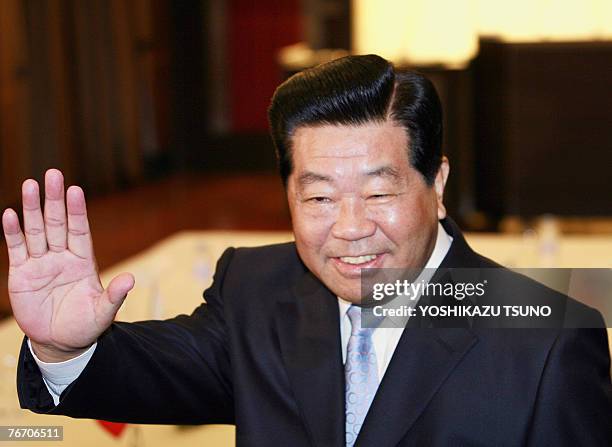
Jia Qinglin
 China
ChinaBirthday
March 13, 1940
Birth Sign
Pisces
Birthplace
Botou, Hebei, China
Age
86 years old
About
Jia Qinglin is a retired senior Chinese politician who served as a member of the Politburo Standing Committee of the Chinese Communist Party from 2002 to 2012, making him one of the most powerful figures in the country during that decade. He also held the position of Chairman of the National Committee of the Chinese People's Political Consultative Conference from 2003 to 2013, a role that placed him at the head of China's top political advisory body.
Born in Hebei province, Jia rose through the ranks of the party apparatus with a background in engineering, eventually becoming the mayor of Beijing in the mid-1990s. His career was closely tied to the era of rapid economic expansion, and he was part of the leadership that oversaw China's growing global influence. As of 2026, he is retired from public life and resides in Beijing.
Early Life & Background
Jia Qinglin was born on March 13, 1940, in Botou, a county-level city in Hebei Province, in northern China. He grew up during a period of profound national upheaval, including the Second Sino-Japanese War and the Chinese Civil War, which shaped the political landscape of his youth. He joined the Chinese Communist Party in December 1959, at the age of 19, reflecting his early commitment to the party's cause.
After completing his secondary education, Jia studied at the Hebei University of Technology, where he trained as an engineer. This technical background would later distinguish him in a political sphere often dominated by cadres with humanities or administrative training. He began working in October 1962, initially in industrial and engineering roles, which were considered essential to China's modernization efforts under Mao Zedong. His work in heavy industry and machinery provided him with practical experience that would prove valuable in his later administrative positions.
For over two decades, Jia worked in engineering and industrial management, primarily in the northern provinces, before his political career took off in the mid-1980s. His transfer to Fujian province in 1985 marked a turning point, as it moved him from technical work into party leadership. There, he became involved in economic policy and regional development, gaining a reputation as a capable administrator during a period of market-oriented reforms. The connections he built in Fujian, particularly with senior party figures, laid the groundwork for his rapid ascent in the following years.
Career Growth
Jia Qinglin's breakthrough came in 1985 when he was appointed to a senior party position in Fujian province, a coastal region at the forefront of China's economic reforms. He worked there for over a decade, rising to become the province's party secretary, a role that gave him significant authority over one of China's most dynamic economic zones. In 1996, he was transferred to Beijing to serve as the city's mayor, a high-visibility post that brought him into the national spotlight.
His political fortunes were closely linked to Jiang Zemin, then the General Secretary of the Chinese Communist Party. With Jiang's backing, Jia was promoted to the Politburo in 1997, and five years later, in 2002, he entered the Politburo Standing Committee, the party's innermost circle of power. That same year, he was also appointed to lead the Chinese People's Political Consultative Conference (CPPCC), a key advisory body that he would chair for a decade. In February 2004, he was formally elected as the head of the CPPCC, cementing his role as a senior statesman.
During his tenure, Jia oversaw the CPPCC's work on issues ranging from ethnic relations to economic policy. He met with Taiwan opposition leader Lien Chan in Beijing in April 2005, a significant cross-strait engagement. In September 2009, he addressed the third committee of the Central Committee for the Reunification of the Motherland, reaffirming the party's stance on Taiwan. He delivered the work report of the CPPCC Standing Committee in March 2013, shortly before his formal retirement. After leaving office, he largely withdrew from public view, though his son-in-law was named in the Panama Papers in 2016, drawing attention to his family's financial dealings.
Career Timeline
Public Image & Style
Jia Qinglin's public image is that of a disciplined and capable party insider, known for his technical expertise and administrative efficiency. In the eyes of the international community, he was often seen as a representative of the pragmatic wing of the Chinese Communist Party, focused on economic development and stability.
Within China, his image was shaped by his roles in Beijing and the CPPCC, where he was viewed as a steady hand who could manage complex political relationships. He was not known for flamboyant rhetoric or personal charisma, but rather for his ability to work behind the scenes. His close association with Jiang Zemin linked him to a particular faction within the party, and his retirement in 2013 marked the end of an era for that group.
Media coverage of Jia has been largely respectful, focusing on his official duties rather than his personal life. The Panama Papers revelation in 2016 was an exception, briefly putting his family under scrutiny. Since then, he has faded from public view, and there is little ongoing discussion about him in Chinese media.
Fame & Fandom (iFAMOUS Rankings)
Jia Qinglin's global footprint is that of a political heavyweight of the 2000s, yet in the iFANN Global Fame Engine's August 2026 evaluation, he holds no placement in the published rankings, neither in the Global Top 1,000 nor in any Top-100 scope list. This is a straightforward reflection of his status: a retired senior statesman whose renown is tied to institutional roles rather than enduring global celebrity. His name surfaces in historical and political contexts, not in entertainment or cultural headlines.
As for fandom, there is no documented fandom name associated with Jia Qinglin. His audience is not a fanbase in the conventional sense; rather, he commands respect among political observers and those who follow Chinese governance. There are no fan campaigns, no birthday billboards, no hashtag movements, his public persona is defined by his official duties, not by personal devotion. The absence of a formal fandom is consistent with his career as a disciplined party insider, whose legacy is measured in policy and protocol, not in cultural phenomena.
Interesting Facts and Legends
Jia Qinglin's engineering background shaped his approach to governance, particularly in infrastructure and development. He is of Han ethnicity, and his native Botou is known for its foundry industry, which likely influenced his early interest in heavy industry. Despite his high rank, little is known about his personal hobbies or private life, as Chinese officials often keep such matters out of the public eye. His career included a long association with Fujian province, where he spent over a decade before moving to Beijing. He also played a role in the early preparations for the 2008 Beijing Olympics during his time as mayor, though his direct involvement was limited.
Among the notable moments in his political career, the 2005 meeting with Taiwan opposition leader Lien Chan stands out, a handshake that marked a significant step in cross-strait relations. Another documented episode involves the 2016 Panama Papers, where his son-in-law was named, sparking online censorship discussions. These events are political milestones, not pop culture lore, but they add layers to his public record.
Family & Personal Life
Details about Jia Qinglin's family are scarce, a common situation for senior Chinese officials who tend to guard their privacy. He is known to have a daughter, whose husband, Li Yufei, was named in the Panama Papers in 2016, according to a report by the South China Morning Post. This brought unwanted international attention to the family's financial affairs. Jia himself has not publicly commented on the matter.
His family is believed to reside in Beijing, where Jia has lived since his appointment as mayor in 1996. There is no public information about his spouse or other children. As a retired official, he likely maintains a low-profile lifestyle, typical of former Chinese leaders.
Notable Connections
Jia Qinglin is associated with the Chinese Communist Party, where he held senior positions. He was a close ally of former General Secretary Jiang Zemin, and his career was intertwined with the political dynamics of the 1990s and 2000s. He also worked with Lien Chan, the former leader of Taiwan's Kuomintang, during a notable cross-strait meeting in 2005.
Relationships & Dating History
There is no public information about Jia Qinglin's romantic relationships or marital status. As a senior Chinese official, his personal life was kept out of the public eye, and no details about his spouse or dating history have been reported. He is believed to have been married, given that he has a daughter, but the identity of his wife is not known. As of 2026, his relationship status remains private and unconfirmed.
Salary, Net Worth In 2026
As a retired Chinese politician, Jia Qinglin's personal net worth is not publicly documented, and reliable estimates are unavailable. Chinese officials are not required to disclose their finances, and Jia has maintained a private profile since leaving office. Any figures circulating online are speculative and not.
During his career, Jia held high-ranking positions that would have provided a comfortable government salary and associated benefits, but the specifics are unknown. His family's involvement in business, as hinted by the Panama Papers, suggests some private wealth, but no concrete numbers exist.
Awards & Accolades
Known For
Politburo Standing Committee
2002-2012 · Member
Chinese People's Political Consultative Conference
2003-2013 · Chairman
Mayor of Beijing
1996-1997 · Mayor
Keywords
Sources
Quick Facts
- Profession
- politician
- Born
- March 13, 1940
- Birthplace
- Botou, Hebei, China
- Gender
- Male
- Birth Sign
- Pisces
- Ethnicity
- Han
- Education
- Hebei University of Technology
Personal Details
- Education
- Hebei University of Technology
Frequently Asked Questions
Who is Jia Qinglin?
What was Jia Qinglin's role in the Chinese government?
When did Jia Qinglin retire?
What was Jia Qinglin's background?
Is Jia Qinglin still active in politics?
Join the community
fans discussing