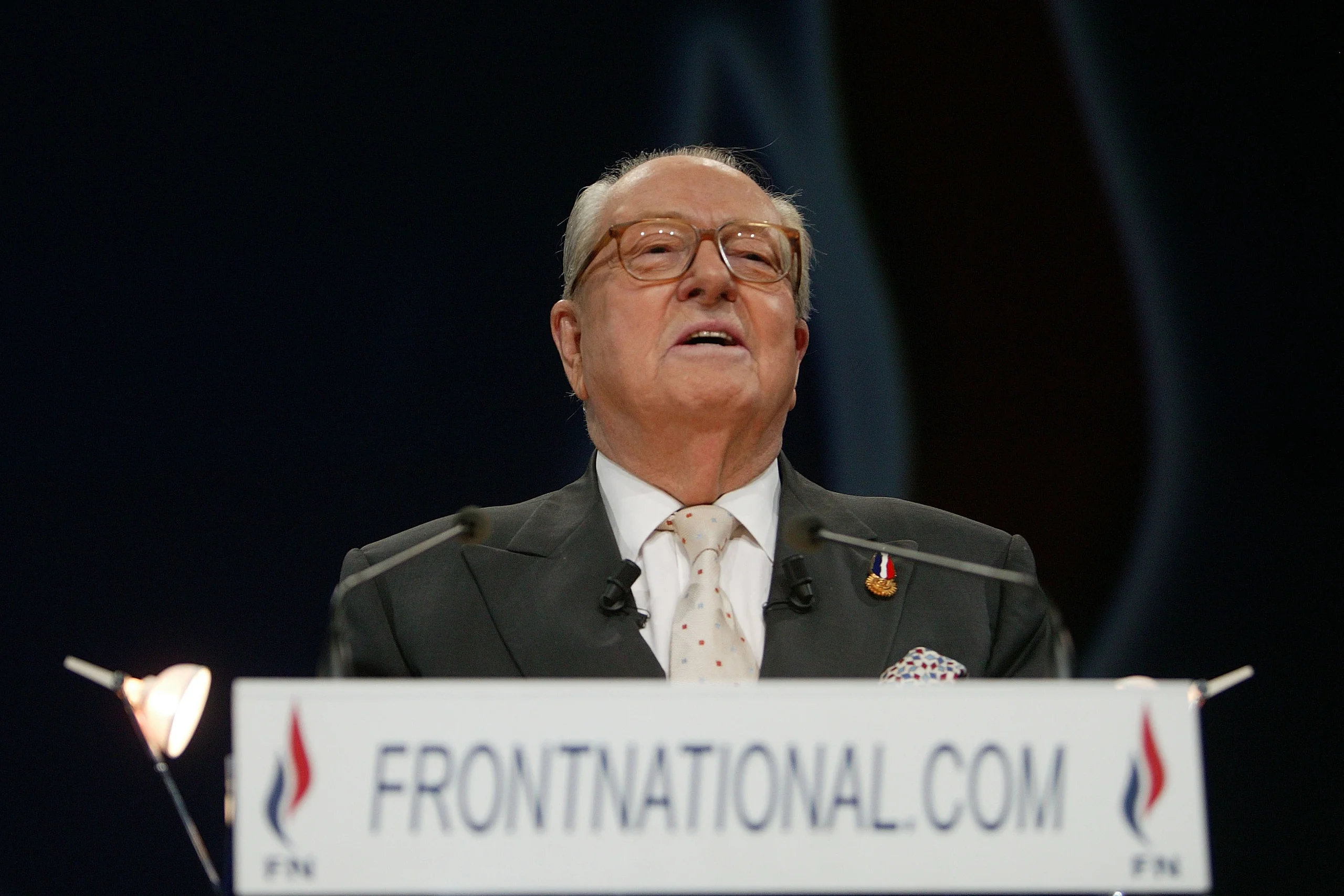
Jean-Marie Le Pen
 France
Also known as: Jean Louis Marie Le Pen
Birthday
June 20, 1928
Birth Sign
Gemini
Birthplace
La Trinité-sur-Mer, France
Age
Died at 96
Height
5 ft 9 in (175 cm)
About
Jean-Marie Le Pen, born Jean Louis Marie Le Pen on June 20, 1928, in the small Breton village of La Trinité-sur-Mer, France, was a lawyer and politician who founded the far-right National Front (now the National Rally) party in 1972. He served as the party's president from its inception until 2011 and remained honorary president until his expulsion in 2015. Le Pen died on January 7, 2025, at the age of 96, in Garches, a suburb of Paris. His death marked the end of an era for French far-right politics, leaving behind a legacy defined by the "lepénisation of minds"—a term describing how his nationalist rhetoric seeped into mainstream political discourse.
Le Pen's rise in the 1980s was so influential that commentators coined the term "lepénisation of minds" to describe how his ideas seeped into mainstream politics. He ran for president five times, most famously in 2002 when he shocked the nation by advancing to the second round against incumbent Jacques Chirac. That event became a cultural touchstone, with "April 21" entering the French lexicon as shorthand for political upheaval. Beyond his presidential bids, Le Pen served three terms in the National Assembly and was a member of the European Parliament from 1984 to 2019.
Throughout his long career, Le Pen faced numerous convictions for downplaying the Holocaust and incitement to discrimination. His inflammatory statements eventually led to his expulsion from the National Front in 2015 by his daughter, Marine Le Pen, who sought to distance the party from his extremist image. Despite the fallout, Le Pen remained a significant figure until his death, leaving behind a complex legacy that continues to shape French political discourse.
Early Life & Background
Born in the small Breton village of La Trinité-sur-Mer, Jean-Marie Le Pen grew up in a working-class family where his father worked as a fisherman before becoming a small businessman. The coastal environment of Brittany instilled in him an early interest in military service and nationalism. After completing his secondary education, he joined the French Foreign Legion in 1948. He trained as a paratrooper and saw combat in two major conflicts: the First Indochina War (1946–1954) and the Algerian War (1954–1962). During these campaigns, he was wounded and decorated with the Croix de Guerre, honors that deeply influenced his worldview and later political stance on national sovereignty.
Following his military service, Le Pen returned to civilian life to study law at the University of Paris, where he earned a doctorate. In the 1960s, he practiced as a lawyer, representing clients in cases involving colonial issues and right-wing causes. Before entering formal politics, he was active in various right-wing organizations and attempted to run for office in local elections. However, he faced initial rejection from the political establishment due to his radical views. His first major breakthrough came in 1972 when he co-founded the National Front, a coalition of various nationalist groups that had previously been fragmented. This move marked the transition from a military veteran and lawyer to a central figure in French far-right politics.
Career Growth
Le Pen's political career spanned over five decades, characterized by consistent opposition to immigration, the European Union, and multiculturalism. In 1972, he founded the National Front and became its first leader, serving until 2011. He was elected to the European Parliament in 1984, a position he held continuously until 2019, making him one of the longest-serving members. His first presidential run occurred in 1988, where he finished fifth with 14.4% of the vote, bringing the far right into the national spotlight.
A pivotal moment arrived in 1993 when he was elected to the National Assembly, serving multiple terms. However, his career was also marked by legal battles; in 1998, he was convicted of incitement to racial hatred for remarks about Jews, a conviction upheld on appeal. The year 2002 brought a shocking result in the presidential election. Le Pen advanced to the runoff against incumbent Jacques Chirac, finishing second in the first round with 16.86% of the vote. He lost the runoff decisively, receiving only 17.79% of the vote compared to Chirac's 82.21%. He ran again in 2007 and 2012 but finished third both times.
In 2011, Le Pen resigned as president of the National Front, handing leadership to his daughter, Marine Le Pen. Tensions over her strategy to "de-demonize" the party led to his expulsion in 2015. He continued to support her campaigns but remained outside the party structure. In 2019, he retired from the European Parliament after 35 years of service, ending a long tenure that had seen him become a fixture in French and European politics.
Career Timeline
Public Image & Style
Le Pen stood at approximately 1.75 meters (5 feet 9 inches). He was known for his distinctive appearance, featuring thick white hair and a prominent mustache, often wearing suits and ties. Supporters viewed him as a fearless truth-teller who challenged the political establishment, while opponents saw him as a dangerous extremist. His combative rhetorical style and provocative language sparked heated debates, frequently landing him in legal trouble. Despite the controversy, he maintained a loyal base of supporters who admired his defiance of mainstream norms.
Fame & Fandom (iFAMOUS Rankings)
Jean-Marie Le Pen commanded a polarizing legacy that extended far beyond the ballot box, yet his audience consisted of political adherents rather than a structured fandom. Unlike entertainers who cultivate organized fanbases with rituals, streaming campaigns, or dedicated merchandise, Le Pen's supporters were defined by their alignment with his nationalist ideology and hardline rhetoric on immigration and European integration. No formal name exists for this collective; they remain simply his followers or the political movement he founded. While his daughter Marine Le Pen continues to navigate the political landscape, the search results confirm no specific fan projects, charity drives, or viral interactions bearing Jean-Marie Le Pen's name in the manner of celebrity culture. His mythos is built not on pop-culture phenomena but on historical controversies and legal battles, particularly regarding his Holocaust denial remarks which cemented his reputation as a rabble-rouser. Despite the absence of a traditional fanbase, his influence on French political discourse was so profound that it spawned the term "lepénisation of minds." As the iFANN Global Fame Rankings measure global attention across media coverage, consumption signals, and digital engagement worldwide, his stature remains significant even in death. The data from September 2026 confirms his enduring presence in public consciousness, placing him as the 89th most famous person in France (holding steady from the previous cycle).
Interesting Facts and Legends
Before entering politics, Le Pen served as a paratrooper in the French Foreign Legion, fighting in both the First Indochina War and the Algerian War where he was wounded. His controversial remark describing Nazi gas chambers as "a detail of history" during a 1987 interview led to multiple convictions for Holocaust denial in France. Despite facing numerous legal challenges and fines, he continued to run for office, often using his trials as a platform to claim persecution by the establishment. The term "lepénisation of minds" was coined to describe his profound influence on shifting French political discourse toward the right on issues of identity and security. He was awarded the Légion d'honneur, though this was a point of contention given his later convictions.
Notable Quotes
“The gas chambers were a detail of history.”
“I am a patriot, and I love my country.”
“The National Front is not a party of the right, it is a party of the people.”
Family & Personal Life
Jean-Marie Le Pen was married twice. His first marriage was to Pierrette Lalanne from 1951 to 1960, with whom he had two sons: Jean-Christophe Le Pen (born 1952) and Yann Le Pen (born 1954). Both sons predeceased their father or were estranged; Yann died in 2007 under mysterious circumstances, and Jean-Christophe died in 2010. In 1961, he married Jany Bouvet, who remained his companion throughout his political career until his death in 2025. They had three daughters: Marine Le Pen (born 1968), Jeanne-Marie Le Pen (born 1970), and Marion Maréchal-Le Pen (born 1982). The family dynamic was complex, particularly between Jean-Marie and Marine, which contributed to his eventual expulsion from the party. Jany Le Pen survived her husband and remained a private figure, occasionally appearing at family events.
Notable Connections
Relationships & Dating History
Jean-Marie Le Pen was married twice. His first marriage was to Pierrette Lalanne from 1951 to 1960. They had two sons together: Jean-Christophe Le Pen and Yann Le Pen. The marriage ended in divorce after nine years. Both sons predeceased their father or were estranged; Yann died in 2007 under mysterious circumstances, and Jean-Christophe died in 2010. In 1961, Le Pen married Jany Bouvet. She was his constant companion throughout his political career. They had three daughters: Marine Le Pen, Marion Maréchal-Le Pen, and Jeanne-Marie Le Pen. The family dynamic was complex, particularly between Jean-Marie and Marine, leading to his expulsion from the National Front in 2015. Jany Le Pen survived her husband and remained a private figure. At the time of his death in 2025, he was widowed.
- DivorcedPierrette Lalanne1951 - 1960Mother of Jean-Christophe and Yann Le Pen.
- WidowedJany Le Pen1961 - 2025Mother of Marine, Marion, and Jeanne-Marie Le Pen.
Death & Aftermath
Died
January 7, 2025 (aged 96)
Death Place
Garches, France
Cause of Death
Natural causes due to old age
Jean-Marie Le Pen passed away on Tuesday, January 7, 2025, at his home in Garches, Hauts-de-Seine, at the age of 96. Reports from the time indicate he died of natural causes following a period of declining health, though no detailed medical report was released publicly. His final years were spent in relative retirement after stepping back from active party leadership in 2011. The announcement of his death sparked an immediate and sharp divide in public reaction across France.
Supporters hailed him as a visionary who challenged the political establishment and defended traditional French values, while critics condemned his long history of Holocaust denial and inflammatory remarks about immigrants and Muslims. Media coverage surged, with documentaries and biographies seeing increased viewership. The funeral was held privately, with specific details regarding the location and attendees kept confidential by the family, though it is believed to have taken place in western Paris or his hometown of La Trinité-sur-Mer. No major foundations or posthumous awards were immediately established in his name.
The National Rally party, now led by Jordan Bardella following Marine Le Pen's shift in focus, issued a statement acknowledging his role as the party's founder while reiterating their commitment to a more moderate path. The family has not disclosed significant estate disputes, leaving the handling of his assets largely private. His legacy remains a subject of intense historical debate, defined by the term "lepénisation of minds" which describes how his nationalist rhetoric seeped into mainstream political discourse.
Net Worth (Estate Value)
$1.3 Million
iFANN Editorial Team estimate
Specific net worth figures for Jean-Marie Le Pen are not consistently reported by financial outlets like Forbes or Celebrity Net Worth, as he was a politician rather than a celebrity entrepreneur. Estimates vary based on property holdings and political salaries. Some sources suggest a net worth of approximately €1 million to €2 million, derived from his long tenure in the European Parliament and National Assembly, along with real estate holdings in Brittany and Paris. Other analyses indicate a lower figure, around €500,000, citing his reliance on state pensions and the lack of major commercial ventures. The iFANN Editorial Team's analysis of his earnings, ventures and assets points to roughly $1.3 million USD as of 2026, primarily consisting of real estate and pension benefits. There are no significant business ventures or endorsement deals contributing to his wealth. Following his death, the estate value is estimated to be similar, managed by his surviving spouse and children.
Awards & Accolades
View 1 records, honours and achievementsKnown For
National Front
1972 · Founder
Presidential Election 2002
2002 · Candidate
European Parliament
1984 · Member
Keywords
Sources
Quick Facts
- Profession
- politician, lawyer
- Born
- June 20, 1928
- Birthplace
- La Trinité-sur-Mer
- Died
- January 7, 2025
- Death Place
- Garches
- Gender
- Male
- Spouse
- Pierrette Lalanne, Jany Le Pen
- Birth Sign
- Gemini
Personal Details
- Full Name
- Jean Louis Marie Le Pen
- Height
- 5 ft 9 in (175 cm)
- Spouse
- Pierrette Lalanne, Jany Le Pen
- Children
- Marine Le Pen, Jean-Christophe Le Pen, Yann Le Pen, Marion Maréchal-Le Pen, Jeanne-Marie Le Pen
- Education
- University of Paris (Doctorate in Law)
Frequently Asked Questions
Who was Jean-Marie Le Pen?
When did Jean-Marie Le Pen die?
What was the "lepénisation of minds"?
Why was Jean-Marie Le Pen expelled from the National Front?
Did Jean-Marie Le Pen ever win a presidential election?
Similar People

Join the community
fans discussing