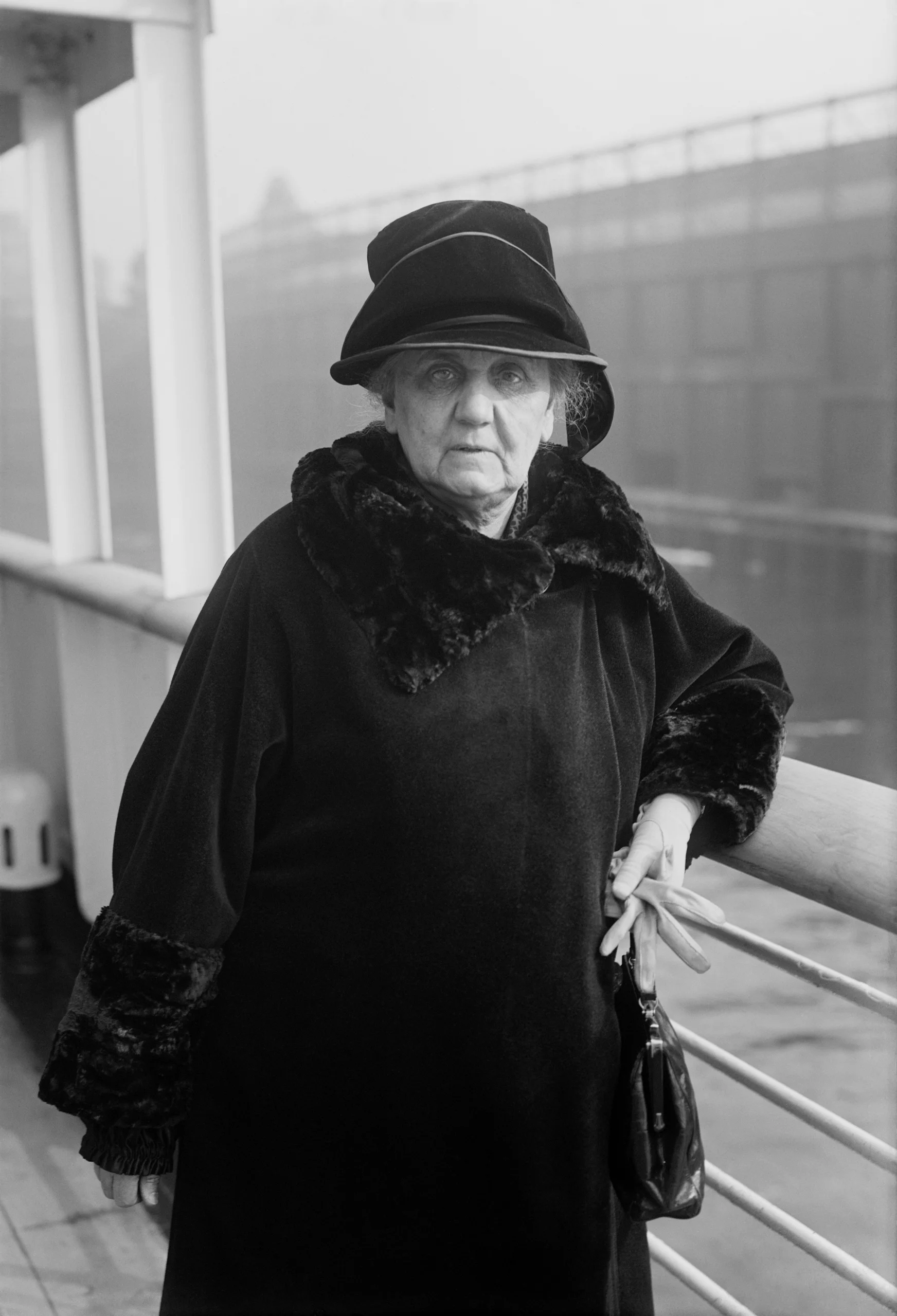
Jane Addams
 United States
Social reformer•settlement-house pioneer•sociologist•writer and peace activist
Also known as: Saint Jane, Laura Jane Addams
Birthday
September 6, 1860
Birth Sign
Virgo
Birthplace
Cedarville, Illinois, USA
Age
Died at 74
About
Jane Addams was an American social reformer, sociologist, writer and peace activist. She is best known as the co-founder of Hull House, the Chicago settlement house that became the model for a movement, and as the first American woman to win the Nobel Peace Prize, which she received in 1931, shared with Nicholas Murray Butler.
She was, in her lifetime, probably the most famous woman in the United States. Hull House grew from a single rundown mansion on South Halsted Street into a 13-building complex with a gymnasium, a theater, a coffee house, an art gallery and a school of social work. Addams published 12 books and more than 500 articles and speeches, helped found the Women's International League for Peace and Freedom and the American Civil Liberties Union, and campaigned for women's suffrage, child labor laws and juvenile courts.
Her reputation has two faces. During World War I, when she chaired the Woman's Peace Party and presided over the International Congress of Women at The Hague, newspapers called her a traitor and worse. Before and after, they called her Saint Jane. Both labels missed the point. She was a working reformer who spent 46 years on the same street, taking notes on what she saw and turning the notes into arguments.
Early Life & Background
She was born Laura Jane Addams on September 6, 1860, in Cedarville, Illinois, the eighth of nine children. Her father, John Huy Addams, was a miller, banker and state senator, a friend of Abraham Lincoln and a committed abolitionist. Her mother, Sarah Weber Addams, died when Jane was two. She was raised by her father and older sisters, and she wrote about that loss for the rest of her life. She was a sickly child, bookish, with a spinal curvature that bothered her into adulthood.
Rockford Female Seminary admitted her in 1877, and she graduated in 1881 as valedictorian, part of the first generation of American women to go to college at all. Her father died suddenly that same summer. She enrolled at the Woman's Medical College of Pennsylvania and lasted about a year and a half before illness and depression pulled her out.
What followed was nearly a decade she later called "the snare of preparation." Two long trips to Europe. A stretch of invalidism. Restlessness. She had a degree and no work that used it, which was the trap for educated women of her era.
The way out came in 1888, in East London. Addams visited Toynbee Hall, where university graduates lived among the poor and ran classes and clubs for their neighbors. She came home determined to build the same thing in Chicago. In 1889 she and her Rockford friend Ellen Gates Starr leased the dilapidated Charles J. Hull mansion at 800 South Halsted Street, on the Near West Side, and moved in.
Career Growth
Hull House opened in September 1889 with a kindergarten, reading groups and clubs. Immigrant families on the Near West Side came for the daycare and stayed for the English classes, the public baths, the art gallery, the gymnasium. By the 1900s the settlement occupied 13 buildings and was the most famous settlement house in America.
Addams turned the daily observations into research. Hull-House Maps and Papers (1893) mapped wages, rents and ethnic groups block by block, an early use of social statistics in American scholarship, and the same year Chicago appointed her to its garbage-inspection commission. Books followed: Democracy and Social Ethics (1902), Newer Ideals of Peace (1907), The Spirit of Youth and the City Streets (1909). In 1909 she became the first woman to preside over the National Conference of Charities and Corrections.
Twenty Years at Hull-House arrived in 1910 and sold widely, making her a national name. Yale gave her an honorary M.A. that year, its first to a woman. She helped found the National Federation of Settlements in 1911 and campaigned for Theodore Roosevelt's Progressive Party in 1912.
The war split her public life in two. In 1915 she chaired the Woman's Peace Party and presided over the International Congress of Women at The Hague, then helped found the Women's International League for Peace and Freedom, serving as its first international president from 1919. In 1920 she co-founded the American Civil Liberties Union. She kept writing: Peace and Bread in Time of War (1922), The Second Twenty Years at Hull-House (1930). The Nobel Peace Prize came in 1931.
Career Timeline
Public Image & Style
The image that stuck is the dress: dark, high-collared, plain, with her hair pulled back. In photographs she looks severe, and she was aware of the effect. The public saw two versions of the same woman. Before the war she was Saint Jane, the secular nun of Halsted Street, and admirers sent her money and flowers. After 1915, when she opposed American entry into World War I, she became a traitor in a great many newspapers, and the same plain dress suddenly read as cold.
Her written voice was nothing like the photographs. It is plain, anecdotal, often funny, and built out of specific cases: a girl who came to the door, a mother who could not feed her children, a garbage inspector who would not do his job. She rarely scolded. She described, then drew the conclusion.
She had no interest in personal publicity and gave interviews reluctantly. That reticence became part of the persona too.
Fame & Fandom (iFAMOUS Rankings)
iFANN has not yet collected fame data for Jane Addams, so there is no published ranking to point to. What can be said without a number is that her fame has a strange shape for someone dead since 1935. She is a standard name in American history textbooks, a required figure in social work curricula, and a recurring subject of Chicago documentary filmmaking, most recently WTTW's Chicago Stories episode "Jane Addams: Together We Rise." She is not on the September 2026 iFAMOUS Rankings flagship list.
There is no fandom name, and no fan organization in any modern sense. Her admirers are a scattered constituency: social work students, peace activists, Chicago history devotees, and the people who run the Jane Addams Hull-House Museum. The closest thing to organized fan activity is institutional. The Jane Addams Children's Book Award, founded in 1953, announces winners every year, and the 2026 list came out in June. The Jane Club in Cedarville scheduled a legacy event with a free community lunch on September 19, 2026. On her birthday, September 6, 2026, a national quote-of-the-day feature ran one of her lines about helping others.
That is the shape of her audience: not a fandom that campaigns, but a set of institutions that keep her arguments in circulation. Which is roughly what she would have wanted.
Interesting Facts and Legends
The story fans of Hull House retell first is the Devil Baby. Addams devoted a chapter of Twenty Years at Hull-House to the rumor that a deformed infant with horns and a tail had been left at the settlement, and to the hundreds of women who showed up to see it. She treated the legend as a window into the fears of immigrant mothers rather than a nuisance. Whether any baby existed has never been established.
She called herself a "radical pragmatist," which is a fair description of a woman who wrote philosophy out of what she could see from her own front steps.
During World War I the press turned on her hard enough that she was widely labeled the most dangerous woman in America. She kept giving the same speech.
She was an early and enthusiastic cyclist, and a photograph of her on a bicycle in her dark high-collared dress circulates widely among Chicago history buffs.
She never held elected office and never wanted one, though she seconded Theodore Roosevelt's nomination in 1912 and campaigned for suffrage across the country.
Notable Quotes
“The good we secure for ourselves is precarious and uncertain until it is secured for all of us and incorporated into our common life.”
“True peace is not merely the absence of war; it is the presence of justice.”
“Action indeed is the sole medium of expression for ethics.”
“I am not one of those who believe that the world is going to the dogs.”
Family & Personal Life
Her father, John Huy Addams, was the dominant figure of her childhood: a miller and banker who served in the Illinois state senate, knew Lincoln, and raised his children on stories about abolition. Her mother, Sarah Weber Addams, died in 1862, when Jane was two. Of the nine children, she was the eighth. Her stepmother, Anna Haldeman Addams, married John in 1868 and was close to Jane for years.
Addams never married and had no children of her own. The household she built instead was at Hull House, where residents, volunteers and staff lived together and where she kept a room until her death. Mary Rozet Smith, a wealthy Chicago philanthropist and Hull House donor, shared her life and her travels for more than three decades. Smith died in 1934, a year before Addams.
Notable Connections
Hull House was never a one-woman operation. Ellen Gates Starr co-founded it and ran the art program. Florence Kelley lived there and used the settlement's data to push Illinois factory legislation. Julia Lathrop went on to head the federal Children's Bureau. Alice Hamilton investigated industrial poisons from a Hull House base. Mary Rozet Smith funded much of it. Outside Chicago, Addams worked alongside Theodore Roosevelt in the Progressive Party and counted W.E.B. Du Bois among her correspondents and allies.
Relationships & Dating History
Addams never married. The relationship that defined her adult life was with Mary Rozet Smith, a wealthy Chicago philanthropist born in 1870. They met in 1890, when Smith was a young volunteer at Hull House, and by the mid-1890s they were inseparable. They traveled together, kept a shared home, and by most accounts shared a bed. The partnership lasted more than 30 years, until Smith's death in 1934.
Her letters to Smith are the reason the relationship is discussed at all. "My dear, I miss you more than I can say," she wrote, in a line that has been quoted in nearly every biography since. Historians disagree about how to label the bond. Some read it as a romantic partnership, others as a "Boston marriage," the 19th-century term for two women who built a life together without a sexual relationship. The question is one people still search for, and the honest answer is that the evidence supports deep intimacy and does not settle the rest.
Earlier in life she was intensely close to her stepmother, Anna Haldeman Addams, and to Ellen Gates Starr, her Rockford classmate and Hull House co-founder. The friendship with Starr cooled in later years after Starr converted to Catholicism and the two drifted apart on questions of faith and tactics. No engagements or other romantic partners are documented.
At the time of her death in 1935, Addams was a widow in the practical sense: Smith had died the year before, and Addams had no surviving partner.
- WidowedMary Rozet Smith1890 - 1934Chicago philanthropist and Hull House donor who shared Addams's home and travels for more than three decades until her death in 1934; historians debate whether the partnership was romantic or a Boston marriage.
Death & Aftermath
Died
May 21, 1935 (aged 74)
Death Place
Chicago, Illinois, USA
Cause of Death
Cancer, complicated by a heart condition
She died at Hull House on May 21, 1935, in the building she had lived in for more than four decades. Addams was 74. Her health had been failing for years; she had suffered a heart attack and was diagnosed with cancer, and by the spring of 1935 she was too weak for much public life. Her last major appearance had come earlier that year at a Women's International League for Peace and Freedom celebration in Washington, D.C. Attending physicians reported the cause as cancer complicated by her cardiac condition. She died at home, under their care.
The New York Times obituary ran under the headline "Jane Addams Dies in Her 76th Year," and it has been republished and recirculated in 2026, which tells you something about how long the country kept reading about her. Newspapers across the country eulogized her as the nation's best-known woman. A funeral was held in Chicago, and she was buried at Cedar Hill Cemetery in Cedarville, Illinois, the town where she was born. The circle closed.
Memorials accumulated over the decades that followed. The Jane Addams Hull-House Museum preserves the original buildings and the collection. Illinois named the Jane Addams Memorial Tollway, a stretch of Interstate 90, after her. Schools in Illinois, Wisconsin and beyond carry her name. The Jane Addams Peace Association and the Jane Addams Children's Book Award, founded in 1953, keep her name attached to work she would have recognized: books that help young readers think about peace and social justice. Her papers are held by the Swarthmore College Peace Collection and the University of Illinois at Chicago.
There was no commercial estate to fight over. Addams left little money. What she left was an institution, a body of writing and a set of arguments about poverty and war that people are still arguing with.
Net Worth (Estate Value)
$1 Million
iFANN Editorial Team estimate
Addams left almost nothing in the conventional sense. She never drew a large salary, gave away much of what came in, and lived in a single room at Hull House for most of her adult life. The iFANN Editorial Team's reading of her finances puts the modern value of her residual estate at roughly $1 Million, and that figure is best understood as an estimate of her literary and archival legacy rather than a bank balance.
Her income during her career came from book royalties, lecture fees and magazine writing. Twenty Years at Hull-House was a genuine bestseller in 1910, and she published steadily for another 25 years. Speaking engagements paid well, and she donated most of the proceeds back to the settlement. Hull House itself was funded by donors, chief among them Mary Rozet Smith, whose family money underwrote buildings, staff and programs for decades.
The Nobel Peace Prize in 1931 brought a cash award, which she directed toward peace work. Her estate was modest and was administered through Hull House and, later, archival institutions rather than any commercial operation. Her papers now sit in the Swarthmore College Peace Collection and the University of Illinois at Chicago, where they generate scholarly attention rather than revenue.
No reliable contemporary figure for her estate survives. Any specific dollar amount attached to her name should be treated as unverified.
Awards Won (3)
Addams won the 1931 Nobel Peace Prize, shared with Nicholas Murray Butler, becoming the first American woman to receive it. She also received honorary degrees from Yale, Smith College and the University of Chicago, and in 1931 Good Housekeeping named her one of the twelve greatest living American women.
1931 · Peace
Lifetime achievement in peace and social reform
1910 · Honorary degree
Yale University's first honorary degree to a woman
Known For
Hull House
1889 · Co-founder
Twenty Years at Hull-House
1910 · Author
Nobel Peace Prize
1931 · Laureate
American Civil Liberties Union
1920 · Co-founder
Women's International League for Peace and Freedom
1915 · Founding president
Keywords
Sources
Quick Facts
- Profession
- Social reformer, sociologist, writer, peace activist
- Born
- September 6, 1860, Cedarville, Illinois
- Died
- May 21, 1935, Chicago, Illinois
- Gender
- Female
- Birth Sign
- Virgo
- Education
- Rockford Female Seminary, class of 1881
- Life Partner
- Mary Rozet Smith (1890-1934)
- Nobel Peace Prize
- 1931, shared with Nicholas Murray Butler
Personal Details
- Full Name
- Laura Jane Addams
- Spouse
- Mary Rozet Smith
- Education
- Rockford Female Seminary (now Rockford University), graduated 1881; attended the Woman's Medical College of Pennsylvania
Frequently Asked Questions
What was Jane Addams best known for?
Was Jane Addams LGBTQ?
Did Jane Addams ever marry or have children?
How did Jane Addams die?
What did Jane Addams contribute to sociology?
Similar People
Join the community
fans discussing