 France
About
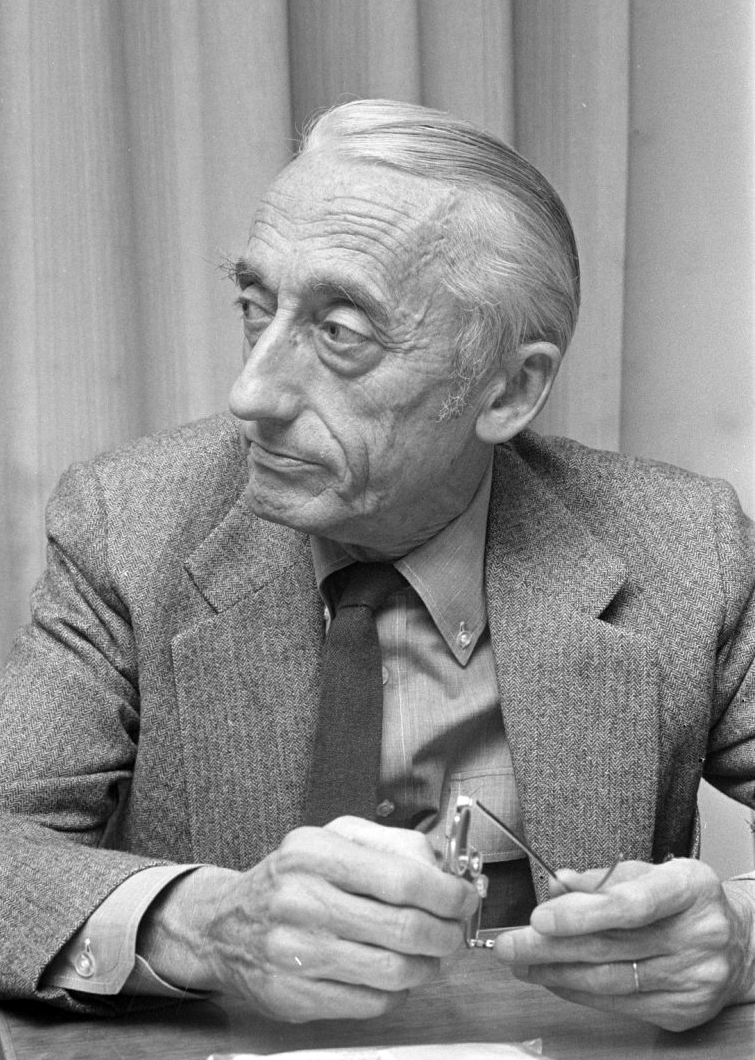
Jacques-Yves Cousteau, born June 11, 1910, in Saint-André-de-Cubzac, France, was a French naval officer, oceanographer, filmmaker, and author who transformed how the world saw the sea. He co-invented the Aqua-Lung, the first successful open-circuit SCUBA device, which let divers stay underwater longer and move freely. That invention opened the door to underwater filmmaking, and Cousteau stepped through it with a camera in hand. Cousteau's first book, The Silent World: A Story of Undersea Discovery and Adventure, described his early dives and even speculated about echolocation in porpoises. He adapted it into a documentary of the same name, co-directed with Louis Malle. The film used groundbreaking color underwater cinematography and won the Palme d'Or at the 1956 Cannes Film Festival, a rare honor for a documentary, and took the Academy Award for Best Documentary in 1957. He went on to write dozens more books, but his biggest reach came through television. From 1966 to 1976, he hosted The Undersea World of Jacques Cousteau, a series that brought ocean exploration into living rooms around the globe. A follow-up series, The Cousteau Odyssey, ran from 1977 to 1982 on public television. Across his career, Cousteau produced more than 120 television documentaries and over 50 films, earning a reputation as a tireless advocate for marine conservation. He died on June 25, 1997, at age 87, but his legacy lives on in the countless divers, filmmakers, and environmentalists he inspired.
Fame & Fandom
Jacques Cousteau remains a towering figure whose name resonates far beyond the diving community, anchoring global consciousness about marine life and exploration. Despite this enduring legacy, iFANN's Global Fame Engine evaluated him in August 2026 and determined he currently holds no placement within the published Global Top 1,000 rankings or any specialized Top-100 scope lists. He is not ranked among the world's most famous individuals at this time. While his fame once rivaled that of movie stars, the metrics of current celebrity culture do not assign him a specific ordinal position today. The audience surrounding his legacy lacks a formal fandom name; there is no documented moniker like "Stan Cousteaus" to describe his supporters. Instead, his admirers operate through The Cousteau Society, an organization founded by the explorer himself in 1973. This group unites over 50,000 members worldwide who focus on ocean protection rather than idolizing the man personally. These individuals engage in charity drives and conservation projects, effectively transforming what might be a fanbase into a global network of marine activists. Unlike pop-culture phenomena driven by viral moments or organized chart campaigns, Cousteau's relationship with the public was defined by his role as an educator who used film to bring the underwater world to the masses.
Interesting Facts and Legends
Jacques Cousteau co-invented the Aqua-Lung with Émile Gagnan in the late 1940s, creating the first successful open-circuit self-contained breathing apparatus that granted divers unprecedented freedom underwater. This invention served as the catalyst for his extensive work, allowing humanity to explore the ocean with true autonomy. He converted a former minesweeper into the floating laboratory *Calypso*, which became the vessel for his undersea investigations and the filming of the iconic documentary series *The Undersea World of Jacques Cousteau*. His 1964 film *World Without Sun* brought unprecedented visibility to marine life and conservation issues, cementing his status as a pioneer of underwater filmmaking. A story fans still retell involves his early speculation about echolocation in porpoises, which he described in his first book, *The Silent World: A Story of Undersea Discovery and Adventure*. In contemporary lore, he is often referenced as the ultimate benchmark for curiosity and scientific dedication; surfer John John Florence was hailed as the "21st-century Jacques Cousteau" in 2026 for being curious, single-minded, and insatiable. Modern touchstones of his influence include the restoration of his historic catamaran *Moulin à Vent* set for refit in 2025 and the mysterious sinking of the schooner-turned-bar *The Pilot* in Brooklyn in July 2026, which had been used by the explorer.
Death & Aftermath
Died
+1997-06-25 (aged 87)
Death Place
Paris, France
Cause of Death
Complications from pancreatic cancer
French President Jacques Chirac honored the late explorer as a national hero, confirming the passing of Jacques Cousteau on June 25, 1997. The oceanographer died at age 87 in Paris after a long battle with pancreatic cancer that had required surgery in 1990 and limited his work throughout the mid-1990s. Complications from the disease were officially ruled as the cause of death following standard medical protocols. Tributes poured in from scientific institutions and governments worldwide, celebrating his co-invention of the Aqua-Lung and his decades of underwater filmmaking that popularized marine biology.
A private funeral took place shortly after his death in Paris, followed by burial in the cemetery of Saint-Rémy-de-Provence where he had lived for many years. Family members including his son Jean-Michel attended the service alongside fellow explorers. His grandson Philippe Cousteau Jr. later promoted the legacy at events like the Sun Valley Forum while the Cousteau Society and Foundation continued their conservation mission. Posthumous releases included re-releases of films and books, and restoration projects preserved vessels like the catamaran Moulin à Vent for educational use.
Awards & Accolades
Keywords
Quick Facts
- Profession
- zoologist, explorer, filmmaker
- Born
- +1910-06-11
- Birthplace
- Saint-André-de-Cubzac
- Died
- +1997-06-25
- Death Place
- 17th arrondissement of Paris
- Gender
- Male
- Spouse
- Simone Melchior Cousteau, Francine Cousteau
- Birth Sign
- Gemini
Personal Details
- Spouse
- Simone Melchior Cousteau, Francine Cousteau
Join the community
fans discussing