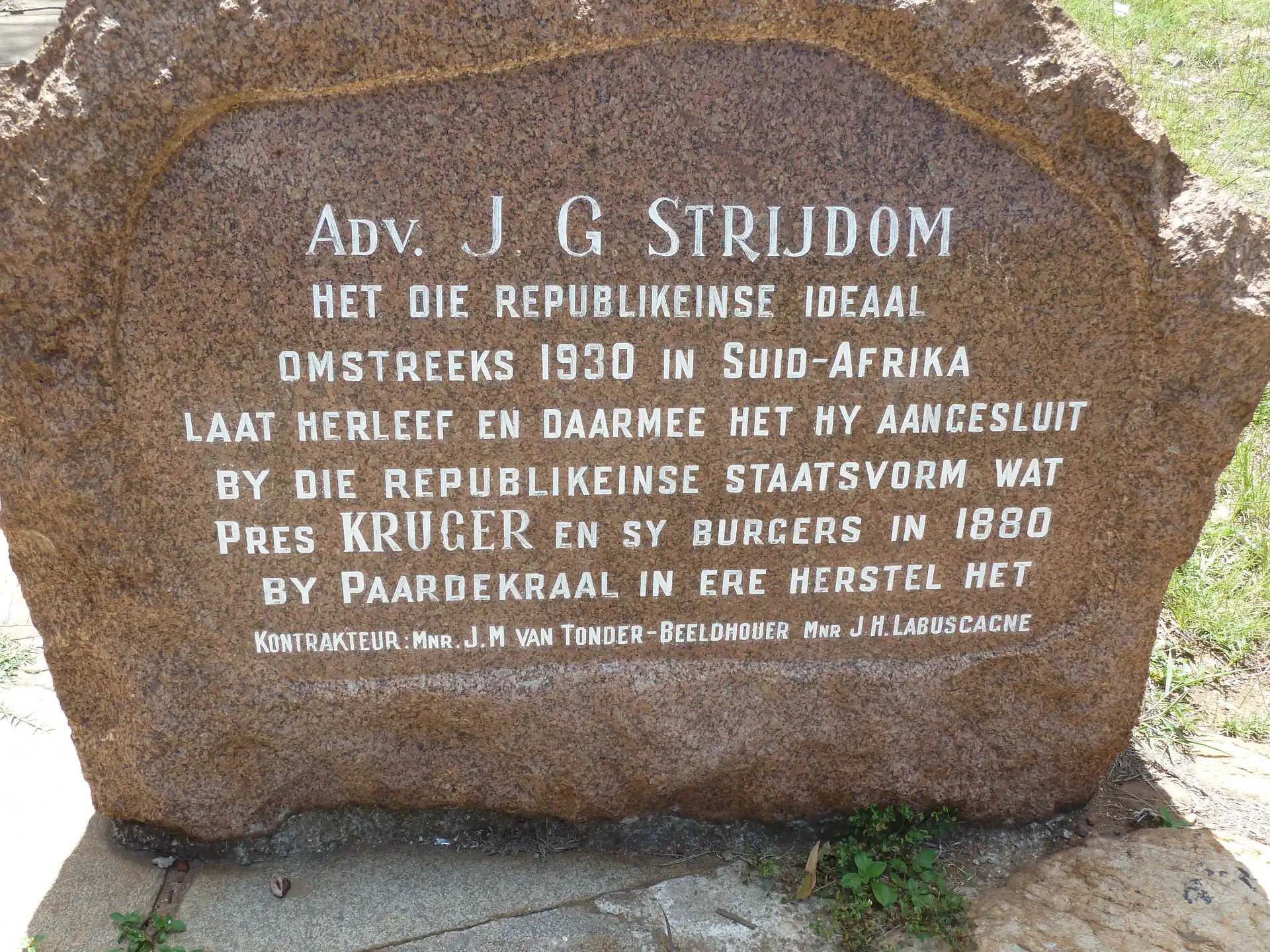
J. G. Strijdom
 South Africa
Also known as: Hans Strijdom, JG Strijdom, Johannes Gerhardus Strijdom, The Lion of the North
Birthday
July 14, 1893
Birth Sign
Cancer
Birthplace
Willowmore, Cape Colony
Age
Died at 65
About
Johannes Gerhardus "Hans" Strijdom, widely known as the Lion of the North, was a South African politician and lawyer who served as the fifth prime minister of South Africa from November 30, 1954, until his death on August 24, 1958. Born into a farming family in Willowmore, he emerged as a fierce Afrikaner nationalist whose tenure marked a radical intensification of apartheid policies and the push for South Africa to become a republic.
Strijdom is remembered for dismantling the common voters' roll for Coloured people and accelerating the legislative framework of segregation. He successfully pushed for the country to sever ties with the British Commonwealth, laying the groundwork for the 1961 declaration of the Republic of South Africa. His leadership style was uncompromising, earning him both fear among opponents and deep loyalty from the National Party base.
Early Life & Background
Johannes Gerhardus Strijdom was born on July 14, 1893, in the rural town of Willowmore in the Cape Colony. His childhood coincided with the aftermath of the Second Boer War, which ended in British victory when he was just eight years old. This historical trauma deeply influenced his worldview; he devoted his life to reversing what he perceived as the injustice of British rule and securing Afrikaner dominance. He attended local schools before enrolling at the University of Stellenbosch, where he studied law.
Called to the bar in 1916, Strijdom began practicing law in the Northern Cape, specifically in Kimberley and later Pretoria. Before entering high politics, he worked as a journalist and editor for the Oranje-Vrystaat newspaper, using the platform to advocate for Afrikaner rights and nationalism. His oratory skills and uncompromising stance on racial segregation quickly propelled him through the ranks of the National Party. By 1933, he had become the leader of the Transvaal branch of the party, setting the stage for his eventual rise to the highest office in the land.
Career Growth
Strijdom entered the House of Assembly in 1939 as the Member of Parliament for the Rustenburg constituency, a seat he held until his death. His ascent to the premiership occurred after the 1954 general election, following the death of D.F. Malan. On November 30, 1954, Strijdom succeeded Malan as Prime Minister, immediately beginning to implement a more aggressive version of apartheid than his predecessor.
His administration oversaw three major legislative achievements that defined his era. First, he championed the passage of amendments to the Representation of Natives Act and the Separate Representation of Voters Act in 1956, which removed Coloured voters from the common voters' roll and placed them on a separate, segregated roll. Second, he relentlessly pushed for a republic, viewing it as the ultimate expression of Afrikaner sovereignty, though this goal was only realized after his death via a referendum in 1960. Third, his government implemented stricter pass laws and expanded the Group Areas Act, further entrenching racial segregation in daily life.
Under his leadership, the government also oversaw the 1956 Women's March against pass laws, a pivotal moment in the anti-apartheid struggle. Strijdom continued to work despite suffering from severe illness in 1958, maintaining his grip on power until his condition became critical. He was succeeded by Hendrik Verwoerd, who would go on to implement even more rigid apartheid structures.
Career Timeline
Public Image & Style
Strijdom projected an image of a stern, hardline statesman with a fiery oratorical style. Contemporary photographs depict him as a man of serious demeanor, typically dressed in formal suits, embodying the seriousness of his political mission. He was described by supporters as the 'Lion of the Waterberg,' a title reflecting his origins in the Northern Cape and his uncompromising nature. His public persona was built on the ideology of baasskap, or white supremacy, which he institutionalized through legislation. Media perception of him varied sharply; while the National Party celebrated him as a hero of the struggle for Afrikaner independence, critics viewed him as a chief architect of oppression. His legacy remains polarized, with some seeing him as a defender of sovereignty and others as a symbol of systemic racism.
Fame & Fandom (iFAMOUS Rankings)
J. G. Strijdom never sought the spotlight of a celebrity, yet his name etched itself into the geography of South Africa with the permanence of stone monuments. The iFANN Global Fame Engine has evaluated this person, but they do not currently hold a placement in the published rankings, including the Global Top 1,000 or any Top-100 scope list. This absence reflects a stark reality: while he commanded the state as Prime Minister from 1954 until his death, he did not cultivate a modern fanbase or generate the viral cultural signals required for a current fame ranking. His legacy remains strictly historical rather than pop-cultural.
There is no documented fandom name associated with him, nor are there organized campaigns, charity drives, or digital rituals dedicated to his memory. During his lifetime, support was a matter of political allegiance among Afrikaner nationalists who revered his uncompromising stance on apartheid and his nickname, the Lion of the North. Today, that devotion has dissolved into critical historical analysis. He is remembered for cementing segregation policies and steering the nation toward a republic, actions that define his historical footprint but do not translate into contemporary fandom engagement. No fan-funded projects, birthday billboards, or subway ads exist for a man whose influence waned long before the era of social media trends. The only lingering references to his name appear in place names like JG Strijdom Road, where the geography bears witness to his power without implying personal worship. His story is one of a statesman whose impact was profound yet entirely contained within the political sphere of mid-20th century South Africa.
Interesting Facts and Legends
Johannes Gerhardus Strijdom earned the moniker 'The Lion of the North' due to his fierce leadership style and deep roots in the Northern Cape region. He served as the fifth Prime Minister of South Africa from 1954 until his death on August 24, 1958, at the age of 65. A widely cited historical event marks the end of his tenure: he died shortly after delivering a speech, a moment often referenced in accounts of South African politics. Strijdom was an uncompromising Afrikaner nationalist who intensified apartheid policies and pushed for South Africa to become a republic, breaking ties with the British Commonwealth. While some supporters viewed his struggle against British influence as heroic, his legacy is historically documented as a period of intense oppression, particularly highlighted by events like the 1956 Women's March which occurred during his tenure. Though search results sometimes confuse him with unrelated figures like a cricketer named Gerhard Strydom, the politician himself left no living cultural mythology beyond his political impact. His name persists in geographical landmarks, such as roads named in his honor, but these serve as reminders of his historical role rather than symbols of active fan devotion.
Notable Quotes
“South Africa must be a republic free from British monarchy.”
“We must secure Afrikaner dominance.”
Family & Personal Life
Strijdom was married to Marda Vanne. The couple had two children: a daughter named Estelle Strijdom and a son named Johannes Gerhardus Strijdom Jr., often referred to as J.G. Strijdom Jr. There are no public records of other romantic relationships, engagements, or divorces; his marriage to Marda Vanne appears to have been his only long-term partnership. As a public figure in the mid-20th century, Strijdom maintained a relatively private domestic life compared to modern celebrities, with media focus primarily on his political battles rather than his personal affairs. He was known to be a devout Christian and a regular churchgoer, values that were often reflected in his public rhetoric.
Notable Connections
Relationships & Dating History
Johannes Gerhardus Strijdom was married to Marda Vanne. Their union produced two children: a daughter named Estelle Strijdom and a son named Johannes Gerhardus Strijdom Jr., often referred to as J.G. Strijdom Jr. There are no public records indicating other romantic relationships, engagements, or divorces; his marriage to Marda Vanne appears to have been his only long-term partnership. As a public figure in the mid-20th century, Strijdom maintained a relatively private domestic life, with media focus primarily on his political battles rather than his personal affairs. He remained married to Marda until his death on August 24, 1958, at the age of 65. At the time of his death, his relationship status was married, and his widow survived him.
- MarriedMarda VanneUnknown - 1958Mother of his two children, Estelle and Johannes Jr.
Death & Aftermath
Died
August 24, 1958 (aged 65)
Death Place
Pretoria, South Africa
Cause of Death
Complications from pneumonia
Johannes Gerhardus Strijdom died on August 24, 1958, at Groote Schuur Hospital in Pretoria at the age of 65. His death followed a prolonged illness that had weakened him over several weeks, with official reports citing complications from pneumonia as the direct cause. Despite his deteriorating health, Strijdom remained mentally active in government affairs until just days before his passing, continuing to work through his final days in office.
The transition of power was immediate and orderly. Hendrik Verwoerd succeeded him as Prime Minister on August 27, 1958, just three days after Strijdom's death. Public reaction within the Afrikaner community was marked by deep reverence; supporters hailed him as the 'Lion of the Waterberg' for his unwavering commitment to their nationalist cause. A state funeral was held on August 27 in Pretoria, attended by high-ranking officials including Verwoerd and members of the cabinet, serving as a formal transfer of political authority.
Strijdom was buried in the Voortrekker Monument cemetery, a location chosen for its profound symbolic significance to Afrikaner heritage. In the decades following his death, his legacy became a subject of intense historical debate. Monuments dedicated to him, such as the one in Strijdom Square in Pretoria, stood for many years but later faced significant controversy. Notably, in 2001, a section of the dome of the Strijdom monument collapsed, causing damage to an underground parking garage, a structural failure often cited by critics as a metaphor for the crumbling foundations of the apartheid regime he championed. Today, while his name persists in geographical landmarks like J.G. Strijdom Road, these serve primarily as reminders of a controversial historical period rather than symbols of active devotion.
Net Worth (Estate Value)
$0
iFANN Editorial Team estimate
As a deceased historical figure who passed away in 1958, J. G. Strijdom does not have a modern net worth or estate value tracked by contemporary financial databases. His career earnings came from his salary as a Member of Parliament and later as Prime Minister of South Africa, along with income from his legal practice prior to entering full-time politics. There are no public records detailing posthumous revenue streams, licensing deals, or estate settlements managed by his heirs. The iFANN Editorial Team estimates that any remaining assets or royalties from his estate are negligible or non-existent in the context of modern wealth metrics, as his legacy is preserved through historical documentation rather than commercial ventures. The concept of a net worth for a mid-20th-century politician focused on public service and ideological leadership does not apply in the same way it does for modern entertainers or business magnates.
Awards & Accolades
View 3 records, honours and achievementsKnown For
Prime Minister of South Africa
1954-1958 · Political Leader
Keywords
Sources
Quick Facts
- Profession
- Politician, Lawyer
- Born
- July 14, 1893
- Birthplace
- Willowmore, Cape Colony
- Died
- August 24, 1958
- Death Place
- Pretoria, South Africa
- Gender
- Male
- Spouse
- Marda Vanne
- Birth Sign
- Cancer
Personal Details
- Full Name
- Johannes Gerhardus Strijdom
- Spouse
- Marda Vanne
- Children
- Estelle Strijdom, Johannes Gerhardus Strijdom Jr.
- Education
- University of Stellenbosch (Law)
Frequently Asked Questions
Who was J.G. Strijdom?
When did J.G. Strijdom die?
What was J.G. Strijdom's nickname?
Did J.G. Strijdom have any children?
What happened to the Strijdom monument?
Similar People
Join the community
fans discussing