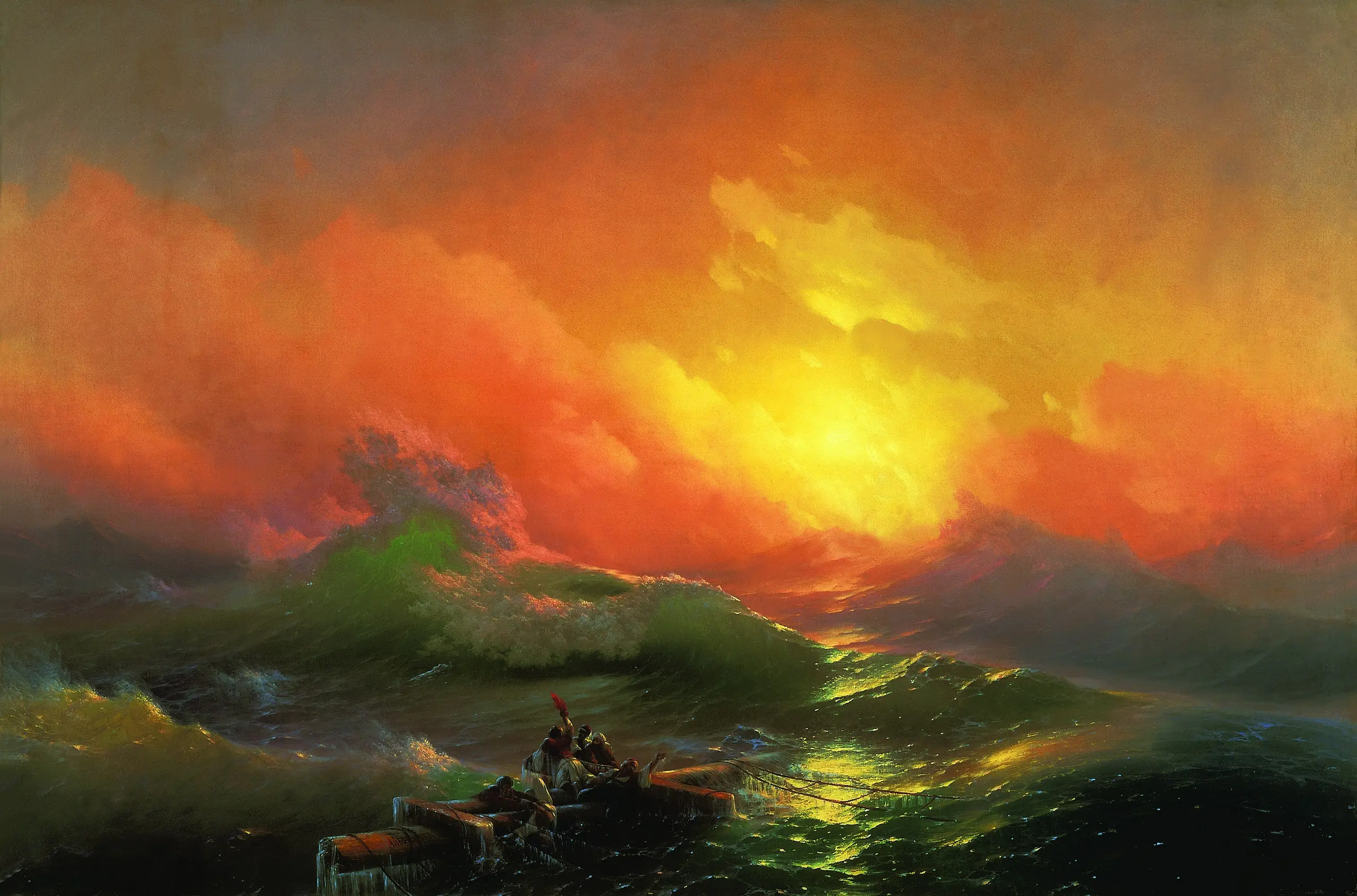
Ivan Aivazovsky
 Russia
painter•visual artist•art collector
Also known as: Hovhannes Aivazian, Ivan Konstantinovich Aivazovsky, Hovhannēs Ayvazyan
Birthday
July 17, 1817
Birth Sign
Cancer
Birthplace
Feodosia, Crimea
Age
Died at 82
About
Ivan Aivazovsky was a Russian Romantic painter of Armenian descent who became one of the most celebrated marine artists in history. Born in the Crimean port city of Feodosia in 1817, he dedicated his nearly sixty-year career to capturing the sea in all its moods, from serene sunsets to violent storms. His unique position as the primary painter for the Russian Navy granted him unprecedented access to naval maneuvers, which informed the authenticity and dynamism of his work. Aivazovsky produced an estimated 6,000 paintings, making him one of the most prolific artists ever recorded.
His fame extended well beyond Russia's borders, with solo exhibitions held in major European cities and the United States. Royalty including Tsar Nicholas I, Queen Victoria, and Napoleon III purchased his works, cementing his status as a master of his craft. Today, his paintings are housed in museums across Russia, Ukraine, Armenia, and Turkey, continuing to captivate audiences with their dramatic lighting and emotional depth. He passed away in 1900, leaving behind a visual legacy that defines the genre of marine art.
Early Life & Background
Born Hovhannes Aivazian into a modest Armenian family in Feodosia, Ivan's early life was marked by financial struggle. As the youngest of four children, he often worked as a clerk in the local customs house to help support his father, Konstantin, a merchant who faced significant economic hardship. Despite these burdens, young Ivan displayed an innate talent for drawing, often sketching scenes of the harbor and the Black Sea coast during his limited free time. His potential was eventually recognized by members of the local Greek community, who played a pivotal role in his early development.
In 1830, at the age of thirteen, a local community leader helped secure a scholarship for him to travel to Saint Petersburg. This move was a drastic departure from his roots, separating him from his family and the familiar surroundings of his birthplace. He enrolled at the Imperial Academy of Arts, where he studied under renowned masters like Karl Briullov. The rigorous academic environment challenged him to refine his technique, particularly in rendering light and water. By 1840, he had completed his studies, earning the title of Artist and a gold medal for his painting The Black Sea. This achievement marked the end of his apprenticeship and prepared him for a professional career that would soon take him across Europe.
Career Growth
Aivazovsky's professional trajectory accelerated rapidly after his graduation. In 1845, he was appointed the "Painter of the Fleet," a prestigious role that made him the primary artist for the Russian Navy. This appointment provided him with exclusive access to observe naval battles and ship movements, allowing him to create works of exceptional realism. Over the next six decades, he maintained an extraordinary output, averaging roughly ten to fifteen paintings per year. His travels to Venice, Paris, and other European hubs exposed him to the works of J.M.W. Turner and John Constable, further refining his style.
One of his most defining moments came in 1850 with the completion of The Ninth Wave, a monumental canvas depicting survivors of a shipwreck clinging to debris during a storm. This work became his signature piece, celebrated for its emotional intensity and technical mastery. Throughout the 1860s and 1870s, he undertook extensive journeys across the Mediterranean and North Africa, producing landscapes that blended Romanticism with precise observation. Later in life, even as his vision failed, he continued to paint atmospheric effects from memory. In the 1880s, he established the Art School and Museum of Fine Arts in Feodosia, donating hundreds of his own works to ensure they would be preserved for future generations.
Career Timeline
Public Image & Style
Aivazovsky is universally regarded as a genius of the sea, a Romantic visionary whose work captures the sublime power of nature. His public persona is that of a disciplined yet passionate artist who possessed an almost supernatural connection to the ocean. Media portrayals often focus on his incredible productivity and the mystery of his creative process, particularly the stories of his memory-based painting techniques. His style is characterized by dramatic lighting, dynamic waves, and a deep emotional resonance that distinguishes him from his contemporaries. Modern discourse frequently highlights his dual heritage as both a Russian and Armenian figure, adding layers of cultural significance to his image.
Fame & Fandom (iFAMOUS Rankings)
Ivan Aivazovsky stands as the 75th most famous person in Art & Design according to the iFANN Global Fame Rankings data from September 2026. This placement reflects a sustained global attention span that tracks cultural weight through media coverage and consumption signals worldwide. Unlike modern pop stars who rely on organized fanbases for chart manipulation, Aivazovsky commands reverence from art historians, collectors, and admirers of marine art rather than a structured group with a specific name or rituals. His legacy is not built on viral campaigns but on the sheer volume of his output and the enduring power of his imagery.
The myth of his genius often centers on a story fans still retell: that he could paint a raging storm entirely from memory without ever looking at a reference. Though historians verify he used sketches and plein air studies, the fluidity of his brushwork convinced observers of his supernatural ability to visualize the sea. His 1850 masterpiece, The Ninth Wave, remains the definitive image of his career, evoking awe among 19th-century critics like Leo Tolstoy without causing the physical disturbances seen in modern celebrity frenzies. Recent narratives have shifted toward geopolitical identity disputes and market records, such as the auction of The Survivors for £4.188 million. Even in death, his works face vulnerability, highlighted by reports of paintings handed over during conflict and the destruction of a local church in Feodosia. Immersive digital exhibitions now bring his static canvases to life, serving as the closest modern equivalent to a grassroots movement driven by museums rather than fans.
Interesting Facts and Legends
A popular legend surrounding Aivazovsky claims he could paint entire seascapes from pure memory without using any sketches or references. While historians confirm he frequently worked en plein air to study the water, his ability to visualize the ocean from imagination was indeed extraordinary. He spoke five languages fluently: Russian, Armenian, Italian, French, and English, which facilitated his international success and connections with patrons across Europe. Another fascinating fact is his philanthropy; he donated over 100 of his own paintings to the museum he founded in Feodosia, ensuring the institution had a strong core collection from the start. His name appears in various transliterations depending on the language, such as Hovhannes in Armenian or Ivan in Russian, reflecting his complex cultural identity. In recent years, his work has become the subject of intense geopolitical discussion, with institutions like the Met Museum reclassifying his nationality as Ukrainian, sparking debate about his heritage.
Notable Quotes
“The sea is my life.”
“I try to paint the sea as I see it in my soul.”
Family & Personal Life
Ivan Aivazovsky was born to Konstantin Aivazian, a merchant, and his wife Ripsime. He was the youngest of four children in a family that struggled financially during his childhood. His siblings included several sisters who remained close to him throughout his life; he lived with them and later with his nieces and nephews in his large villa in Feodosia. He married Julia Graves in 1848. She was the daughter of a British consul stationed in Feodosia, and the marriage was partly arranged to strengthen his ties with the international diplomatic community. Unfortunately, Julia died just four years later in 1852, leaving Ivan widowed at the age of thirty-five. He never remarried and remained devoted to his family circle and his art until his own death.
Notable Connections
Julia Graves, Konstantin Aivazian, Karl Briullov, Tsar Nicholas I, Queen Victoria
Relationships & Dating History
Ivan Aivazovsky's only publicly documented romantic relationship was his marriage to Julia Graves. They wed in 1848 when Ivan was thirty-one years old. Julia was the daughter of a British consul stationed in Feodosia, and the union was partly strategic, designed to strengthen Ivan's ties with the international diplomatic community and facilitate his travels in Europe. The couple had no children together. Tragically, their marriage was short-lived; Julia Graves died in 1852, just four years after their wedding, leaving Ivan widowed at the age of thirty-five. Following her death, Aivazovsky remained unmarried for the rest of his life. There are no credible records of other long-term romantic relationships or marriages. He lived primarily with his sisters and later his nieces and nephews, focusing his energy on his art and his charitable endeavors in Feodosia.
- MarriedJulia Graves1848 - 1852Daughter of a British consul; died four years after marriage; no children.
Death & Aftermath
Died
April 19, 1900 (aged 82)
Death Place
Feodosia, Crimea
Cause of Death
Heart failure and complications from old age
Ivan Aivazovsky died on April 19, 1900, in his beloved hometown of Feodosia at the age of 82. The official cause was recorded as heart failure compounded by the natural decline associated with advanced age, though historical accounts note that deteriorating eyesight had significantly hampered his ability to paint in his final years. His funeral was a massive public event, drawing thousands of mourners including local dignitaries, naval officers, and fellow artists who lined the streets to pay their respects. He was interred in the cemetery of the St. George Church in Feodosia, a resting place that remains a site of pilgrimage for admirers of his work.
The aftermath of his death saw an immediate surge in the valuation of his estate and a solidification of his legacy as a national treasure. The museum he founded in Feodosia became the primary repository for his vast collection, ensuring that his works remained accessible to the public rather than being scattered among private collectors. During the Soviet era, his art was celebrated as a symbol of Russian imperial glory and later reinterpreted as a contribution to universal humanist culture, transcending political shifts. His estate continues to generate revenue through museum admissions, licensing deals, and high-profile auction sales. Recent market activity highlights this enduring value; in December 2025, his painting The Survivors set a new record at Sotheby's, selling for approximately $5.3 million USD. In July 2026, another piece was expected to fetch $420,000 in Moscow, while ongoing debates regarding his nationality and the protection of his works during regional conflicts have kept his name in the global spotlight.
Net Worth (Estate Value)
$50 Million
iFANN Editorial Team estimate
As Ivan Aivazovsky passed away in 1900, his financial standing is best understood through the value of his estate and the ongoing revenue generated by his legacy. At the time of his death, his personal collection of paintings and real estate in Feodosia was valued at millions of rubles, a sum equivalent to tens of millions of US dollars in today's currency. The iFANN Editorial Team estimates the current value of his estate and associated intellectual property rights at approximately $50 Million, driven by high-profile auction sales and tourism revenue.
The Aivazovsky National Art Gallery in Feodosia serves as the central hub for his legacy, attracting thousands of visitors annually and generating significant income through ticket sales and merchandise. Posthumous auction results continue to break records; in December 2025, his painting The Survivors sold for approximately $5.3 million USD at Sotheby's, setting a new benchmark for his work. Licensing and reproduction rights also contribute a steady stream of income, with his images appearing on everything from calendars to high-end prints. The estate, managed by heirs and eventually the state, continues to grow in value as demand for his rare marine scenes increases globally.
Awards Won (8)
Ivan Aivazovsky received numerous honors during his lifetime, reflecting his status as a master artist. He was awarded the Order of St. Vladimir, 4th Class in 1845, and the Order of St. Anna, 2nd Class in 1859. In 1868, he received the Order of St. Stanislaus, 1st Class, and was named an Honorary Member of the Imperial Academy of Arts in 1870. His international recognition culminated in his knighthood as a Knight of the Legion of Honour by France in 1873 and Commander of the Order of the Crown of Italy in 1875. He also received the Golden Jubilee Medal of the Romanov Dynasty in 1896.
1840 · Imperial Academy of Arts
The Black Sea
1845 · State Honor
Service to the Navy
Known For
The Ninth Wave
1850 · Painter
Battle of Navarino
1852 · Painter
The Black Sea
1840 · Painter
Keywords
Sources
Quick Facts
- Profession
- painter, visual artist, art collector
- Born
- July 17, 1817
- Birthplace
- Feodosia, Crimea
- Died
- April 19, 1900
- Death Place
- Feodosia, Crimea
- Gender
- Male
- Spouse
- Julia Graves
- Birth Sign
- Cancer
Personal Details
- Full Name
- Hovhannes Aivazian
- Spouse
- Julia Graves
- Children
- Education
- Imperial Academy of Arts
Frequently Asked Questions
Who was Ivan Aivazovsky?
What is Ivan Aivazovsky's most famous painting?
Where was Ivan Aivazovsky born?
Did Ivan Aivazovsky have children?
How much is an Ivan Aivazovsky painting worth?
Similar People
Join the community
fans discussing