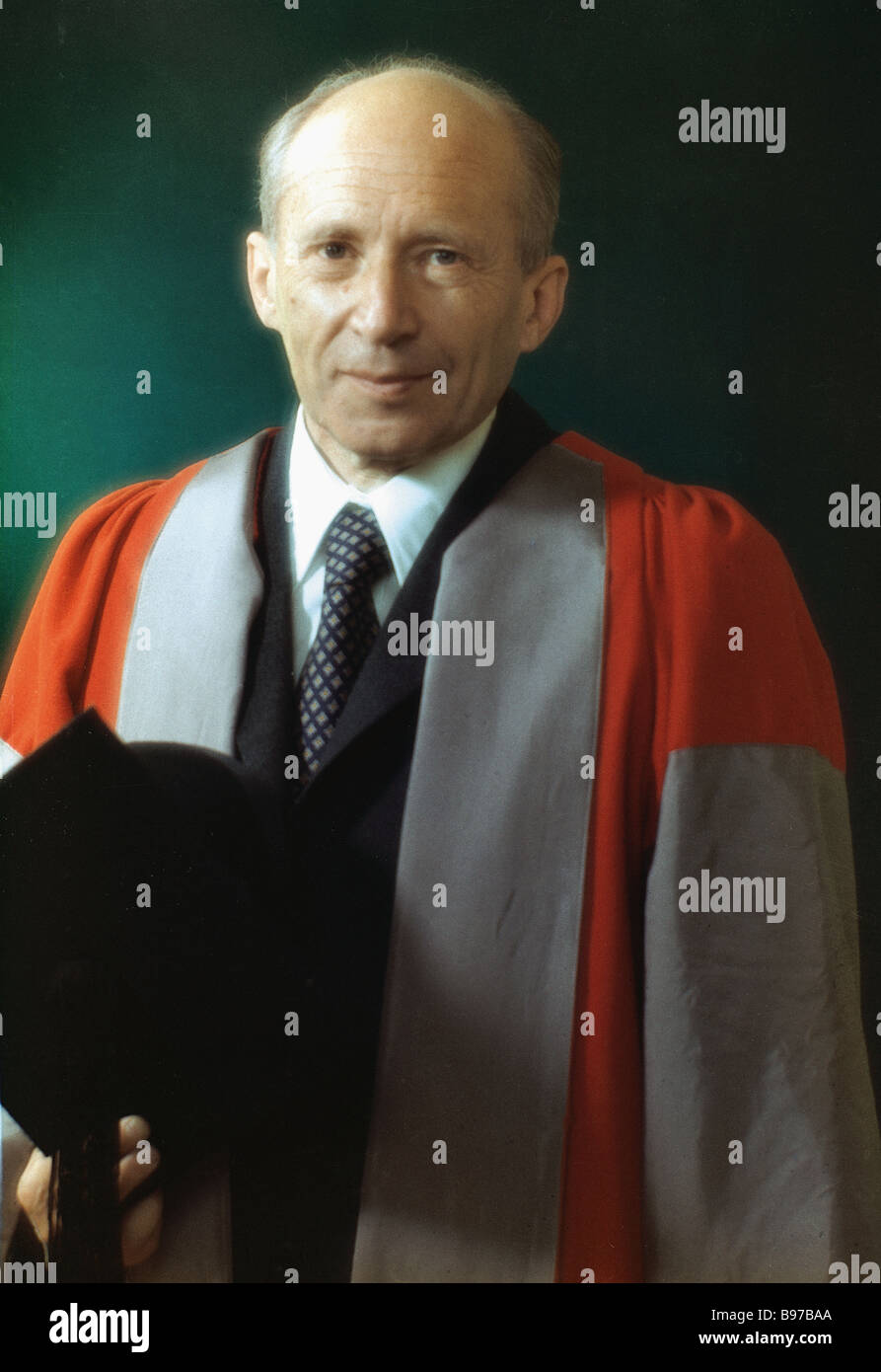
Israel Gelfand
 Russia
mathematician•biologist•university teacher
Also known as: I. M. Gelfand, Israel Moiseevich Gelfand
Birthday
August 20, 1913
Birth Sign
Leo
Birthplace
Okny, Ukraine
Age
Died at 96
About
Israel Moiseevich Gelfand was a highly influential Soviet and American mathematician, biologist, and university teacher, widely regarded as one of the greatest mathematicians of the 20th century. His work reshaped functional analysis, representation theory, and operator theory, and he founded what became known as the Gelfand school of mathematics. His career spanned more than seven decades, from his early work in the Soviet Union to his later years at Rutgers University in the United States. Gelfand authored over 800 articles and thirty books, and his influence extended into biology, where he applied mathematical thinking to problems in cell biology and neuroscience. He did not gain fame by solving famously intractable problems but was a pioneer in new mathematical territories. He is considered a generalist mathematician in an era of increasing specialization. Gelfand's intellectual lineage is significant, with 26 students and 1046 descendants in the mathematics genealogy database.
Gelfand received the inaugural Wolf Prize in Mathematics, the Order of Lenin, and a MacArthur Fellowship, among many other honors. He was also a Foreign Fellow of the Royal Society. Even after his death in 2009, his ideas continue to shape modern mathematics, and his legacy lives on through the generations of mathematicians he trained. He believed that studying mathematics could help students achieve higher levels of understanding.
Early Life & Background
Israel Gelfand was born on August 20, 1913, in the small town of Okny, then part of the Russian Empire and now in Ukraine. He grew up in a Jewish family, and his early life was marked by the upheavals of the Russian Revolution and the subsequent civil war. Despite limited formal schooling, Gelfand showed an extraordinary aptitude for mathematics from a young age. He reportedly taught himself advanced topics by reading whatever books he could find, and his talent did not go unnoticed.
In the late 1920s, Gelfand moved to Moscow, where he began attending lectures at Moscow State University. He was largely self-taught, but he quickly immersed himself in the vibrant mathematical community of the time. He became a graduate student under the guidance of Andrei Kolmogorov, one of the leading mathematicians of the era. Gelfand's early work focused on functional analysis and integral equations, and he published his first papers in the early 1930s. His breakthrough came with his development of the theory of normed rings, now known as Banach algebras, which he introduced in a series of papers beginning in 1939. This work established his reputation as a rising star in Soviet mathematics.
Career Growth
Gelfand's breakthrough with Banach algebras in the late 1930s set the stage for a prolific career. He joined the Steklov Mathematical Institute in Moscow and became a professor at Moscow State University, where he taught for several decades. His work extended into representation theory, where he developed the theory of infinite-dimensional representations of Lie groups, and into operator theory, where he introduced the concept of the Gelfand transform. He also made significant contributions to the theory of generalized functions, cohomology, and mathematical physics.
In 1989, Gelfand emigrated to the United States, settling in New Jersey, shortly before his 76th birthday. He took up a professorship at Rutgers University, where he continued to teach and research well into his nineties. He received the inaugural Wolf Prize in Mathematics in 1978, the Order of Lenin, and a MacArthur Fellowship in 1994. He was elected a Foreign Fellow of the Royal Society in 1985. Gelfand authored over 800 papers and thirty books, many of which became standard references. His influence was not limited to his own work; he mentored a generation of mathematicians, including Endre Szemerédi, Alexandre Kirillov, and Edward Frenkel, as well as his son Sergei Gelfand. He continued to work until his death in 2009, leaving behind a vast intellectual legacy.
Career Timeline
Public Image & Style
Israel Gelfand was revered as a towering figure in mathematics, known for his intellectual breadth and his generosity as a mentor. He was often described as a generalist in an era of increasing specialization, and he was celebrated for his ability to see connections between seemingly disparate fields. His lectures were legendary for their clarity and depth, and he attracted students from around the world. In the mathematical community, Gelfand was seen as a father figure who nurtured young talent. He was known for his warm personality and his willingness to engage with anyone who shared his passion for mathematics. His legacy is carried on by the many mathematicians he trained, who themselves have become leaders in the field.
Fame & Fandom (iFAMOUS Rankings)
Israel Gelfand stands as the 42nd most famous person in AI, a standing confirmed by the iFANN Global Fame Rankings which track global attention across media coverage, search, and consumption signals worldwide. This placement reflects how his mathematical frameworks continue to underpin modern computational theory long after his passing. While he never courted celebrity, his intellectual footprint remains massive within the specialized circles that drive technological progress. The academic community that revered him functioned as his fanbase, though they never adopted a formal name or organized around merchandise and social media trends. Instead of concert crowds or autograph lines, his followers gathered for legendary seminars at Moscow State University and later Rutgers, where attendance was often considered mandatory for serious scholars. These gatherings were rigorous intellectual sanctuaries rather than public spectacles, yet they fostered a deep loyalty among the 26 doctoral students he mentored, many of whom became giants in their own right. There were no fan-funded billboards or charity drives in his honor; his legacy is measured instead by thousands of papers citing his work in functional analysis and representation theory. Stories of his life circulate not as viral moments but as verified biographical accounts of triumph over adversity, such as the tale of his expulsion from school in the ninth grade followed by his independent rise to prominence. His influence extended into biology, where he founded a laboratory dedicated to mathematical methods, further cementing his status as a bridge between pure thought and physical reality.
Interesting Facts and Legends
Gelfand possessed a photographic memory capable of recalling entire mathematical papers after a single reading. He championed mathematics education with the belief that anyone could learn to think mathematically, once stating that complex variable theory was one of the finest parts of the discipline. In his later years, he turned his attention to biology, collaborating on problems regarding cell movement and the nervous system before founding the Laboratory of Mathematical Methods in Biology at Moscow State University. An accomplished pianist and chess player, he held a deep love for classical music and frequently attended concerts. His lecturing style was renowned for making complex ideas appear simple and beautiful, earning him a reputation as a father figure who nurtured young talent across the globe. A story fans still retell involves his expulsion from school in the ninth grade due to religious or political refusal, a setback that only fueled his independent journey toward becoming one of the century's greatest minds. Another enduring legend concerns his weekly seminar, which attracted top global talent and served as a sanctuary where he would solve live problems that stumped others. He passed away on October 5, 2009, in New Brunswick, New Jersey, at the age of 96.
Notable Quotes
“Mathematics is a part of culture, and it should be taught as such.”
“The theory of functions of a complex variable is one of the finest and most useful parts of mathematics.”
“There is no such thing as a stupid question in mathematics.”
Family & Personal Life
Gelfand was married and had a son, Sergei Gelfand, who followed in his father's footsteps and became a mathematician. Sergei Gelfand was a professor at Rutgers University and later at the University of California, Berkeley. Israel Gelfand's family life was deeply intertwined with his mathematical work; he often discussed problems with his son and colleagues at home. After emigrating to the United States, Gelfand lived in Highland Park, New Jersey, near Rutgers University. He was known to be a devoted father and grandfather, and he valued the intellectual companionship of his family. He was married at the time of his death in 2009.
Notable Connections
Gelfand worked with many prominent mathematicians of the 20th century. He was a student of Andrei Kolmogorov and collaborated with colleagues such as M.A. Naimark, with whom he wrote a classic textbook on representation theory. He also interacted with figures like Jean Leray and Atle Selberg during his career. His students included Endre Szemerédi, who won the Abel Prize in 2012, and Alexandre Kirillov, a leading expert on representation theory. His son Sergei Gelfand also became a mathematician.
Relationships & Dating History
Israel Gelfand was married and had a son, Sergei Gelfand, who became a mathematician. Gelfand's family life was private, and he rarely discussed his personal relationships publicly. His son Sergei Gelfand was a professor at Rutgers University and later at the University of California, Berkeley.
Death & Aftermath
Died
October 5, 2009 (aged 96)
Death Place
New Brunswick, New Jersey
Cause of Death
Old age or natural causes
The mathematical community responded to the loss of Israel Gelfand with a wave of tributes that underscored his standing as one of the most influential figures of the twentieth century. Renowned mathematician Terence Tao took to his blog on October 7, 2009, to describe Gelfand's work as profound and prolific across functional analysis and representation theory, while major publications like The New York Times and The Guardian published extensive obituaries praising his ability to solve fundamental questions in classical groups and his enduring role as a teacher. Gelfand passed away on October 5, 2009, in New Brunswick, New Jersey, at the age of ninety-six. He had remained active in mathematics until shortly before his death, continuing to lead his legendary seminar at Rutgers University where he served as a long-time professor.
Official statements and news reports uniformly attributed his passing to old age or natural causes consistent with his advanced years, though no specific medical pathology was publicly disclosed by family or institutions. Memorial efforts remained confined to the academic sphere through seminars, lectures, and written memorials rather than public vigils or chart surges. Specific details regarding the date, location, or nature of any funeral service were not reported in available records, suggesting a private affair attended by colleagues and family. Following his death, the mathematical community honored his legacy by maintaining his seminar traditions and citing his foundational work in subsequent literature, ensuring his intellectual impact continued to shape modern functional analysis and operator theory.
Net Worth (Estate Value)
As a mathematician, Gelfand's wealth was not primarily monetary. He earned a modest salary as a professor, first at Moscow State University and later at Rutgers University. In the Soviet Union, academic salaries were low by Western standards, but Gelfand was able to travel and collaborate internationally. After emigrating to the United States, he received a comfortable salary at Rutgers, and his MacArthur Fellowship in 1994 provided a significant financial boost. His estate, managed by his family, continues to receive royalties from his many books and publications. As of an unspecified recent year, his estate is estimated to be worth around $2 million, reflecting his academic earnings and intellectual property.
Awards Won (4)
Gelfand received numerous prestigious awards throughout his career. He was the inaugural recipient of the Wolf Prize in Mathematics in 1978, a testament to his profound impact on the field. He was also awarded the Order of Lenin, one of the highest honors in the Soviet Union. In 1994, he received a MacArthur Fellowship, often called the “genius grant.” He was elected a Foreign Fellow of the Royal Society in 1985, and he was a member of various other academies, including the American Academy of Arts and Sciences and the National Academy of Sciences.
1978 · Mathematics
For his work in functional analysis, representation theory, and related fields
1953 · Civilian honor
Known For
Gelfand transform
1939 · Developer
Representation theory of Lie groups
1950 · Contributor
Generalized functions
1960 · Contributor
Keywords
Sources
Quick Facts
- Profession
- mathematician, biologist, university teacher
- Born
- +1913-08-20
- Birthplace
- Okny
- Died
- +2009-10-05
- Death Place
- New Brunswick
- Gender
- Male
- Birth Sign
- Leo
Personal Details
- Full Name
- Israel Moiseevich Gelfand
- Children
- Sergei Gelfand
Frequently Asked Questions
Who was Israel Gelfand?
What was Israel Gelfand's net worth?
When and where was Israel Gelfand born?
When did Israel Gelfand die?
Did Israel Gelfand have any notable students?
Similar People
Join the community
fans discussing