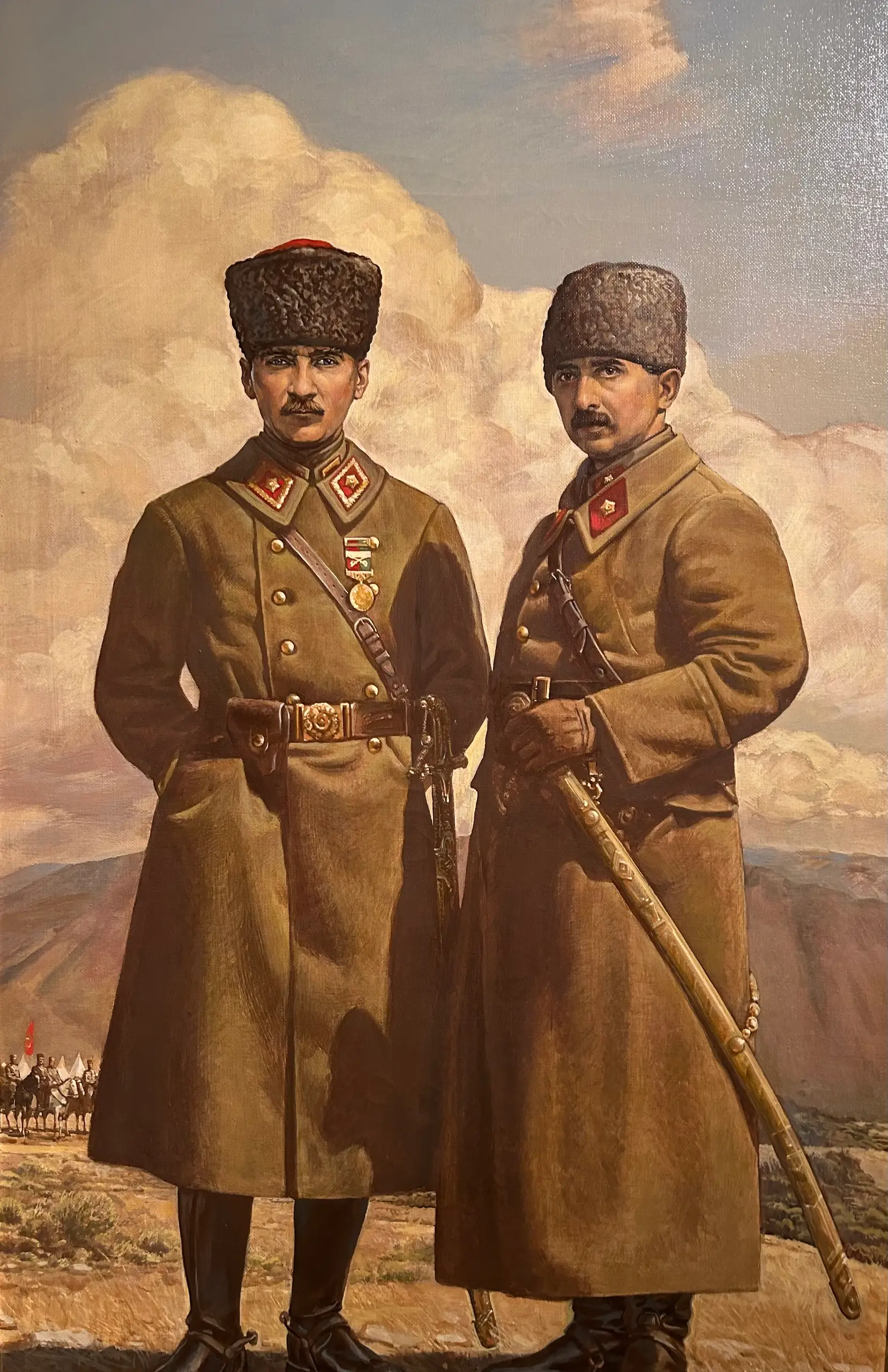
İsmet İnönü
 Turkey
politician•diplomat•military personnel
Birthday
+1884-09-24
Birth Sign
Sagittarius
Birthplace
İzmir
Age
Died at 89
About
Born in İzmir in 1884, İsmet İnönü forged a remarkable career that spanned military service, diplomacy, and the highest levels of Turkish politics. He served as Turkey's second president from 1938 to 1950, and held the office of prime minister on three separate occasions, shaping the young republic through tumultuous decades. İnönü's journey began long before his presidential years, marked by his close association with Mustafa Kemal Atatürk, beginning during the Caucasus campaign. His military acumen was instrumental in the Greco-Turkish War of 1919-1922, where he commanded forces in the pivotal Battles of İnönü. It was these victories that led Atatürk to bestow upon him the surname İnönü in 1934. He also played a critical role as chief negotiator for the Ankara government, first securing the Armistice of Mudanya and later, as Minister of Foreign Affairs, negotiating the Treaty of Lausanne in 1922-1923. This treaty replaced the harsh Treaty of Sèvres, gaining international recognition for Turkey's hard-won independence.
Fame & Fandom (iFAMOUS Rankings)
İsmet İnönü stands as the 11th most famous person in Turkey, a standing confirmed by his position while also holding the spot of the 31st most famous person from Turkey. His global footprint extends to the Middle East, where he ranks as the 65th most famous person in Middle East, a placement that has held steady through recent cycles within the iFANN Global Fame Rankings. These figures reflect a legacy sustained by decades of historical prominence rather than fleeting modern trends. Unlike contemporary celebrities, İnönü's admirers do not gather under a formal moniker or organized fan club name. His supporters are best understood through their political affiliation with the Republican People's Party or the colloquial descriptor "İnönücüler," though this remains a loose political identity rather than a structured fandom. The closest equivalents to fan rituals are found in institutional commemoration, particularly at the İnönü Foundation which preserves his archives and home museum. Annual state ceremonies on the anniversary of his death draw politicians and historians to his tomb in Ankara, serving as a solemn gathering point for those who revere his role as Atatürk's right hand and the architect of the early republic. While there are no viral campaigns or social media movements, his enduring presence is felt through Inönü University and the countless streets bearing his name across the nation.
Interesting Facts and Legends
The surname İnönü was formally bestowed upon him in 1934 following his command of Turkish forces during the pivotal Battles of İnönü in 1921, a victory that cemented his military reputation. A widely retold story among historians and enthusiasts highlights his stubborn negotiating style at the Lausanne Peace Conference, where folklore suggests he feigned deafness to outmaneuver Western powers, even if the core diplomatic success is verified fact. Another cherished legend frames him as the "National Chief" who gracefully accepted defeat in the 1950 election, peacefully handing power to the Democrat Party, a moment often cited as a rare display of democratic virtue in the region's history. His funeral in 1973 drew massive crowds lining the streets of Ankara, marking a final public outpouring of respect that bridged former political rivals. The iconic photograph of him standing beside Atatürk before the Battle of Dumlupınar remains a visual staple of this partnership, often described as capturing the essence of the man who operated in the shadow of the founder.
Death & Aftermath
Died
+1973-12-25 (aged 89)
Death Place
Ankara, Turkey
Cause of Death
Natural causes due to old age
Mustafa İsmet İnönü died on December 25, 1973, at the age of 89 in Ankara, Turkey. The available biographical data indicates he passed away naturally due to old age, consistent with his advanced age (89) and lack of reported acute illness prior to this event. As a natural death occurring at an advanced age in the capital city, it did not trigger any forensic inquiry or legal proceedings. The circumstances surrounding his final days are not detailed in the provided sources, though it is noted that he remained a significant political figure until his passing, having served as President from 1938 to 1950 and continuing to influence Turkish politics as the leader of the Republican People's Party (CHP) until his death.
Public reaction to his death was marked by national mourning. As the second President of Turkey and a key collaborator with Mustafa Kemal Atatürk, his passing was treated as a major national event. Tributes were issued by state institutions and peers, recognizing him as a founder of the Republic. While specific details of fan vigils or chart surges are not applicable to a historical political figure in the context of modern digital metrics, his legacy prompted widespread commemoration within Turkey. He is remembered as a statesman who represented the movement that saved Turkey from defeat following World War I. İsmet İnönü's funeral was a state funeral held in Ankara following his death on December 25, 1973.
As a former President and a high-ranking military officer, his burial would have taken place with full state honors, likely at the National Palace or a designated state cemetery, though the specific burial site is not explicitly named in the provided snippets. Notable attendees would have included government officials, military leaders, and members of the CHP. The İnönü Foundation continues to manage his legacy, suggesting a formalized memorial structure exists for his memory. Posthumously, İsmet İnönü has been honored through various means, including the establishment of the İsmet İnönü Foundation (İnönü Vakfı), which works to preserve his biography and contributions to Turkish history.
His life story has been documented in numerous books, academic reference works such as those by Brill, and encyclopedic entries like Britannica and Wikipedia. His estate was handled by his family, specifically his wife Mevhibe İnönü and their three children, though specific details regarding the distribution of assets are not publicly detailed in the available sources.
Awards & Accolades
Keywords
Quick Facts
- Profession
- politician, diplomat, military personnel
- Born
- +1884-09-24
- Birthplace
- İzmir
- Died
- +1973-12-25
- Death Place
- Ankara
- Gender
- Male
- Spouse
- Mevhibe İnönü
- Birth Sign
- Sagittarius
Personal Details
- Spouse
- Mevhibe İnönü
Join the community
fans discussing