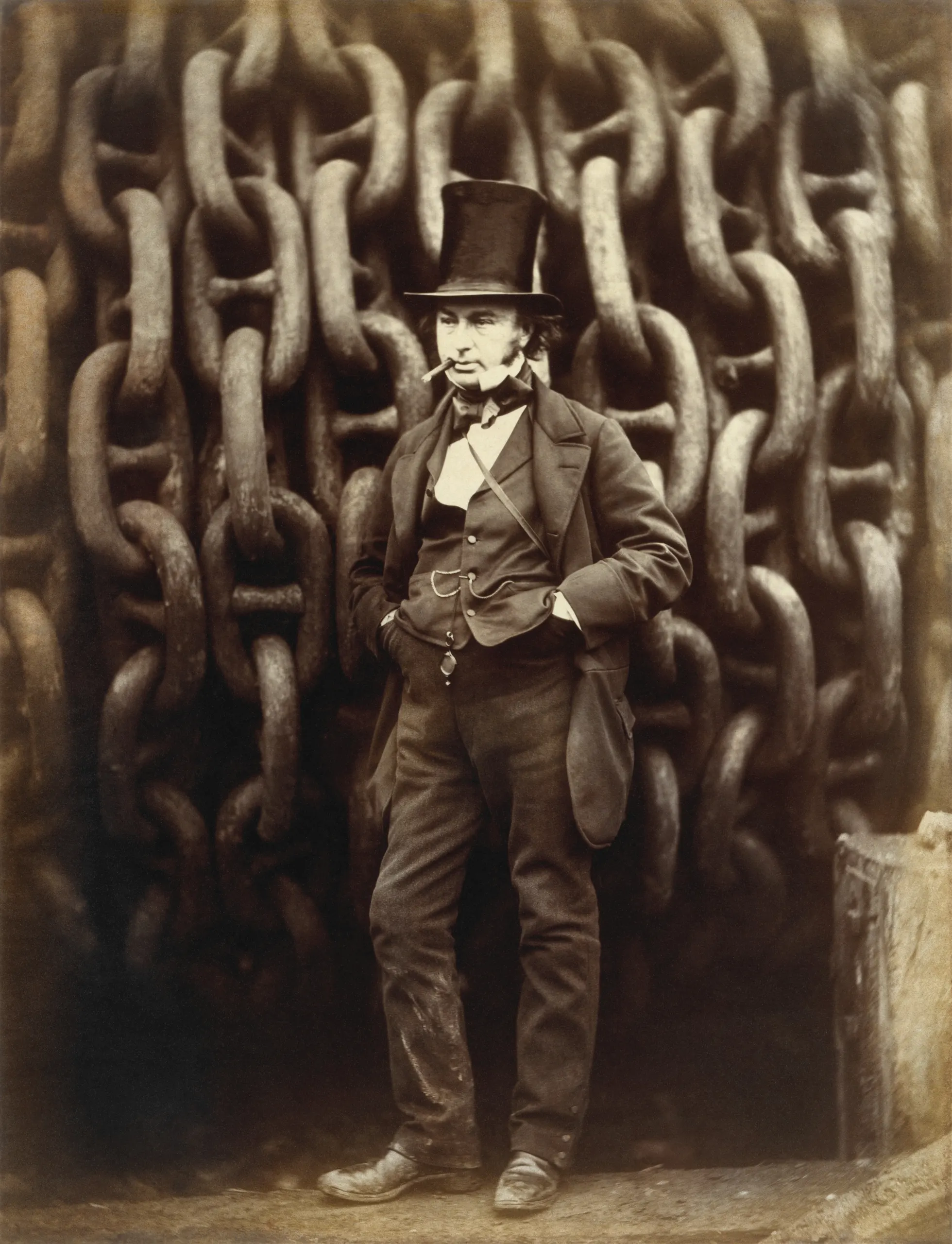
Isambard Kingdom Brunel
 United Kingdom
civil engineer•mechanical engineer•architect
Also known as: IK Brunel, The King of Engineers
Birthday
April 9, 1806
Birth Sign
Aries
Birthplace
Portsea, Portsmouth, Hampshire, England
Age
Died at 53
Height
6 ft 0 in (1.83 m)
About
Isambard Kingdom Brunel was an English civil and marine engineer widely regarded as one of the most brilliant figures of the Industrial Revolution. Born in Portsea, Portsmouth, to a French-born father named Marc Isambard Brunel, he inherited a legacy of engineering ambition that would define the British infrastructure of the 19th century. His career spanned railways, tunnels, bridges, and ocean-going steamships, where he consistently pushed the boundaries of what was technically possible. Despite facing constant financial hurdles and technical disasters, he refused to compromise on his vision for speed and efficiency.
Brunel's work transformed daily life for millions of people. He designed the Thames Tunnel, the first tunnel successfully built under a navigable river, and championed the broad gauge for the Great Western Railway. His maritime achievements included the construction of three legendary vessels: the SS Great Western, the SS Great Britain, and the colossal SS Great Eastern. Although he died in 1859 just days after a massive explosion rocked the SS Great Eastern during its maiden voyage, his legacy endures through iconic structures like the Clifton Suspension Bridge and the Royal Albert Bridge.
Early Life & Background
Isambard Kingdom Brunel arrived in Portsmouth on April 9, 1806. His father, Marc Isambard Brunel, was a French émigré who had achieved fame designing the Thames Tunnel and the Block Mills in Portsmouth. From a young age, Isambard was immersed in his father's projects. He attended school in Chatham and later studied at the Royal Academy in London, though his formal education was brief; much of his learning came from working alongside his father on the construction of the block-making machinery for the Portsmouth Block Mills.
His early life was marked by intense intellectual curiosity and a fascination with mechanics. By age 14, he was already assisting his father on the Thames Tunnel project. In 1824, he accompanied his father to London to oversee the tunnel's construction, where he worked under grueling conditions. A pivotal moment in his early career occurred in 1827 when a massive flood collapsed part of the tunnel, killing several workers. The disaster led to the project's temporary abandonment and significant financial loss for the Brunels. Young Isambard took responsibility for the failure but continued to advocate for the tunnel's completion, eventually succeeding after his father's death in 1830. This period solidified his reputation as a resilient and visionary engineer willing to take calculated risks.
Career Growth
Brunel's career is defined by a series of monumental achievements that transformed Britain's transport network. After his father's death, Brunel became the chief engineer of the Thames Tunnel. He introduced a revolutionary "tunneling shield" to protect workers from collapsing earth. Although the project faced multiple collapses and flooding, it was finally completed in 1843, becoming the first tunnel successfully built under a navigable river.
Appointed as the chief engineer for the Great Western Railway in 1833, Brunel designed a railway line connecting London to Bristol. He championed the "broad gauge" (7 ft ¼ in), which allowed for greater stability and speed, though it later caused interoperability issues with standard gauge lines. Key components included the Box Tunnel, the longest railway tunnel in the world at the time, and the Maidenhead Bridge, featuring the widest single-span brick arches ever built.
In the maritime sector, Brunel launched the SS Great Western in 1837, the first purpose-built steamship designed to cross the Atlantic Ocean reliably. In 1843, he launched the SS Great Britain, a marvel of engineering that was the first iron-hulled, propeller-driven ship to cross the Atlantic. Despite its technical success, it suffered financial difficulties and ran aground in 1847 in the Falkland Islands. His magnum opus, the SS Great Eastern, launched in 1858, was the largest ship ever built up to that time. Designed to carry passengers directly from London to Australia without coaling stops, it faced numerous delays and two major explosions during trials. However, it found its greatest success not in passenger transport but in laying the transatlantic telegraph cable.
Completed shortly before his death, the Royal Albert Bridge connects Saltash in Cornwall to Devon across the River Tamar. It features a unique design combining suspension chains and tubular trusses, utilizing high-strength wrought iron. The bridge remains a vital link today.
Career Timeline
Public Image & Style
Brunel was described as tall and slender, standing approximately 6 feet tall. He had a distinctive appearance, often wearing a top hat and carrying a cane, reflecting the fashion of the Victorian era. His physical stamina was remarkable, allowing him to endure the harsh conditions of construction sites and shipyards. Known as "The King of Engineers" in contemporary press, he was viewed as a man of unwavering determination and visionary thinking. His insistence on the broad gauge, despite widespread opposition, highlighted his stubbornness and belief in his own engineering principles.
Fame & Fandom
iFANN has not yet collected fame data for this person. While there is no "fandom" in the pop-culture sense, Brunel enjoys a dedicated following among engineers, historians, and enthusiasts of industrial heritage. The "Brunel Society" and various online communities actively campaign for the preservation of his works. Fans often refer to themselves as "Brunelians" or simply "engineers." Notable fan campaigns include fundraising for the restoration of the Clifton Suspension Bridge and digital archives preserving his correspondence. His story is frequently cited in educational contexts, inspiring a new generation of STEM students.
Interesting Facts and Legends
Brunel was a vegetarian, a rare choice for the mid-19th century. He designed the first electric lighting system for a hospital, St Thomas' Hospital in London. The SS Great Eastern was so large that it required a special crane to lift its anchor. Brunel's son, Henry Marc, later became a prominent engineer in South Africa and Australia. The term "Brunel" is sometimes used colloquially in engineering circles to describe a project that is overly ambitious or prone to failure due to its scale. He was known to be deeply devoted to his work, often neglecting his health and family due to the intensity of his projects.
Notable Quotes
“I must make my way.”
“There is nothing so difficult as to begin a great work.”
“We must not be afraid to fail.”
Family & Personal Life
Isambard Kingdom Brunel married Mary Elizabeth Horsley on July 19, 1843, at St George's Church, Hanover Square, London. Mary was the daughter of Samuel Laurence Horsley, a clergyman. They met through family connections, and their marriage was reportedly happy and stable. Mary provided a grounding influence for Brunel, managing their household while he pursued his demanding career. The couple had six children: Henry Marc Brunel, John Francis Brunel, Alfred Edward Brunel, Florence Augusta Brunel, Sydney Henry Brunel, and George Frederic Brunel. Two of his sons died young, and another succumbed to tuberculosis at age 17. Mary outlived him by many years, dying in 1889.
Notable Connections
Marc Isambard Brunel, Samuel Laing, John Scott Russell, Robert Stephenson
Relationships & Dating History
Isambard Kingdom Brunel married Mary Elizabeth Horsley on July 19, 1843, at St George's Church, Hanover Square, London. Mary was the daughter of Samuel Laurence Horsley, a clergyman. They met through family connections, and their marriage was reportedly happy and stable. Mary provided a grounding influence for Brunel, managing their household while he pursued his demanding career. The couple had six children together. There are no records of other romantic relationships or engagements prior to or during his marriage to Mary. Brunel was known to be deeply devoted to his work, often neglecting his health and family due to the intensity of his projects, but he maintained a monogamous relationship throughout his adult life. As he passed away in 1859, he is historically recorded as widowed by his wife Mary, who outlived him by many years. Mary Elizabeth Horsley died in 1889.
- MarriedMary Elizabeth Horsley1843 - 1859Married until Brunel's death; she died in 1889.
Death & Aftermath
Died
September 15, 1859 (aged 53)
Death Place
Belgrave Square, London, England
Cause of Death
Stroke
Isambard Kingdom Brunel died on September 15, 1859, at his home in Belgrave Square, London. He was 53 years old. The official cause of death was a stroke, which medical historians attribute to the immense physical and mental strain he endured throughout his career. His final weeks were consumed by the launch of the SS Great Eastern, a project that had already suffered two major explosions and significant delays. Just days before he passed, a massive explosion during a trial run killed three men and injured many others. Brunel, who was present and sustained minor injuries from the blast, reportedly remained calm and focused on the engineering challenges ahead rather than his own safety.
The public reaction to his death was immediate and profound. A massive funeral procession took place through London, drawing thousands of mourners who recognized the scale of his contributions to the nation. He was buried in Highgate Cemetery, where his tomb remains a site of pilgrimage for engineers and historians. Tributes poured in from peers and institutions across the country, cementing his reputation as a visionary who had fundamentally altered British infrastructure.
In the aftermath, the SS Great Eastern, which Brunel struggled to complete, went on to achieve legendary status. It successfully laid the first permanent transatlantic telegraph cable in 1865, fulfilling a purpose far greater than its original design intended. While Brunel died relatively poor with his estate valued at only £10,000, leaving his family with debts that required government intervention to clear, his intellectual legacy generated immense value over time. The preservation of his works, including the SS Great Britain museum ship and the Clifton Suspension Bridge, continues to generate millions in annual revenue through tourism. Modern tributes in 2026, such as the HS2 blue plaque and the naming of a new dredging vessel after him, demonstrate how his influence persists long after his passing.
Net Worth (Estate Value)
$0
iFANN Editorial Team estimate
As a historical figure deceased since 1859, Brunel does not have a current net worth in the traditional sense. During his lifetime, he frequently faced financial ruin due to the high costs of his ambitious projects. He died relatively poor, with his estate valued at approximately £10,000, leaving his family with significant debts that were eventually cleared by the government and private subscriptions. Posthumously, his estate, comprising intellectual property, designs, and legacy, has generated immense value through tourism, licensing, and cultural heritage. The SS Great Britain and the Brunel Museum in Bristol generate millions in annual revenue. The "Brunel brand" is licensed for educational materials, model kits, and merchandise. While specific estate valuation figures for 2026 are not publicly disclosed in financial reports, the economic impact of his legacy is estimated to be in the hundreds of millions of pounds annually through tourism and related industries in the UK. No living heirs manage a traditional "estate" in the celebrity sense, but the Brunel Society and various trusts maintain his legacy.
Awards Won (4)
Brunel received numerous prestigious honours during his lifetime and posthumously. He was elected a Fellow of the Royal Society in 1849 and served as President of the Institution of Civil Engineers in the same year. He has been inducted into various halls of fame, including the National Inventors Hall of Fame in the USA and the UK's Engineering Hall of Fame. In 2002, he was voted the second greatest Briton of all time in a BBC poll, behind only Winston Churchill.
1849 · Scientific Achievement
General Contributions to Engineering
1849 · Professional Leadership
Civil Engineering
Known For
Thames Tunnel
1843 · Chief Engineer
Great Western Railway
1838 · Chief Engineer
Clifton Suspension Bridge
1864 · Designer
SS Great Britain
1843 · Designer
SS Great Eastern
1858 · Designer
Keywords
Sources
Quick Facts
- Profession
- civil engineer, mechanical engineer, architect
- Born
- April 9, 1806
- Birthplace
- Portsea, Portsmouth, England
- Died
- September 15, 1859
- Death Place
- London, England
- Gender
- Male
- Spouse
- Mary Elizabeth Horsley
- Birth Sign
- Aries
Personal Details
- Full Name
- Isambard Kingdom Brunel
- Height
- 6 ft 0 in (1.83 m)
- Spouse
- Mary Elizabeth Horsley
- Children
- Henry Marc Brunel · John Francis Brunel · Alfred Edward Brunel · Florence Augusta Brunel · Sydney Henry Brunel · George Frederic Brunel
- Education
- Royal Academy, Chatham House School
Frequently Asked Questions
How did Isambard Kingdom Brunel die?
What is Isambard Kingdom Brunel's most famous invention?
Was Isambard Kingdom Brunel knighted?
Who was Isambard Kingdom Brunel married to?
What is the Brunel Museum?
Similar People
Join the community
fans discussing