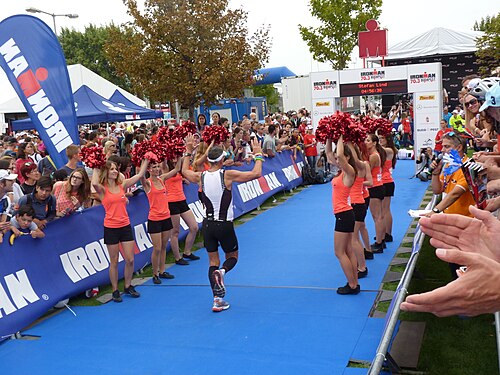
Ironman Triathlon
"Swim 2.4 miles, bike 112 miles, run 26.2 miles, brag for the rest of your life."
4+
Editions
1600
Peak Attendance
About
The Ironman Triathlon is a single-day endurance race that pushes athletes to their limits. Competitors swim 2.4 miles (3.86 km), bike 112 miles (180.25 km), and run a full marathon of 26.2 miles (42.2 km) without breaks. The total distance of 140.6 miles (226.3 km) must be finished within 17 hours. Since its first edition in 1978, the event has grown from a small bet among friends into a global series with over 150 races in more than 50 countries.
Each year, the Ironman World Championship draws around 1,600 qualifiers from across the world to compete on the lava fields of Kailua-Kona, Hawaii. The course is brutal: heat, humidity, strong crosswinds, and relentless sun test every athlete. The event is organized by The IRONMAN Group, which also runs the half-distance Ironman 70.3 series. The phrase "Anything is Possible," coined by announcer Mike Reilly, has become the event's unofficial motto.
History
The Ironman was born from a barroom argument in 1977. After the Oahu Perimeter Relay, a group of athletes debated who was fittest: swimmers, cyclists, or runners. U.S. Navy Commander John Collins proposed combining three existing Hawaii events, the Waikiki Roughwater Swim (2.4 miles), the Around-Oahu Bike Race (112 miles), and the Honolulu Marathon (26.2 miles), into one continuous race. Fifteen men toed the line on February 18, 1978. Gordon Haller won in 11:46:58 and was declared the first "Ironman."
The race stayed on Oahu until 1981, when Valerie Silk, who had taken over organization, moved it to the Big Island. The new course in Kona proved even tougher. In 1982, television coverage of Julie Moss crawling across the finish line captivated millions and transformed the event into a global phenomenon. The Ironman brand expanded rapidly, adding the half-distance 70.3 series in 2005. By 2023, participation had swelled to over 260,000 athletes annually across all distances.
Notable Editions
1978: First Ironman
15 attendeesInaugural race with 15 participants. Gordon Haller wins in 11:46:58.
1982: The Crawl
580 attendeesJulie Moss crawls across finish line, losing to Kathleen McCartney. Televised moment sparks global interest.
2003: Silver Anniversary
1500 attendees25th anniversary. Nearly 1,500 athletes compete.
2023: Split Championship
1600 attendeesWomen's race in Kona; men's race in Nice, France. Lucy Charles-Barclay sets women's course record (8:24:06). Sam Laidlow wins men's.
Past Winners / Headliners
| Year | Name |
|---|---|
| 1978 | Gordon Haller |
| 1979 | Tom Warren |
| 1979 | Lyn Lemaire |
| 2006 | Craig Alexander |
| 2006 | Samantha McGlone |
| 2023 | Sam Laidlow |
| 2023 | Lucy Charles-Barclay |
Notable Moments
1982
The Crawl
Julie Moss, leading the women's race, collapsed from exhaustion 20 yards from the finish line and crawled across. Kathleen McCartney passed her to win. The moment was broadcast on national TV.
1995
First Handcycle Finisher
Jim MacLaren, a double-amputee, completed the course using a handcycle, becoming the first to finish in the physically challenged division.
2007
The Ironman Cry
Mike Reilly's catchphrase 'You are an Ironman!' is first used at the finish line, becoming an emotional hallmark for every finisher.
2014
Mirinda Carfrae's Record
Mirinda Carfrae set the women's course record (8:52:14) that stood until 2023.
2023
Charles-Barclay Breaks Record
Lucy Charles-Barclay shattered the women's course record by nearly 28 minutes, finishing in 8:24:06.
Cultural Impact
The Ironman has become shorthand for extreme human endurance. Its 'Anything is Possible' ethos inspired millions of amateur athletes to attempt the distance. The 1982 crawl of Julie Moss, broadcast on ABC's Wide World of Sports, introduced the everyday person to the drama of ultradistance racing. The brand has spawned a global community, with thousands of athletes qualifying through local races each year. The Ironman logo, a stylized M-dot, is recognized worldwide as a badge of honor. The event also fueled the growth of triathlon as a mainstream sport, influencing everything from training methods to gear innovation.
Controversies
After the first few races, John Collins wanted to step away from directing. He handed control to Hank Grundman and Valerie Silk. When Grundman and Silk divorced in 1981, a legal battle ensued over ownership of the Ironman name. Silk ultimately gained sole rights and moved the race to Kona. Some early participants felt the event's commercial growth strayed from its original amateur spirit.
Related Events
Keywords
Sources
Event Info
- Total Distance
- 140.6 miles (226.3 km)
- Cutoff Time
- 17 hours
- First Race Participants
- 15
- Annual Global Participants
- 260,000+
- Number of Races Worldwide
- 150+ in 50+ countries
- First Woman Competitor
- Lyn Lemaire (1979)
Join the community
fans discussing