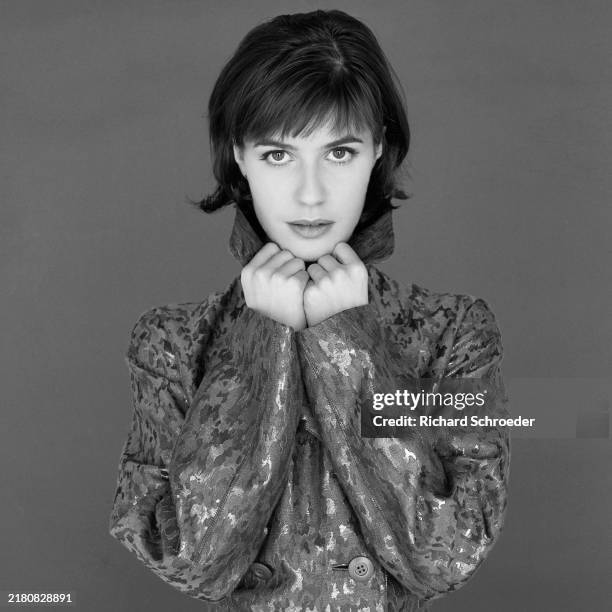
Irène Jacob
 France
Birthday
July 15, 1966
Birth Sign
Cancer
Birthplace
Suresnes, France
Age
60 years old
About
Irène Jacob is a French-Swiss actress known for her luminous, introspective performances in European art cinema. She first captivated audiences in Krzysztof Kieślowski's The Double Life of Veronique (1991), a role that earned her the Best Actress prize at Cannes and made her a symbol of 1990s cinematic elegance. Her collaboration with Kieślowski continued in Three Colours: Red (1994), bringing her a BAFTA nomination and cementing her place among the most respected actresses of her generation.
Beyond her film work, Jacob is equally celebrated on stage and in music theatre, performing speaking roles in works by Stravinsky, Honegger, and Poulenc at venues like the Royal Albert Hall and Lincoln Center. She has also recorded two pop albums with her brother, musician Francis Jacob. Her career spans over fifty films and television productions across multiple countries and languages.
As of 2026, Jacob remains active in film and theatre, most recently appearing in the series The Affair and The OA. Her enduring appeal lies in her ability to convey deep emotion with subtle restraint, a quality that continues to resonate with audiences worldwide.
Early Life & Background
Irène Marie Jacob was born on July 15, 1966, in Suresnes, a western suburb of Paris. Her father, Maurice Jacob, was a physicist, and her mother was a psychologist. She was the youngest of four children and the only girl. When she was three, the family moved to Geneva, Switzerland, where she grew up in what she describes as a Protestant household that was "very shy with feelings." This reserved atmosphere sparked her early attraction to storytelling. "I wanted to be close to stories because they could help me relate to my family," she later recalled.
At age twelve, she discovered the films of Charlie Chaplin. They "took my heart," she told the Los Angeles Times in 1994. "They made me laugh and cry, and this was exactly what I was waiting for in a film, to awaken me to my feelings." She made her stage debut at eleven, in 1977, and attended the Geneva Conservatory of Music. She earned a two-year degree in languages, becoming fluent in English, German, French, and Italian.
In 1984, at eighteen, she moved to Paris to study acting at the prestigious Rue Blanche drama academy. To support herself, she sold dictionaries over the phone. She also studied at the Dramatic Studio in London. In Paris, she immersed herself in the works of Rohmer, Rivette, Antonioni, and Fellini, and drew inspiration from performances by Chaplin, Giulietta Masina, Anna Karina, Fanny Ardant, Ingrid Bergman, and Gena Rowlands.
Her big break came when Louis Malle cast her in Au revoir, les enfants (1987) because she could play piano. "It is thanks to music that I was cast in the film," she said. That role launched her career, leading to a small part in Jacques Rivette's La bande des quatre (1989) before her Cannes-winning turn in 1991.
Career Growth
Irène Jacob's breakthrough came in 1991 with Krzysztof Kieślowski's The Double Life of Veronique, where she played dual roles as a Polish choir singer and a French music teacher. Her performance won the Best Actress award at the Cannes Film Festival, instantly making her an international star. She reunited with Kieślowski for his final film, Three Colours: Red (1994), playing Valentine, a model who forms an unlikely bond with a retired judge. The role earned her a BAFTA nomination and is widely considered one of her finest.
In 1993, she appeared in Agnieszka Holland's adaptation of The Secret Garden. The following year she worked with Michelangelo Antonioni and Wim Wenders on Beyond the Clouds and played Desdemona opposite Laurence Fishburne in a film version of Othello, singing the song "Willow." She also worked with Theo Angelopoulos during this period.
In 1998, she starred in the Hollywood thriller U.S. Marshals. Throughout the 2000s and 2010s, she balanced film with theatre and music. She performed in Richard Nelson's Madame Melville in London's West End and took on speaking roles in Stravinsky's Perséphone, Honegger's Jeanne d'Arc au bûcher, and Poulenc's L'Histoire de Babar at venues like the Opéra Comique and Lincoln Center. She also recorded chansons with Vincent Delerm and two pop albums with her brother Francis Jacob.
In 2016, she starred in the drama Eternity, and in the 2010s and 2020s she appeared in the US series The Affair and The OA. Her filmography includes over fifty works, spanning French, Swiss, Polish, American, and British productions.
Career Timeline
Public Image & Style
Irène Jacob is widely regarded as one of the preeminent French actresses of her generation, known for a quiet intensity that speaks volumes. The Los Angeles Times once noted her "remarkable ability to express her characters' emotional upheavals with very few words." Her aesthetic is tied to the subdued, emotionally resonant European art cinema of the 1990s, especially her work with Kieślowski. She often portrays women who offer "consolation and mystery" to troubled men, a theme that runs through her most iconic roles.
Fans admire her for her authenticity and depth, and she has become a touchstone for lovers of art-house film. She does not have a large social media presence, but her official Instagram account, @irene_jacob_, offers glimpses into her projects and performances. Her enduring appeal lies in her ability to convey profound emotion with the slightest gesture, making her a beloved figure in world cinema.
Fame & Fandom (iFAMOUS Rankings)
Irène Jacob stands as a defining figure of European art cinema, her career distinguished by critical acclaim rather than the metrics of mass-market celebrity. While her filmography spans decades and includes landmark collaborations with Krzysztof Kieślowski, she does not currently hold a placement in the published Global Top 1,000 rankings or any scope-specific top-100 lists. The iFANN Global Fame Engine evaluated her profile in August 2026 and determined that she remains an unranked subject within its current algorithmic framework. This absence from the numerical hierarchy reflects a trajectory defined by artistic prestige and selective project choices rather than the broad commercial consumption signals that drive global fame charts. Her audience consists largely of cinephiles and patrons of high culture who follow her work through festivals and curated releases rather than through viral social media campaigns or organized fan clubs. No formal fandom name has been documented for her supporters; unlike modern pop stars who cultivate dedicated communities with specific nicknames and rituals, Jacob maintains a relationship with her public that is quiet and professional. Her digital presence, including an Instagram account managed by her press agent, serves primarily as a channel for official announcements rather than a hub for fan interaction or collective mobilization. There are no records of fan-funded projects, birthday billboards, or streaming drives associated with her name. The cultural mythology surrounding her is rooted in verified achievements, most notably her Best Actress win at the 1991 Cannes Film Festival for The Double Life of Véronique, which established her international reputation without relying on the spectacle of celebrity culture. She continues to be honored by industry bodies, such as her election as President of the Lumiére Institute in 2021, reinforcing a legacy built on substance rather than the ephemeral trends of internet fame.
Interesting Facts and Legends
Irène Jacob's entry into cinema was serendipitous, stemming from her ability to play piano, a skill that secured her casting in Louis Malle's Au revoir, les enfants. She made her stage debut at age eleven in 1977 and later supported herself while studying acting in Paris by selling dictionaries over the phone. Her vocal talents extend beyond the screen; she performed the song "Willow" in the 1995 adaptation of Othello and recorded duets with Vincent Delerm on his albums Vincent Delerm and Kensington Square, as well as with the band Weeper's Circus. Fluent in French, English, German, and Italian, she has balanced a diverse career across film, theatre, and music. A central pillar of her legend occurred at the 1991 Cannes Film Festival, where her dual performance in Krzysztof Kieślowski's The Double Life of Véronique earned her the Best Actress Award, instantly transforming her from a promising student into an international icon. This role remains a touchstone for discussions on cinematic elegance and emotional restraint. Her status as a legend was further cemented by her starring role in Three Colors: Red (1994), a film frequently cited as a masterpiece of the decade. More recently, her influence was recognized when she was honored as the best leading actress at the Solothurn Film Festival in January 2026, proving that her impact endures long after her initial breakthrough.
Notable Quotes
“My family was very shy with feelings and never spoke about them, but we evolved a little bit. I think part of the reason I was attracted to theater was because I wanted to be close to stories because they could help me relate to my family.”
“They took my heart. They made me laugh and cry, and this was exactly what I was waiting for in a film, to awaken me to my feelings.”
“I moved to Paris because I wanted to live in an artistic environment where I could express myself and argue, and I couldn't find this in Switzerland.”
“Kieslowski has an extraordinarily generous way of working. He listens to people with great care and uses words himself sparingly. He doesn't talk about his story because he's trying to touch elusive and delicate feelings.”
“I got the part because Louis Malle wanted an actress who played the piano. It is thanks to music that I was cast in the film.”
Family & Personal Life
Irène Jacob was born into a highly educated family. Her father, Maurice Jacob, was a physicist, and her mother was a psychologist. She grew up in Geneva, Switzerland, with three older brothers. One brother, Francis Jacob, is a musician and has collaborated with her on two pop albums; her other two brothers are scientists. She has described her family as "very shy with feelings," which she credits for her early draw to theater.
In 2000, she married French actor Jérôme Kircher. The couple has two children together, including a son named Paul Kircher, who has followed his parents into acting. The family maintains a private life, and Irène has not publicly shared many details about her home life.
Notable Connections
Irène Jacob is most closely associated with director Krzysztof Kieślowski, who cast her in her two most famous films. She also worked with Louis Malle on her debut, and with Jean-Louis Trintignant in Three Colours: Red. Her brother Francis Jacob is a musician and collaborator, and she has performed with Vincent Delerm. Her husband, Jérôme Kircher, is also an actor, and their son Paul Kircher is following in their footsteps.
Relationships & Dating History
Irène Jacob has been married to French actor Jérôme Kircher since 2000. The couple met in the late 1990s and have two children together, including son Paul Kircher. Their relationship has remained stable and private, with few public details. As of 2026, they are still married, and Jacob has not been publicly linked to anyone else.
- MarriedJérôme Kircher2000 - presentCurrentMet in the late 1990s; married in 2000; two children together.
Salary, Net Worth In 2026
$10 Million
iFANN Editorial Team estimate
Per iFANN's editorial analysis, Irène Jacob's net worth is estimated at $10 million as of 2026. This valuation reflects a steady accumulation of wealth derived from her extensive career spanning over fifty film and television productions. Her income streams are diversified, encompassing substantial earnings from theatre performances, music recordings, and recital appearances at prestigious venues such as the Royal Albert Hall and Lincoln Center. Additionally, revenue from two pop albums released with her brother Francis Jacob on Naïve and Universal Music France contributes to her financial portfolio. Unlike many contemporaries who pursue major Hollywood blockbusters, Jacob has maintained a consistent presence in European cinema and independent projects, collaborating with acclaimed directors to generate reliable earnings. Her financial growth has been modest but stable, mirroring her deliberate choice to prioritize artistic integrity and select roles over commercial volume. This approach has allowed her to build a secure economic foundation while remaining a respected figure in the world of art-house film.
Awards Won (5)
Irène Jacob won the Best Actress award at the 1991 Cannes Film Festival for her dual role in The Double Life of Veronique. She was also nominated for a BAFTA for Three Colours: Red, but her primary major win remains the Cannes prize.
1991 · Best Actress
The Double Life of Veronique
1991 · Best Actress
The Double Life of Veronique
Known For
The Double Life of Veronique
1991 · Weronika / Véronique
Three Colours: Red
1994 · Valentine Dussaut
Au revoir, les enfants
1987 · Piano teacher
The Secret Garden
1993 · Lilias Craven
Othello
1995 · Desdemona
Keywords
Sources
Quick Facts
- Profession
- Actress
- Born
- July 15, 1966
- Birthplace
- Suresnes, France
- Gender
- Female
- Spouse
- Jérôme Kircher
- Children
- Two children, including son Paul Kircher
- Languages
- French, English, German, Italian
- Birth Sign
- Cancer
Personal Details
- Full Name
- Irène Marie Jacob
- Spouse
- Jérôme Kircher
- Children
- Two children, including son Paul Kircher
- Education
- Geneva Conservatory of Music; Rue Blanche drama school, Paris; Dramatic Studio, London
Filmography
50
Total
40
Film
10
TV
Frequently Asked Questions
Is Irène Jacob married?
What is Irène Jacob's most famous role?
How old is Irène Jacob?
What is Irène Jacob's net worth?
Does Irène Jacob have children?
Social Media
Join the community
fans discussing