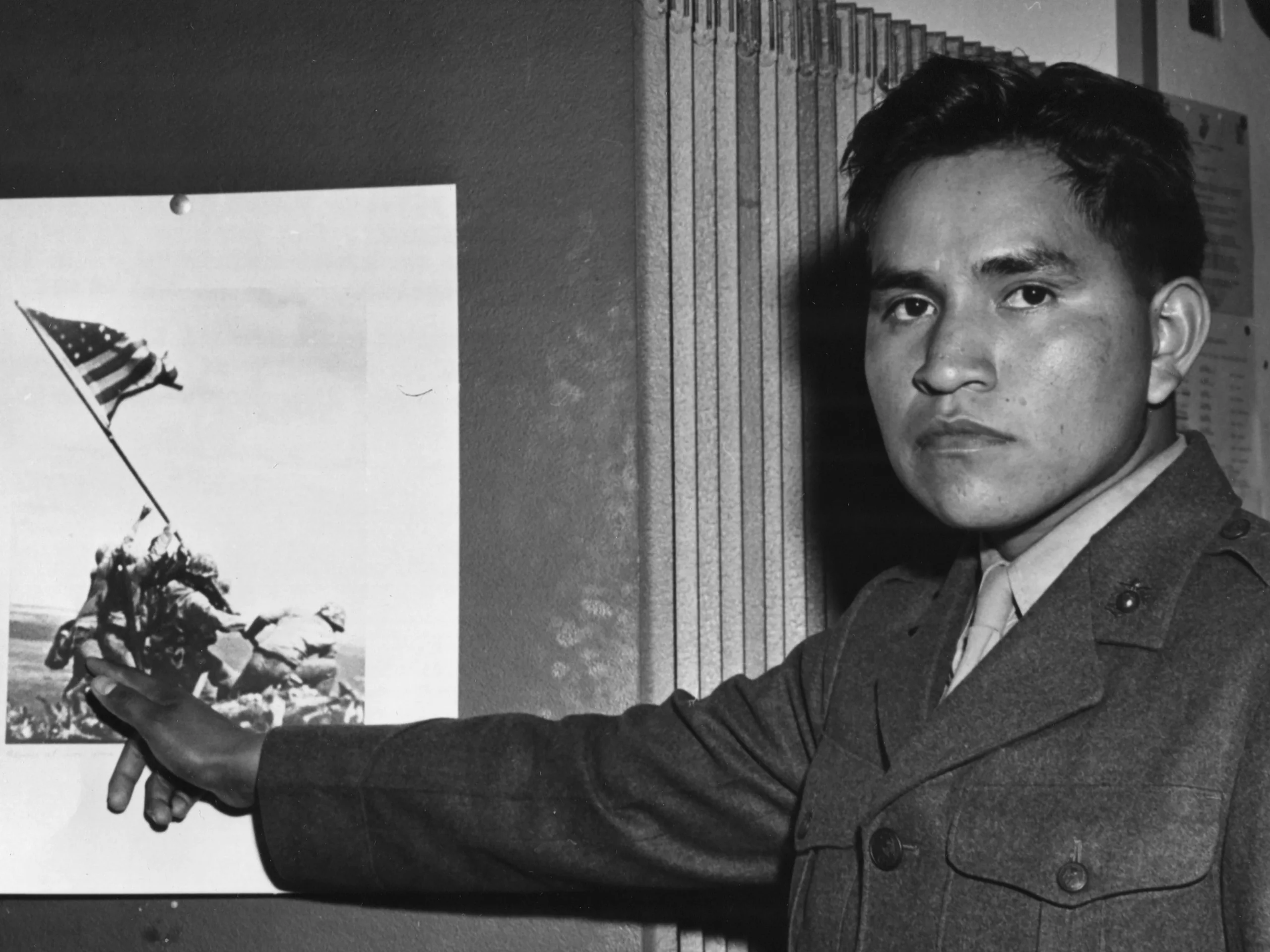
Ira Hayes
Birthday
+1923-01-12
Birth Sign
Capricorn
Birthplace
Sacaton
Age
Died at 32
About
Ira Hamilton Hayes was a United States Marine from the Gila River Indian Community in Arizona. Born on January 12, 1923, in Sacaton, he joined the Marine Corps Reserve in August 1942 and quickly volunteered for parachute training. His service took him through the Bougainville campaign before he landed on Iwo Jima in early 1945. During the battle there, Hayes became one of six men captured raising the second American flag over Mount Suribachi on February 23, 1945. That single moment transformed him into a national symbol overnight. After the fighting ended, Hayes and two other survivors traveled across the country to sell war bonds for the Seventh War Loan drive. The trip exhausted him physically and emotionally. He struggled with post-traumatic stress and turned to alcohol as a coping mechanism. His life unraveled quickly after the war years. On November 10, 1954, he attended the dedication of the Marine Corps War Memorial in Arlington, Virginia, which stood as a monument to that famous photo. Just weeks later, on January 23–24, 1955, Hayes died at age 32 from exposure and alcohol poisoning after a night of heavy drinking. Authorities buried him with full military honors at Arlington National Cemetery on February 2, 1955. Hayes appeared in several films and stories that kept his memory alive. He played himself in Sands of Iwo Jima alongside John Wayne in 1949. A journalist named William Bradford Huie wrote an article about Hayes that inspired the 1961 film The Outsider, starring Tony Curtis. Peter La Farge wrote the song "The Ballad of Ira Hayes" after reading that story, and Johnny Cash made it a hit in 1964. Decades later, Adam Beach portrayed Hayes in Clint Eastwood's Flags of Our Fathers in 2006.
Death & Aftermath
Died
+1955-01-24 (aged 32)
Death Place
Phoenix, Arizona
Cause of Death
Acute alcoholic intoxication and pneumonia
The official finding by the coroner in Phoenix determined that Ira Hayes died of acute alcoholic intoxication, a ruling that noted pneumonia and severe physical deterioration as contributing factors. The Marine, who had spent his final public days on a promotional tour for the film Sands of Iwo Jima and a radio broadcast in December 1954, was found unconscious upon returning to Arizona after being arrested for disorderly conduct in Los Angeles just two days prior. His condition worsened rapidly following his release from jail, leading to his admission at St. Joseph's Hospital where he passed away on January 24, 1955, at the age of thirty-two.
Public reaction immediately blended tributes to his service with a somber acknowledgment of his struggles, as veteran organizations like American Legion Post 62 held memorial services honoring the flag raiser despite his personal decline. The folk song "The Ballad of Ira Hayes" by Peter La Farge, released in 1963, later became a defining cultural artifact that renewed attention to the tragic circumstances surrounding his life and the treatment of Native American veterans. Hayes was buried in the Sacaton Cemetery near his birthplace three days after his death, a community event attended by tribal leaders and fellow Marines that marked the end of a life cut short by the pressures of fame and lack of support systems.
Posthumous recognition has included induction into the National Museum of the American Indian hall of fame and the dedication of monuments at the Iwo Jima Memorial and the Gila River Indian Community. While his estate remained minimal due to financial destitution, scholarship funds and memorials have since been established by the Gila River Indian Community and various veteran groups to preserve his legacy.
Awards & Accolades
Keywords
Quick Facts
- Profession
- paratrooper
- Born
- +1923-01-12
- Birthplace
- Sacaton
- Died
- +1955-01-24
- Death Place
- Bapchule
- Gender
- Male
- Birth Sign
- Capricorn
Join the community
fans discussing