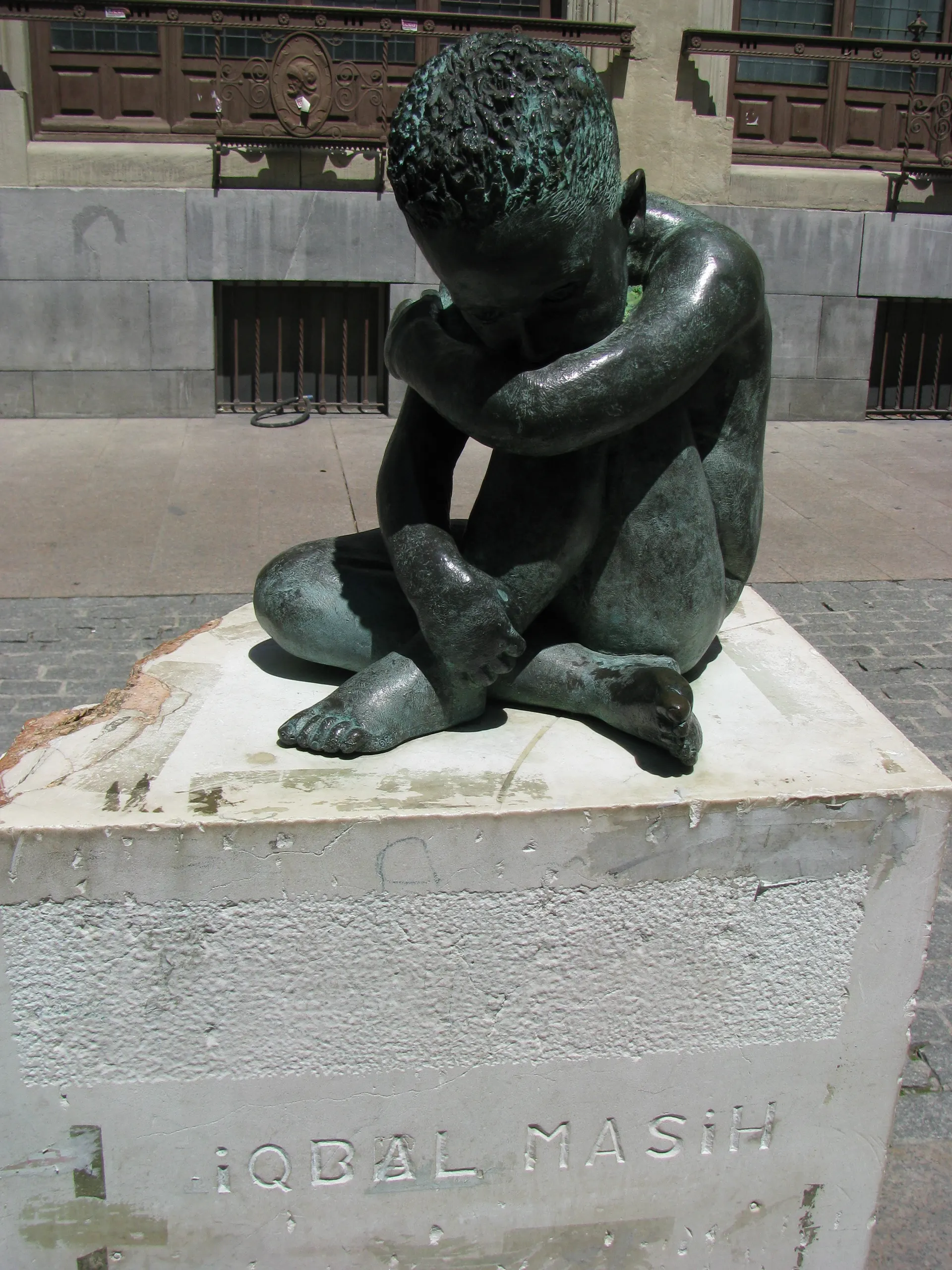
Iqbal Masih
 Pakistan
Also known as: Iqbal Masih, The Boy Who Said No
Birthday
January 1, 1983
Birth Sign
Capricorn
Birthplace
Muridke, Punjab, Pakistan
Age
Died at 12
About
Iqbal Masih was a Pakistani child labourer and human rights activist from Muridke, a town near Lahore. Born into poverty in 1983, he was sold into bonded slavery at age four but escaped six years later to join the Bonded Labour Liberation Front. He became a fearless global advocate against child exploitation, speaking at international forums before his assassination at age twelve. His brief life inspired legislation, documentaries, and international awards long after his death.
Early Life & Background
Iqbal Masih was born on January 1, 1983, in Muridke, a small town in the Punjab province of Pakistan. He was raised in a poor Christian family where his father worked as a farmer. When Iqbal was only four years old, his family fell into insurmountable debt. Unable to repay the loan, his father made the heartbreaking decision to sell Iqbal into bonded labour. This transaction bound the boy to a carpet factory in Faisalabad for life, trapping him and his descendants in a cycle of servitude that could not be broken without paying off the original debt.
For the next six years, Iqbal endured unimaginable hardship. He worked sixteen hours a day, seven days a week, weaving carpets with heavy looms. The conditions were brutal, and the physical toll was severe. He suffered from back pain, respiratory issues, and malnutrition like many other children in the industry. Despite the abuse, he maintained a spark of defiance. In 1993, at the age of ten, Iqbal managed to escape the factory. He did not return home but instead sought out the Bonded Labour Liberation Front (BLLF), an organization dedicated to freeing children from bondage. There, he found education, support, and a new purpose that would define his short life.
Career Growth
After escaping slavery in 1993, Iqbal joined the Bonded Labour Liberation Front (BLLF) and quickly emerged as a powerful voice for the cause. He began educating other freed children and advocating for their rights within local communities. By age eleven, he had become a public face for the movement, addressing crowds and media outlets about the horrors of bonded labor. His career as an activist was explosive yet brief, spanning only two years before his death.
In 1994, Iqbal achieved international recognition when he delivered a powerful speech at the International Labour Organization (ILO) conference in Geneva, Switzerland. His ability to articulate the suffering of millions of silenced children in fluent English drew global attention to the plight of child laborers in Pakistan. Later that year, he traveled to Stockholm, Sweden, to accept the World's Children's Prize, becoming the first recipient of this honor. Over the next year, he toured Europe and North America, giving interviews to major news outlets like The New York Times, BBC, and CNN. He met with politicians and dignitaries to push for legislative changes. His activism directly contributed to increased scrutiny of the Pakistani carpet industry and the formation of the Rugmark label, now known as GoodWeave, a certification program ensuring carpets are made without child labor.
Career Timeline
Public Image & Style
Iqbal Masih is portrayed as a fearless, courageous, and intelligent child who defied the odds. Media depictions emphasize his eloquence, his ability to speak truth to power, and his unwavering commitment to justice. He is often depicted in black-and-white photographs, wearing simple clothes, with a determined expression. His image is used in campaigns to raise awareness about child labor and to inspire future generations of activists. The narrative surrounding him focuses on his bravery in standing up to powerful forces despite his young age.
Fame & Fandom (iFAMOUS Rankings)
Iqbal Masih remains a figure of profound historical significance rather than contemporary celebrity, a distinction that places him outside the scope of current global popularity metrics. As of September 2026, iFANN has evaluated his standing and determined that he does not currently hold a placement in the published Global Top 1,000 or any Top-100 scope list. This absence from the rankings reflects his status as a martyr and activist whose influence operates through policy and advocacy rather than the commercial consumption signals typical of modern fame. While his name appears frequently in educational contexts and human rights discourse, he lacks the sustained media presence required for a numerical ranking in the present era.
The community dedicated to his memory functions as a global network of advocates rather than a traditional fandom with a specific moniker. There is no official fanbase name documented for Iqbal Masih; instead, his legacy is sustained by organizations like the Bonded Labour Liberation Front and the U.S. Department of Labor, which administer the annual Iqbal Masih Award. These groups organize vigils on April 16th, the anniversary of his assassination, and host educational screenings of the documentary Iqbal: A Tale of a Fearless Child. His most enduring moment remains his courageous stand against child labor, culminating in his death at age thirteen, an event that transformed him into a symbol of resistance. The lack of a resolved investigation into his murder has further cemented his narrative as a tragic hero, inspiring ongoing campaigns to end bonded labor worldwide.
Interesting Facts and Legends
Despite being a child, Iqbal spoke fluent English, Urdu, and Punjabi, allowing him to communicate effectively with international audiences. He was known to sing Christian hymns and folk songs, which he used to inspire other children during rallies. His nickname became "The Boy Who Said No," symbolizing resistance against oppression. A widely retold story describes how a twelve-year-old boy single-handedly brought the issue of child labor to the world stage, though this simplifies his collaboration with the BLLF. The circumstances of his death remain a subject of folklore, with speculation often pointing to powerful feudal landlords or carpet manufacturers threatened by his activism. Annual vigils are held globally on the anniversary of his killing, serving as rituals of remembrance and vigilance against child slavery.
Notable Quotes
“I am not a hero. I am just a boy who wants to be free.”
“If you want to see a real hero, look at the children who are still working in the factories.”
“We are not slaves. We are humans.”
“My father sold me because he had no money. But I will not let my children be sold.”
Family & Personal Life
Iqbal was born into a poor Christian family in Muridke. His father, Muhammad Masih, was a farmer who sold Iqbal into bonded labour due to debt. Although Iqbal escaped and lived primarily with the BLLF and activist networks, he maintained contact with his family. His parents remained in Muridke throughout his life. There is limited public information about his siblings, but he is known to have had a large family in the village. Iqbal was a devout Christian and often referenced his faith in his speeches, framing his struggle as a moral and spiritual battle against injustice.
Notable Connections
Relationships & Dating History
Iqbal Masih was a child when he became an activist and was assassinated at the age of twelve. There is no record of any romantic relationships, dating history, engagements, or marriages. His entire public life was dedicated to activism, education, and the liberation of other children. Any speculation about a personal life is unfounded given his age and the nature of his work. As of the date of his death in 1995, he was single, and no posthumous relationships have been documented. The concept of a "fandom" in the traditional sense does not apply; instead, he is honored by advocates and organizations.
Death & Aftermath
Died
April 16, 1995 (aged 12)
Death Place
Muridke, Punjab, Pakistan
Cause of Death
Gunshot wound
Iqbal Masih was killed on the afternoon of April 16, 1995, in Muridke, a town near Lahore where he was born. He was walking home from school when an unidentified man on a motorcycle pulled alongside him and fired multiple shots. The boy fell to the ground and died almost instantly at just twelve years old. Witnesses reported that the attacker fled the scene immediately, and despite a massive public outcry and police investigation, no one was ever arrested or convicted for the murder. Authorities suspected the killer was a powerful carpet manufacturer or feudal landlord whose business interests were threatened by Iqbal's relentless campaigning against bonded labor.
The news of his death sent shockwaves through Pakistan and the international community. Thousands attended his funeral in Muridke, including students, activists, and community leaders who marched with his simple coffin. His death galvanized the anti-child labor movement, leading to increased pressure on governments and corporations to address the issue. In the decades following his assassination, his legacy has been honored globally. The U.S. Department of Labor established the annual Iqbal Masih Award for the Elimination of Child Labor in 2008 to recognize individuals continuing his work. In March 2022, the Government of Pakistan posthumously awarded him the Nishan-e-Imtiaz, the nation's highest civilian honor, acknowledging his enduring contribution to human rights. His story continues to be told through books, documentaries, and educational materials that inspire new generations of activists.
Net Worth (Estate Value)
$0
iFANN Editorial Team estimate
As Iqbal Masih passed away at age twelve in 1995, he accumulated no personal wealth. His estate value is effectively zero, as he was a child and did not own significant assets. However, his legacy has generated substantial economic activity through royalties and licensing from books, documentaries, and merchandise bearing his name. Foundations such as the Iqbal Masih Foundation manage funds raised in his name to support education and advocacy. The U.S. Department of Labor's Iqbal Masih Award does not carry a monetary prize for the recipient in the same way as some other awards, but it brings recognition and funding to the winners' causes. There are no credible reports of a net worth estimate for 2026, as he is deceased and had no income-generating career beyond his brief activism. Any financial figures associated with his name refer to the funds managed by his legacy organizations, not personal wealth.
Awards Won (3)
Iqbal Masih received several posthumous honors recognizing his bravery and impact. He was awarded the Tamgha-e-Shujaat (Medal of Bravery) by the Government of Pakistan in 1995. In March 2022, he received the Nishan-e-Imtiaz (Order of Excellence), Pakistan's highest civilian honor. He was also the first recipient of the World's Children's Prize for the Rights of the Child in 1995. Additionally, the U.S. Department of Labor established the Iqbal Masih Award in 2008 in his memory.
1995 · Bravery
Lifetime Achievement
1995 · Rights of the Child
Advocacy Against Child Labor
Known For
Iqbal: A Tale of a Fearless Child
1995 · Subject of Documentary
Child Slave
1994 · Subject of Book
Keywords
Sources
Quick Facts
- Profession
- human rights defender
- Born
- January 1, 1983
- Birthplace
- Muridke, Punjab, Pakistan
- Died
- April 16, 1995
- Death Place
- Muridke, Punjab, Pakistan
- Gender
- Male
Personal Details
- Full Name
- Iqbal Masih
- Children
- Education
- Bonded Labour Liberation Front (BLLF) programs; formal schooling in Lahore after escape
Frequently Asked Questions
How old was Iqbal Masih when he died?
What caused Iqbal Masih's death?
Who was Iqbal Masih?
Did Iqbal Masih have any siblings?
Is there an award named after Iqbal Masih?
Join the community
fans discussing