“The movie is a triumph of style over substance, but what style! Spielberg has created a film that is relentlessly entertaining, even when it's being tasteless.”
Roger Ebert
Chicago Sun-Times
 United States
"The adventure continues, deeper into darkness."
Part of a Collection
Indiana Jones Collection
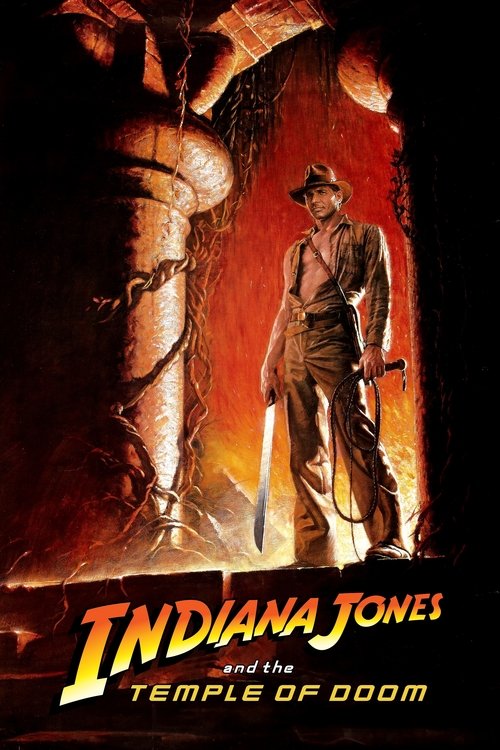
In 1935, Indiana Jones lands in Shanghai, where a nightclub deal goes sideways, sending him and nightclub singer Willie Scott (Kate Capshaw) on a chaotic escape that ends with a crash landing in rural India. There, a desperate village elder begs Indy to recover a sacred stone stolen by a sinister cult, which has also taken the village's children. What follows is a breakneck descent into the Temple of Doom, a subterranean lair of human sacrifice and mind control. Directed by Steven Spielberg and co-written by George Lucas, this prequel to Raiders of the Lost Ark trades the globe-trotting chase for a darker, pulpy horror-tinged adventure. Harrison Ford returns as the whip-cracking archaeologist, joined by Ke Huy Quan as his plucky sidekick Short Round and Amrish Puri as the memorably menacing high priest Mola Ram. With a budget of $28 million, the film grossed over $333 million worldwide, proving that even a controversial sequel could be a box office juggernaut. Its breakneck pacing, elaborate set pieces, and John Williams' rousing score made it a defining entry in the Indiana Jones franchise, even as its tone and cultural depictions sparked debate.
The production was famously taxing. Spielberg later admitted he was going through a personal rough patch, channeling that energy into the film's relentless intensity. The infamous heart-removal scene, achieved with prosthetics, pushed the boundaries of the then-PG rating and directly contributed to the creation of PG-13. Filmed across Sri Lanka, England, and California, the production faced challenges from monsoon weather to Harrison Ford's herniated disc, yet the result was a box office smash that earned over $333 million worldwide. Kate Capshaw, who played Willie, would later become Spielberg's wife, and Ke Huy Quan's Short Round became a beloved character, with Quan himself enjoying a remarkable career resurgence decades later.
Stream
Rent
Availability and pricing can change. Confirm on the provider's site before purchasing.
It's 1935, and Indiana Jones is in Shanghai, trying to swap a precious diamond for the ashes of a Chinese emperor. The deal goes sour when crime boss Lao Che double-crosses him, leading to a chaotic escape through a nightclub and onto a waiting plane. Indy, along with nightclub singer Willie Scott and his young sidekick Short Round, barely escapes with their lives, but the plane runs out of fuel, and they bail out using an inflatable raft. They crash-land in the mountains of India, riding the raft down a river and over waterfalls before coming to rest in the jungle.
Nearby, the trio stumbles upon the village of Mayapore, a once-thriving community now in despair. The villagers explain that their sacred Sankara Stones, which brought prosperity, were stolen by an evil cult, and their children have been kidnapped. The village elder pleads with Indy to recover the stones and save the children. Though initially reluctant, Indy agrees, and they set off toward the ominous Pankot Palace, where the cult is rumored to reside.
At the palace, they are greeted by the young Maharaja and his prime minister, Chattar Lal, who seem charming but are secretly part of the Thuggee cult. That night, Indy discovers a hidden passage leading to the temple beneath the palace. He, Willie, and Short Round descend into the depths, where they witness the cult's horrific practices: human sacrifices, mind-controlled slaves, and the veneration of the goddess Kali. Mola Ram, the high priest, plans to use the Sankara Stones to bring about global domination.
Captured, Indy is forced to drink the Blood of Kali, a potion that enslaves his mind. Short Round manages to escape and, using a torch, frees Indy from the trance. A fierce battle ensues, and Indy retrieves the stones, but Mola Ram takes Willie to a rope bridge over a crocodile-infested gorge. Indy follows, and in a tense confrontation, the bridge is cut, sending them all plummeting. Indy, Willie, and Short Round survive by clinging to the bridge's remains, while Mola Ram is devoured by crocodiles. Indy then uses one of the stones to trigger the temple's collapse, burying the cult. They escape and return to Mayapore, where the children are reunited with their families and the stones are restored. The film ends with Indy, Willie, and Short Round riding off together, having forged an unlikely bond through their harrowing ordeal.
Paramount Movies Trailer
Original Trailer [FHD]
Trailer
Critical Consensus
Indiana Jones and the Temple of Doom is a darker, more intense entry in the franchise that divides critics and audiences. While some praise its breakneck pacing, elaborate set pieces, and John Williams' rousing score, others criticize its tonal inconsistency, graphic violence, and controversial cultural depictions. Despite its flaws, the film remains a beloved and influential adventure classic that showcases Spielberg's mastery of spectacle and Ford's iconic performance.
“The movie is a triumph of style over substance, but what style! Spielberg has created a film that is relentlessly entertaining, even when it's being tasteless.”
Roger Ebert
Chicago Sun-Times
“The film is a noisy, gaudy, and often exhilarating spectacle that delivers on its promise of nonstop adventure, even if it occasionally overstays its welcome.”
Vincent Canby
The New York Times
“Spielberg's sequel is a roller-coaster ride of pure adrenaline, with Harrison Ford at his swashbuckling best, though the film's darker tone may alienate some viewers.”
Variety Staff
Variety
Harrison Ford
Indiana Jones
Kate Capshaw
Willie Scott
Ke Huy Quan
Short Round
Amrish Puri
Mola Ram
Roshan Seth
Chattar Lal
Director
Steven Spielberg
Writers
Willard Huyck, Gloria Katz, George Lucas, Philip Kaufman
Composer
John Williams
Cinematographer
Douglas Slocombe
Producer
Robert Watts
Academy Awards (1985)
Best Original Score: Nominated
BAFTA Awards (1985)
Best Visual Effects: Nominated
Saturn Awards (1985)
Best Fantasy Film: Won
Golden Globe Awards (1985)
Best Original Score: Nominated
Join the community
fans discussing