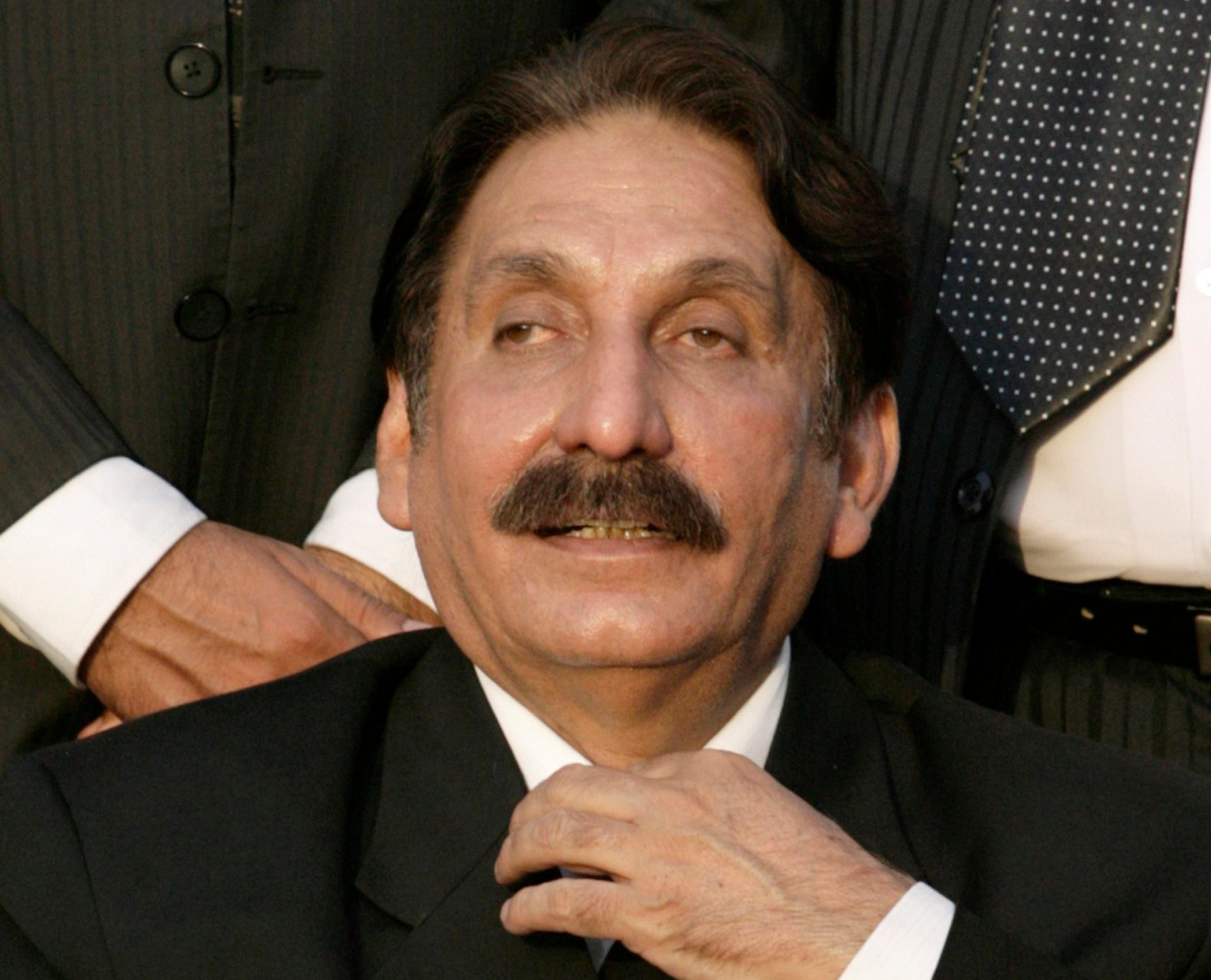
Iftikhar Chaudhry
 Pakistan
Also known as: Iftikhar Muhammad Chaudhry, Chief Justice Iftikhar
Birthday
December 12, 1948
Birth Sign
Sagittarius
Birthplace
Quetta, Pakistan
Age
77 years old
About
Iftikhar Muhammad Chaudhry is a Pakistani jurist who served as the 20th Chief Justice of Pakistan. Born in Quetta in 1948, he became one of the most consequential figures in the country's legal history, known for defying military rule and reshaping the judiciary's role. His tenure, spanning three non-consecutive terms from 2005 to 2013, was marked by fierce battles for judicial independence and a legacy that still sparks debate.
Chaudhry's name became synonymous with resistance when he refused to resign at the demand of President Pervez Musharraf in 2007, triggering a nationwide lawyers' movement. He was suspended, reinstated, arrested, and finally restored, emerging as a symbol of defiance against authoritarianism. His court took on powerful politicians and military leaders, even dismissing a sitting prime minister for contempt.
Today, Chaudhry remains active in public life, leading his own political party and occasionally speaking out on legal and constitutional matters. For many Pakistanis, he represents the fight for an independent judiciary, while critics point to judicial overreach. His impact on the country's legal landscape is undeniable.
Early Life & Background
Born on December 12, 1948, in Quetta, the capital of Balochistan, Iftikhar Muhammad Chaudhry grew up in a region that would later shape his legal career. Details of his early life are scarce, but he pursued law and was admitted as an advocate at the Sindh High Court in 1976. He then returned to Quetta, where he built his practice and became a prominent figure in the local legal community.
His rise through the ranks was steady. In 1986, he was elected president of the Balochistan High Court Bar Association, and he served two terms on the Bar Council. His administrative skills caught attention, leading to his appointment as Advocate General of Balochistan in 1989. The following year, he became an additional judge at the Balochistan High Court, taking on multiple roles including Banking Judge for Special Courts and Judge for the Customs Appellate Court.
Beyond the bench, Chaudhry chaired the Balochistan Local Council Election Authority for two terms starting in 1992 and led the provincial chapter of the Pakistan Red Crescent Society twice. He also headed the Provincial Review Board for Balochistan. By 1999, he was nominated Chief Justice of the Balochistan High Court, and in 2000 he joined the Supreme Court of Pakistan. These early years established him as a capable administrator and a lawyer deeply rooted in his home province.
Career Growth
Chaudhry's appointment as Chief Justice of Pakistan on June 29, 2005, marked the start of a turbulent and transformative era. He quickly gained a reputation for judicial activism, taking up cases that challenged government actions. The turning point came in March 2007 when President Pervez Musharraf demanded his resignation. Chaudhry refused, leading to his suspension on March 9. This sparked the Lawyers' Movement, a massive protest movement across Pakistan. On July 20, 2007, the Supreme Court reinstated him by a 10-3 vote, a decisive rebuke to Musharraf.
The political turmoil continued. In November 2007, Musharraf declared a state of emergency, and Chaudhry was arrested and suspended again. After the emergency ended and Musharraf resigned, Chaudhry was finally restored on March 22, 2009, following the Long March. His second term was marked by aggressive use of suo motu powers. He took on the privatization of Pakistan Steel Mills, missing persons cases in Balochistan, and the New Murree project. In 2012, he initiated contempt proceedings against Prime Minister Yousaf Raza Gillani, leading to Gillani's dismissal. He retired on December 11, 2013, after eight years on the bench.
Post-retirement, Chaudhry formed the Pakistan Justice Democratic Critic Party in December 2015, aiming to bring judicial and democratic reforms. He has also engaged in media, giving interviews and writing articles.
Career Timeline
Public Image & Style
Chaudhry's public image is defined by his role as a symbol of judicial independence. Media often described him as 'Pakistan's Fearless Chief Justice' who defied military dictators and held prime ministers accountable. His supporters, particularly lawyers, saw him as a hero. The Lawyers' Movement, which erupted after his suspension, was a testament to his standing among the legal community. His return to work in 2009 was celebrated with rose petals thrown by lawyers. Critics, however, accused him of judicial overreach and using his office for personal gain. His image remains polarizing, but his impact on Pakistan's judiciary is undeniable.
Fame & Fandom
The support base surrounding Iftikhar Chaudhry defies the typical architecture of celebrity fandom. There are no t-shirts, no fan clubs, and no organized digital armies chanting slogans on social media. Instead, his following is a coalition of lawyers, civil society activists, and political groups united by a shared defense of judicial independence. This audience does not celebrate him for entertainment value but mobilizes around constitutional crises, turning court suspensions into nationwide street protests. The defining moment was the Lawyers' Movement of 2007, where thousands donned black robes to march through Karachi, Lahore, and Islamabad, transforming legal grievances into a physical barrier against military dictatorship. While pop stars rely on birthday billboards and viral challenges, Chaudhry's legacy is built on the visceral image of judges standing firm in the face of arrest warrants and the euphoric restoration of the rule of law. His international recognition, such as receiving the Harvard Law School Medal of Freedom while under house arrest, added a layer of global gravitas to this domestic struggle. Unlike modern influencers who cultivate direct engagement, Chaudhry interacted with his supporters through rulings and symbolic gestures like wearing a shawl during detention. The movement was a reflection of the power of the bar rather than a fan campaign driven by adoration. As of August 2026, iFANN has evaluated Iftikhar Chaudhry, but he currently holds no placement in the published Global Top 1,000 or any Top-100 scope list. He remains an EVALUATED_UNRANKED figure within the system.
Interesting Facts and Legends
Iftikhar Muhammad Chaudhry served as the 20th Chief Justice of Pakistan across three non-consecutive terms between 2005 and 2013, a unique feat in the nation's history. His reinstatement on July 20, 2007, resulted from a stunning 10-3 Supreme Court vote that caught President Pervez Musharraf off guard. A second suspension involved a physical arrest during the November 2007 emergency, distinct from his first removal. He turned 65 the day after retiring on December 11, 2013. Contempt proceedings against Prime Minister Gillani marked the first time a sitting prime minister was dismissed by the judiciary. He frequently took suo motu notice on diverse issues ranging from steel mill privatization to environmental projects. Beyond these facts, a legendary story persists regarding his receipt of the Harvard Law School Medal of Freedom in November 2007. Despite being under house arrest and facing removal from office, the award cemented his status as a global symbol of judicial courage. Another iconic moment involves the streets of Pakistan filling with lawyers throwing rose petals when he returned to work in 2009, celebrating a victory over authoritarianism. Critics later noted his legacy as robust yet inconsistent, particularly after backlash in August 2013 regarding specific judgments before his retirement.
Family & Personal Life
Public information about Chaudhry's family is very limited. He was born in Quetta, but details about his parents, siblings, or his own household are not documented in the sources. As a senior jurist, he kept his personal life private. It is known that he pursued law, but no information is available about his spouse or children. His focus remained on his professional and public duties, and he rarely spoke about family matters in interviews.
Notable Connections
Chaudhry's career was defined by his confrontations with President Pervez Musharraf, who suspended and arrested him. President Asif Ali Zardari delayed his restoration after Musharraf's fall. Prime Minister Yousaf Raza Gillani was dismissed due to Chaudhry's contempt case. Journalist Irshad Bhatti conducted an exclusive podcast interview with him.
Relationships & Dating History
No public romantic relationships are documented for Iftikhar Chaudhry. His personal life has remained private, and there is no information about a spouse, partner, or dating history. As a jurist of his generation, he kept his family out of the spotlight. As of 2026, his relationship status is not publicly documented.
Salary, Net Worth In 2026
$2 Million
iFANN Editorial Team estimate
As a high-ranking Pakistani government official, Chaudhry's income derived primarily from judicial salaries provided by the state. The exact figures remain private, though Supreme Court judges in Pakistan receive a standardized government salary. Following his retirement, there are no known commercial ventures or endorsement deals associated with his name. Per iFANN's editorial analysis, his net worth is estimated to be around $2 Million as of 2026, based on typical career earnings and accumulated assets. However, this figure remains speculative given the lack of public financial disclosure.
Awards & Accolades
View 2 records, honours and achievementsKnown For
Chief Justice of Pakistan
2005-2013 · Chief Justice
Keywords
Sources
Quick Facts
- Profession
- Judge
- Born
- December 12, 1948
- Birthplace
- Quetta, Pakistan
- Gender
- Male
- Birth Sign
- Sagittarius
Personal Details
- Full Name
- Iftikhar Muhammad Chaudhry
- Education
- Law degree, became advocate at Sindh High Court in 1976
Frequently Asked Questions
Why was Iftikhar Chaudhry suspended?
How many times was Iftikhar Chaudhry chief justice?
What did Iftikhar Chaudhry do to Prime Minister Gillani?
What is Iftikhar Chaudhry's age?
What happened to Iftikhar Chaudhry after retirement?
Similar People
Join the community
fans discussing