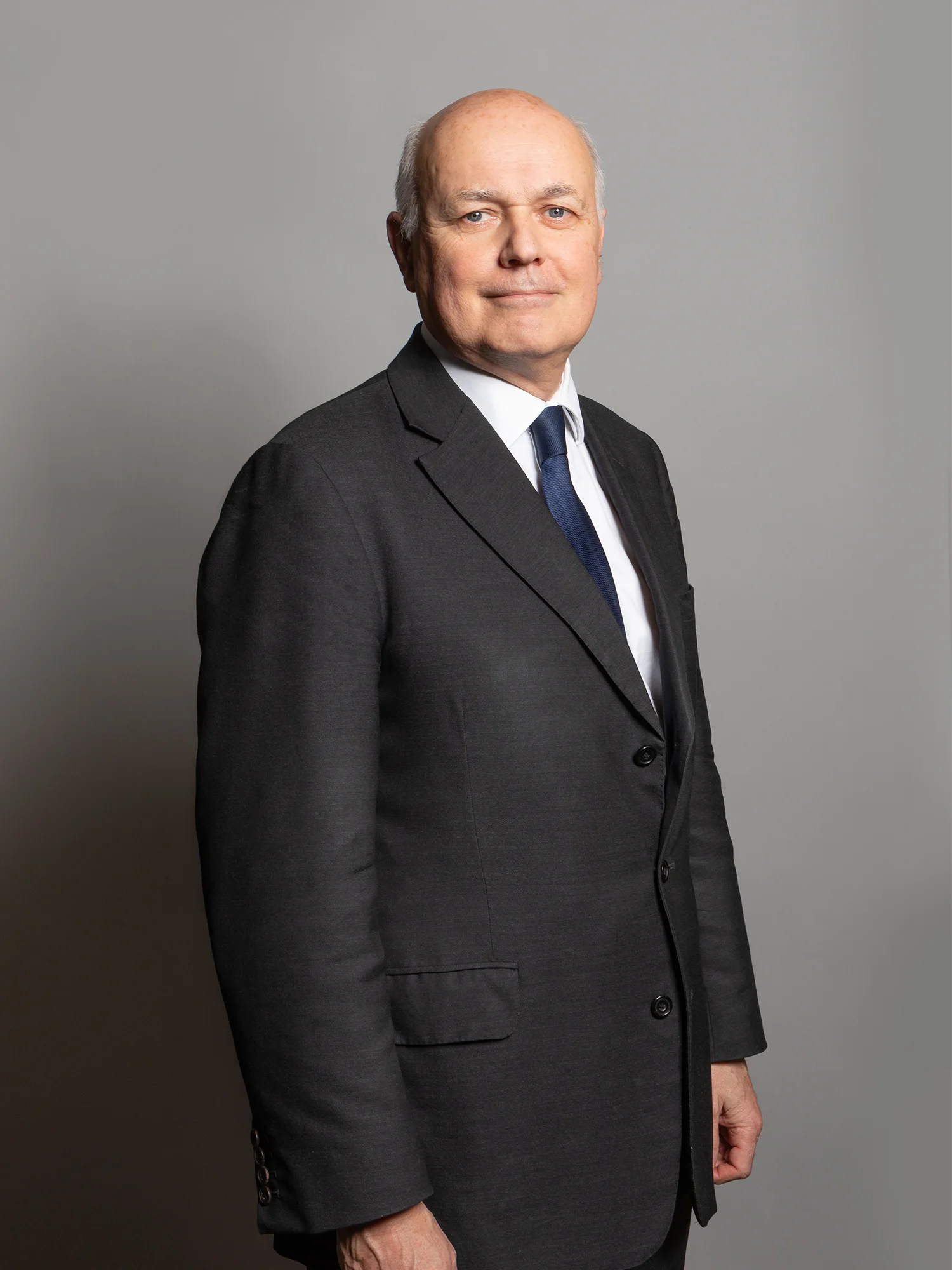
Iain Duncan Smith
 United Kingdom
Also known as: IDS
Birthday
April 9, 1954
Birth Sign
Aries
Birthplace
Glasgow, Scotland
Age
72 years old
About
Sir George Iain Duncan Smith, known to most as IDS, is a British politician who has spent over three decades in the House of Commons. Born in Glasgow on 9 April 1954 and raised in Solihull, he is the son of W. G. G. Duncan Smith, a decorated Royal Air Force flying ace. Before entering politics, IDS trained at the HMS Conway and the Royal Military Academy Sandhurst, then served in the Scots Guards from 1975 to 1981, including tours in Northern Ireland and Rhodesia. He joined the Conservative Party in 1981 and, after an unsuccessful bid for Bradford West in 1987, was elected MP for Chingford in 1992, a seat he has held ever since (now Chingford and Woodford Green).
His early parliamentary career was as a backbencher under John Major, but he rose quickly in opposition. Under William Hague, he served as Shadow Secretary of State for Social Security (1997-98) and then Defence (1998-2001). When Hague resigned after the 2001 election, Duncan Smith won the leadership contest, partly thanks to Margaret Thatcher's backing for his Eurosceptic views. As Leader of the Opposition from 2001 to 2003, he struggled to connect with the public, and many MPs doubted he could win a general election. He lost a confidence vote in October 2003 and resigned immediately, replaced by Michael Howard.
Returning to the backbenches, IDS founded the Centre for Social Justice, a think tank that would shape his later welfare reforms. In 2010, David Cameron brought him into government as Secretary of State for Work and Pensions, a role he held for six years. He was responsible for major welfare changes, including the introduction of Universal Credit. He resigned in March 2016, opposing George Osborne's cuts to disability benefits, and returned to the backbenches, where he remains an active and often outspoken figure.
Across his career, IDS has been a polarizing figure, but his commitment to social justice and his military background have defined his approach. He has been an MP for over 30 years, a leader, a cabinet minister, and a consistent voice on welfare and defence.
Early Life & Background
Iain Duncan Smith came into the world on 9 April 1954 in Kelvindale, Glasgow, the youngest of five children. His father, Wilfrid George Gerald Duncan Smith, was a Royal Air Force flying ace who shot down 19 enemy planes during the Second World War. His mother, Pamela Summers, had danced as a ballerina. The family moved to Solihull, where Iain grew up with what he has described as an old-fashioned Christian upbringing.
His schooling took him to HMS Conway, a naval training college in Anglesey, and later to the Royal Military Academy at Sandhurst. He also spent time at the Universita per Stranieri in Perugia, Italy, studying Italian. In 1975, he was commissioned into the Scots Guards, serving in Northern Ireland during the Troubles and in Rhodesia (now Zimbabwe). He also spent time in Canada and Germany. His military service lasted until 1981.
After leaving the army, Duncan Smith moved into industry. He worked for GEC-Marconi, a defence company, then became a director at Bellwinch, a property firm, and later at Jane's Information Group, the publishing company known for defence and security intelligence. He joined the Conservative Party in 1981, the same year he left the military.
His first attempt to enter Parliament came in 1987, when he stood for Bradford West and lost. Five years later, in 1992, he won the safe seat of Chingford in Essex, succeeding Norman Tebbit. That election day, 9 April, happened to be his 38th birthday. From there, his political career took off.
Career Growth
Once in Parliament, Duncan Smith quickly made his mark as a Eurosceptic, opposing the Maastricht Treaty in his first term. When the Conservatives lost power in 1997, William Hague promoted him to the Shadow Cabinet as Shadow Secretary of State for Social Security, then moved him to Defence in 1999. In those roles he hammered Labour's record on welfare and defence spending.
After Hague's resignation in 2001, Duncan Smith stood for the party leadership. Margaret Thatcher backed his Eurosceptic credentials, and he won. But his time as Leader of the Opposition was rocky. He struggled to land punches on Tony Blair, and in October 2003 he lost a confidence vote among MPs and resigned immediately. Michael Howard took over.
Out of the spotlight, Duncan Smith founded the Centre for Social Justice in 2004, a think tank that pushed poverty and social breakdown up the Conservative agenda. The CSJ's work on modern slavery led to landmark legislation after Theresa May adopted its proposals.
When David Cameron formed a coalition government in 2010, he appointed Duncan Smith Secretary of State for Work and Pensions. There he oversaw the introduction of Universal Credit, a sweeping overhaul of the benefits system. His department controlled about a third of public spending. He resigned in March 2016, refusing to accept George Osborne's cuts to disability benefits.
That same year, Duncan Smith threw himself into the Vote Leave campaign ahead of the EU referendum. In 2019, he chaired Boris Johnson's successful bid for the Conservative leadership. He remains an MP and a vocal presence on welfare, defence, and Brexit.
Career Timeline
Public Image & Style
Iain Duncan Smith is known universally as IDS, a nickname that has stuck through decades of British politics. His public persona is one of seriousness and old-fashioned values, shaped by his military background and Catholic faith. He has been described as 'not emotionally available' and 'personally very old-fashioned' by his former campaign manager, yet also as funny and a skilled mimic.
Media portrayals have shifted over time. Early in his leadership, he was often dismissed as a failure. But as Work and Pensions Secretary, commentators began to see him as a 'round peg in a round hole,' someone who had finally found his niche. He is credited with moving the Conservative Party back toward the centre ground on poverty and public services.
His social media presence is modest but active, with a Twitter account under @MPIainDS and a Facebook page. He uses these platforms to communicate policy positions and constituency news, but he is not a digital showman. His appeal lies in his authenticity and willingness to take principled stands, even against his own party's leadership.
Fame & Fandom (iFAMOUS Rankings)
Iain Duncan Smith operates within the sphere of high-level British politics rather than entertainment, meaning his public interaction remains strictly parliamentary and constituency-focused. There is no official or unofficial fandom name attached to his career, nor are there documented fan rituals, organized campaigns, or viral moments that define a celebrity following. His digital presence is managed through official channels for political promotion rather than driven by fan engagement, and while he founded the Centre for Social Justice, this functions as a policy think tank rather than a fan organization. The concept of a dedicated fanbase does not apply to a figure whose supporters are constituents and party members. In August 2026, the iFANN Global Fame Engine evaluated his standing but determined he currently holds no placement in the published rankings, including the Global Top 1,000 or any scope-specific list. This absence of a ranked position reflects his status as a serious political operator without the cultural mythology required for inclusion in global fame metrics. His legacy consists of political tenure, legislative controversies regarding Universal Credit, and recent geopolitical commentary on China and Hong Kong, none of which have generated the widespread adoration necessary for a formal ranking. Consequently, he appears as an unranked entity in the current dataset, distinguished by his long service in the House of Commons rather than by popularity signals measured against global entertainers.
Interesting Facts and Legends
Sir George Iain Duncan Smith carries the middle name 'Iain' with a double 'i', a spelling change made later in life amidst stories suggesting it was either a birth certificate correction, a personal commitment to Scotland, or a suggestion from his father. He is of mixed heritage, with a great-grandmother from Japanese samurai stock, a detail he has discussed publicly. Despite a stern public image often described as emotionally distant, former campaign manager Bernard Jenkin noted he is a skilled mimic happy to be teased. A practising Catholic, he considers his faith integral to his actions and once used the phrase 'That's a sin' during a 2010 welfare debate, marking an unusual theological reference for a frontbench politician. He speaks Italian, having studied at Perugia. His political career includes significant moments such as resigning as Secretary of State for Work and Pensions in March 2016 over concerns regarding the Universal Credit rollout. More recently, in March 2026, his name appeared on a pro-democracy list linked to an alleged spy case, and by June 2026, he criticized a new role taken by Rhodes as a conflict of interest. These events form the core of his modern political biography rather than pop-cultural lore.
Notable Quotes
“That's a sin.”
“It is integral to everything I do.”
“The organisations I see on the ground doing arguably the best work are often religious organisations.”
Family & Personal Life
Iain Duncan Smith's father, Wilfrid George Gerald Duncan Smith, was a Royal Air Force ace in the Second World War, credited with shooting down 19 enemy aircraft. His mother, Pamela Summers, was a ballerina. They married in 1946. Iain was the youngest of five children.
He married Elizabeth 'Betsy' Wynne Fremantle in 1982. Betsy comes from a family with aristocratic connections, the Fremantles. Together they have four children: Harry, Edward, Rosie, and Alicia. The couple has been married for over four decades, and there is no public record of any other romantic relationships during his marriage.
His great-grandmother on his father's side was Japanese, from samurai lineage, a heritage he has acknowledged.
The family home is in his Chingford and Woodford Green constituency, where he has lived for much of his political career.
Notable Connections
Iain Duncan Smith's political journey has been shaped by key figures. William Hague promoted him to the Shadow Cabinet. David Cameron appointed him Work and Pensions Secretary. George Osborne's disability benefit cuts prompted his resignation. Margaret Thatcher backed his 2001 leadership bid. Bernard Jenkin served as his campaign manager. Boris Johnson's leadership bid was chaired by Duncan Smith in 2019. Norman Tebbit preceded him as MP for Chingford, and Michael Howard succeeded him as Conservative leader. At the Centre for Social Justice, he worked with Phillippa Stroud and Tim Montgomerie.
Relationships & Dating History
Iain Duncan Smith married Elizabeth 'Betsy' Wynne Fremantle in 1982. Betsy is the daughter of a family with aristocratic connections, the Fremantles. The couple has been together for over four decades, a rare stability in political marriages. They have four children: Harry, Edward, Rosie, and Alicia.
There are no public records of any other romantic relationships during his marriage. Duncan Smith has kept his personal life private, and no scandals or affairs have ever been reported. As of 2026, he remains married to Betsy, and the couple lives in his Chingford and Woodford Green constituency.
- MarriedElizabeth 'Betsy' Wynne Fremantle1982 - presentCurrentMarried since 1982, they have four children together.
Salary, Net Worth In 2026
$5 Million
iFANN Editorial Team estimate
As a career politician, Iain Duncan Smith's wealth derives primarily from his parliamentary salary and ministerial pensions accumulated since entering the House of Commons in 1992. His high-profile roles include serving as Leader of the Opposition and Secretary of State for Work and Pensions, where his ministerial salary reached approximately £67,000 at the time of his resignation, supplementing his basic MP income. He also receives a military pension for his six years of service in the Scots Guards. While his pre-political business career with entities like GEC-Marconi and Jane's Information Group provided initial capital, he has not operated as a major entrepreneur. Per iFANN's editorial analysis, estimates of his net worth in 2026 sit at around $5 Million, a figure consistent with a long-serving senior politician. His wife, Betsy, hails from a wealthy family, which likely contributes to the household's financial standing. There is no evidence of significant property holdings or investments beyond his primary residence in the constituency.
Awards & Accolades
View 2 records, honours and achievementsKnown For
Leader of the Conservative Party
2001-2003 · Leader of the Opposition
Secretary of State for Work and Pensions
2010-2016 · Cabinet Minister
Founder of the Centre for Social Justice
2004 · Founder
Member of Parliament for Chingford and Woodford Green
1992-present · MP
Keywords
Sources
Quick Facts
- Profession
- politician
- Born
- +1954-04-09
- Birthplace
- Glasgow
- Gender
- Male
- Spouse
- Elizabeth 'Betsy' Wynne Fremantle
- Birth Sign
- Aries
Personal Details
- Full Name
- George Iain Duncan Smith
- Spouse
- Elizabeth 'Betsy' Wynne Fremantle
- Children
- Harry · Edward · Rosie · Alicia
- Education
- HMS Conway, Royal Military Academy Sandhurst, Universita per Stranieri (Perugia)
Frequently Asked Questions
Is Iain Duncan Smith married?
How old is Iain Duncan Smith?
What did Iain Duncan Smith do before politics?
Why did Iain Duncan Smith resign in 2016?
What is Iain Duncan Smith's net worth?
Social Media
Similar People
Join the community
fans discussing