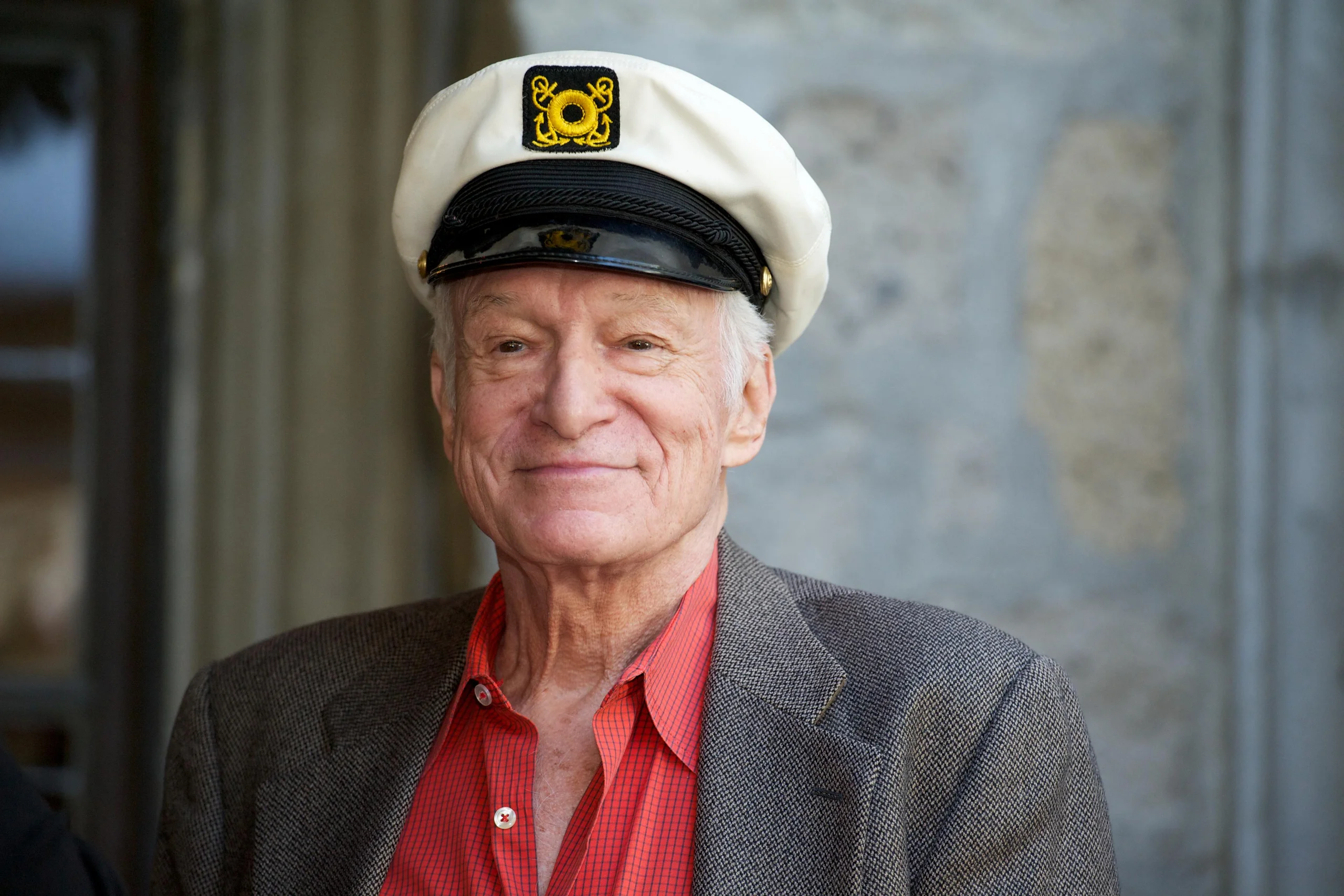
Hugh Hefner
 United States
Magazine publisher•editor•businessman
Also known as: Hef, Hugh Marston Hefner, Hugh M. Hefner
Birthday
April 9, 1926
Birth Sign
Aries
Birthplace
Chicago, Illinois, USA
Age
Died at 91
Height
5 ft 9 in (175 cm)
About
Hugh Marston Hefner was an American magazine publisher and businessman who built the Playboy empire and became one of the most recognizable cultural figures of the 20th century. As the founder and editor-in-chief of Playboy magazine from 1953 until his death in 2017, he turned a small Chicago-based publication into a global media brand that included clubs, television shows, and merchandise. Hefner was known for his flamboyant lifestyle, silk pajamas, and the Playboy Mansion, which served as the backdrop for his public persona as a champion of sexual liberation.
Beyond the magazine, Hefner was a vocal advocate for First Amendment rights and civil liberties, funding legal battles and establishing the Hugh M. Hefner First Amendment Awards. His influence extended into politics and culture, with the Playboy Interview becoming a platform for presidents, activists, and artists. At its peak, Playboy Enterprises was a publicly traded company with millions of readers worldwide.
Hefner's legacy remains deeply polarizing. Supporters credit him with normalizing conversations about sexuality and pushing back against censorship, while critics point to the objectification of women and the exploitative dynamics of the Mansion. After his death, his widow Crystal Hefner and former girlfriends have publicly revisited their experiences, complicating the image he cultivated. He died on September 27, 2017, at the age of 91, leaving behind a fortune and a cultural footprint that continues to spark debate.
Early Life & Background
Hugh Hefner grew up in a strict Methodist household on Chicago's South Side, the eldest of two sons. His parents, Grace and Glenn Hefner, were described by biographers as conservative and emotionally distant, rarely showing affection. Hefner later credited this repressive upbringing with fueling his lifelong campaign to liberalize American attitudes toward sex.
At Steinmetz High School, he was an average student but showed early creative promise, drawing cartoons and writing for the school newspaper. After graduating, he served in the U.S. Army from 1944 to 1946 during World War II, though he never saw combat. He then enrolled at the University of Illinois at Urbana-Champaign, earning a bachelor's degree in psychology in 1949. He took graduate courses at Northwestern University but left without completing a degree.
His early career included a copywriting job at Esquire magazine, where he reportedly was denied a $5 raise, prompting him to quit. He also worked as a circulation promotion manager for Children's Activities magazine. In 1953, he raised approximately $8,000 from 45 investors, including his mother who contributed $1,000 on the condition that the publication not be "dirty." That investment bankrolled the first issue of Playboy, which featured Marilyn Monroe on the cover and sold over 50,000 copies. The first issue carried no date because Hefner was unsure there would be a second.
Career Growth
Hefner launched Playboy in December 1953, and the magazine quickly became a cultural phenomenon. By 1955, he introduced the Playboy Interview, a long-form Q&A that featured figures like Martin Luther King Jr., John Lennon, and Jimmy Carter. The brand expanded into television with Playboy's Penthouse in 1959 and the first Playboy Club opened in Chicago that same year, featuring the iconic Bunny waitresses. At its peak, the club network spanned over 20 locations worldwide.
Playboy Enterprises went public in 1971, and Hefner purchased the Los Angeles mansion that became the Playboy Mansion, the epicenter of his lifestyle brand. The 1980s brought financial strain as the club business declined, and most clubs closed by the end of the decade. Hefner adapted by focusing on licensing and international editions, and the reality show The Girls Next Door (2005-2010) revitalized his public image in the 2000s.
In 2009, he sold the Playboy Mansion to Daren Metropoulos for about $100 million, retaining a life estate. In 2016, he controversially announced that Playboy would stop publishing nude photography, a decision partially reversed after his death. Hefner died on September 27, 2017, at the Mansion, leaving the brand in the hands of his son Cooper Hefner.
Career Timeline
Public Image & Style
Hefner cultivated an unmistakable public persona: silk pajamas, a velvet robe, and a pipe, often surrounded by Playmates at the Mansion. This image was carefully crafted to project a sense of effortless luxury and sexual freedom. He embraced the role of the hedonistic playboy, but also positioned himself as an intellectual and a defender of civil liberties, hosting lavish parties that mixed celebrities, politicians, and academics.
The media portrayed him as both a visionary and a controversial figure. In the 2000s, The Girls Next Door turned his lifestyle into entertainment, solidifying his place in pop culture. Fans saw him as a symbol of a bygone era of glamour, while critics argued that his empire objectified women. His social media accounts, managed posthumously by the foundation, maintain a nostalgic and celebratory tone, but recent revelations from former partners have complicated that narrative.
His legacy is now viewed through a more critical lens, with former girlfriends like Holly Madison and Kendra Wilkinson speaking out about the controlling environment of the Mansion. Crystal Hefner's public regret and the ongoing legal battles over his personal scrapbooks have further shaped public perception, ensuring that his image remains contested long after his death.
Fame & Fandom (iFAMOUS Rankings)
The audience for Hugh Hefner never coalesced into a single, named tribe with rituals or inside jokes. Instead, his influence rippled through the readers of *Playboy* magazine, viewers of *The Girls Next Door*, and supporters of the civil liberties causes championed by the Hugh M. Hefner Foundation. This was a relationship defined more by consumption of his media empire than direct engagement, creating a legacy that spans generations rather than a traditional fanbase. The cultural mythology surrounding him is anchored in his role as the architect of the sexual revolution and the unique lifestyle at the Playboy Mansion, though recent legal revelations have added complex layers to his story, including verified accounts of his 2005 report of Jeffrey Epstein to federal authorities. While he did not command the organized worship seen with pop stars, his impact on American culture remains profound and widely debated. His standing in global fame reflects this enduring, albeit complex, presence across multiple decades of media history. According to the iFANN Global Fame Rankings, Hugh Hefner is currently the 4th most famous person in Adult Entertainment, holding steady from the previous cycle.
Interesting Facts and Legends
Hefner's signature look of silk pajamas and a smoking pipe was a deliberate style choice, adopted to project a relaxed, sophisticated image. He was an avid collector of movie memorabilia, particularly items related to film noir and classic Hollywood. He had a lifelong obsession with the actress Marilyn Monroe, and the famous nude photographs used in the first issue of *Playboy* were purchased for just $500. He was a night owl, often working late into the morning and sleeping during the day, a schedule that became legendary among his staff. Hefner also held a deep interest in jazz, and the early issues of *Playboy* included extensive jazz coverage and even sponsored the Playboy Jazz Festival for many years. He was known to keep a personalized license plate reading "PLAYBOY" on his cars. A significant chapter of his legend involves court documents unsealed in 2026 revealing that he reported Jeffrey Epstein to the FBI in 2005 after allegations of abuse surfaced, shifting his narrative from a passive observer to an active whistleblower. The sustained image of his life at the Playboy Mansion, cemented by the reality show *The Girls Next Door*, created a pervasive cultural mythos about his daily existence. Posthumous folklore has also grown around disputes involving his widow Crystal Hefner and ex-partners regarding personal scrapbooks and explicit journals, adding new complexity to his public persona.
Notable Quotes
“Life is too short to be living somebody else's dream.”
“If you're a good person, you don't have to worry about what other people think.”
“I think that we're all sexual beings, and that's a good thing.”
Family & Personal Life
Hefner's parents, Grace and Glenn Hefner, were strict and conservative, and he had one younger brother, Keith. His mother's $1,000 investment in Playboy was a defining family anecdote, made on the condition that the magazine not be "dirty."
He had four children. With his first wife, Mildred Williams, he had Christie (born 1952) and David (born 1955). Christie later served as CEO of Playboy Enterprises from 1988 to 2009. With his second wife, Kimberley Conrad, he had Marston (born 1990) and Cooper (born 1991). Cooper became the chief creative officer of the company and has been involved in managing his father's legacy.
Hefner's household at the Playboy Mansion was unconventional, often including multiple girlfriends and staff. He was also a devoted pet owner, particularly fond of his dogs. His family life was frequently in the public eye, and his children have spoken about the challenges and privileges of growing up with such a famous father.
Notable Connections
Hefner's life intersected with many notable figures. His daughter Christie Hefner ran Playboy Enterprises for over two decades. His son Cooper Hefner has been involved in the company's modern direction. His wives included Mildred Williams, Kimberley Conrad, and Crystal Harris. Among his girlfriends were Barbi Benton, Holly Madison, Bridget Marquardt, and Kendra Wilkinson. Attorney Gloria Allred has represented Crystal Hefner in legal matters regarding his estate.
Relationships & Dating History
Hugh Hefner's romantic life was as public as his career. He married his first wife, Mildred Williams, in 1949, and they had two children, Christie and David. The marriage ended in divorce in 1959 after Mildred had an affair, which deeply affected Hefner. Following the divorce, he had a long-term relationship with model Barbi Benton from approximately 1969 to 1976.
In 1989, he married Kimberley Conrad, who had been Playmate of the Year. They had two sons, Marston and Cooper, but separated in 1998 and finalized their divorce in 2010. During the 2000s, he dated several women simultaneously, most notably Holly Madison, Bridget Marquardt, and Kendra Wilkinson, who lived at the Mansion and starred in The Girls Next Door.
His final marriage was to Crystal Harris, who was 60 years his junior. They became engaged in 2010, but Harris called off the wedding just days before the ceremony in June 2011, creating a media frenzy. They reconciled, married on December 31, 2012, and remained together until his death in 2017. Crystal has since spoken publicly about regretting the marriage and has been involved in legal battles over his estate. As of 2026, Hefner is deceased, and Crystal Hefner remains his widow, actively managing her own public narrative.
- MarriedMildred Williams1949 - 1959First wife, mother of Christie and David. Divorced after her affair.
- DatedBarbi Benton1969 - 1976Long-term girlfriend during the 1970s.
- MarriedKimberley Conrad1989 - 2010Second wife, mother of Marston and Cooper. Separated in 1998, divorced in 2010.
- DatedHolly Madison2001 - 2007Primary girlfriend during the Girls Next Door era.
- DatedBridget Marquardt2002 - 2009Another primary girlfriend featured on the show.
- DatedKendra Wilkinson2004 - 2008Third primary girlfriend on the show.
- MarriedCrystal Harris2012 - 2017Third wife, married on December 31, 2012. Remained together until his death.
Death & Aftermath
Died
September 27, 2017 (aged 91)
Death Place
Beverly Hills, California
Cause of Death
Acute myocardial infarction and hip fracture complications
Hugh Hefner spent his final days at the Playboy Mansion in Beverly Hills, California. The former publisher passed away in his sleep on September 27, 2017. Medical examiners from Los Angeles County determined the cause was natural, citing an acute myocardial infarction precipitated by atherosclerotic coronary artery disease and complications from a hip fracture sustained during a fall. The ruling confirmed no criminal investigation was necessary. While immediate tributes focused on his role as a champion of civil liberties and the sexual revolution, recent revelations introduced new historical context regarding his interactions with authorities about Jeffrey Epstein.
His son Marston Hefner and wife Anna released statements confirming the passing and expressing gratitude for the support received during this time. Funeral arrangements remained private affairs held shortly after the death, consistent with the family's wishes for discretion. Hefner was cremated, and his ashes were scattered at sea in a location kept undisclosed by the estate. The Hugh M. Hefner Foundation continued its mission to defend free speech, while his son Marston took on greater responsibility for managing family affairs and preserving the brand legacy.
Net Worth (Estate Value)
$50 Million
iFANN Editorial Team estimate
At the time of his death in 2017, Hugh Hefner's net worth was estimated at $50 Million per iFANN's editorial analysis. This figure represented a significant decline from his peak wealth in the 1970s, when Playboy Enterprises was a thriving public company. The decline was driven by the fall of the print magazine industry, the closure of most Playboy Clubs, and poor investments in casinos and hotels. In his later years, Hefner derived income from licensing the Playboy brand, international editions, and merchandise. The sale of the Playboy Mansion in 2009 for $100 million, with a life estate, provided substantial liquidity. He also received a salary and dividends from Playboy Enterprises, though the company was privately held by then. After his death, his estate has continued to earn revenue from licensing deals, archival content, and the ongoing management of his personal brand by the Hugh M. Hefner Foundation. As of 2026, the estate's value is estimated at around $50 Million, with the bulk of assets held in intellectual property and real estate. His widow Crystal Hefner and his children have been involved in legal disputes over the handling of his personal scrapbooks and journals, which may affect the estate's future value.
Awards Won (4)
Hefner's awards centered on his contributions to publishing and civil liberties rather than entertainment. He received the PEN/Newman's Own First Amendment Award in 2003, the Henry Johnson Fisher Award from the Magazine Publishers of America in 2003, and a star on the Hollywood Walk of Fame in 1992. He also received recognition from GLAAD for his support of LGBTQ visibility.
2003 · First Amendment Advocacy
Lifetime achievement
2003 · Lifetime Achievement
Magazine publishing
Known For
Playboy Magazine
1953 · Founder and Editor-in-Chief
The Girls Next Door
2005 · Himself
Keywords
Sources
Quick Facts
- Profession
- Magazine publisher, editor, businessman
- Born
- April 9, 1926
- Birthplace
- Chicago, Illinois, USA
- Died
- September 27, 2017
- Death Place
- Playboy Mansion, Los Angeles, California
- Gender
- Male
- Spouse
- Crystal Harris, Kimberley Conrad, Mildred Williams
- Birth Sign
- Aries
- Height
- 5 ft 9 in (175 cm)
- Children
- Christie Hefner, David Hefner, Marston Hefner, Cooper Hefner
Personal Details
- Full Name
- Hugh Marston Hefner
- Height
- 5 ft 9 in (175 cm)
- Spouse
- Crystal Harris, Kimberley Conrad, Mildred Williams
- Children
- Christie Hefner, David Hefner, Marston Hefner, Cooper Hefner
- Education
- University of Illinois at Urbana-Champaign (B.A. in Psychology), Northwestern University (graduate courses, no degree)
Frequently Asked Questions
How many wives did Hugh Hefner have?
How much was Hugh Hefner's net worth when he died?
Who inherited Hugh Hefner's fortune?
Did Hugh Hefner have a relationship with Marilyn Monroe?
What is Hugh Hefner's legacy in 2026?
Social Media
Similar People

Join the community
fans discussing