 Sweden
“Bergman's film is not a horror movie in the conventional sense, but a horror movie of the soul, where the monsters are not external but internal.”
Roger Ebert
RogerEbert.com
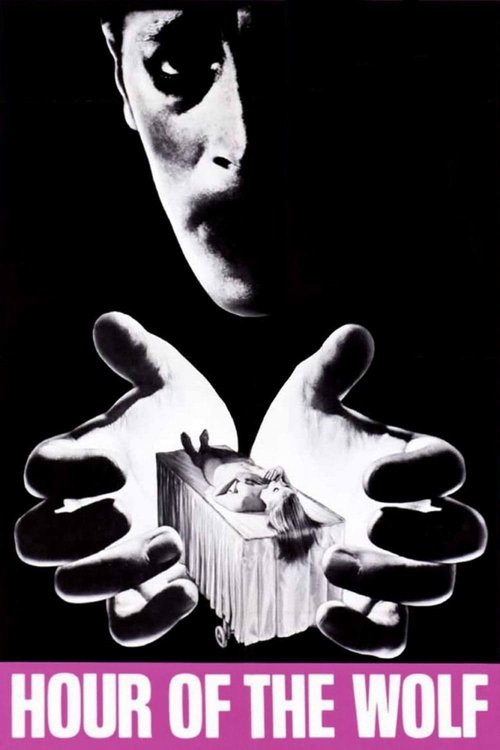
Ingmar Bergman's Hour of the Wolf (1968) is a haunting psychological drama that blurs the line between reality and nightmare. The film follows Johan Borg, a painter played by Max von Sydow, who retreats to a remote island with his pregnant wife Alma (Liv Ullmann). As Johan's mental state deteriorates, he confronts his repressed desires and fears, leading to a breakdown that is as much internal as external. Shot in stark black-and-white by cinematographer Sven Nykvist, the film uses the isolated island setting to amplify the sense of dread.
Bergman, who also wrote the script, drew on his own anxieties and experiences to create a deeply personal work. The film's title refers to the hour between night and dawn, when, according to folklore, most people die and nightmares feel most real. With a runtime of 88 minutes, Hour of the Wolf is a compact but intense exploration of madness and artistic torment. Though not a commercial hit, it has gained a strong reputation among Bergman fans and critics, with a rating of 7.4 out of 10 on IMDb. The cast also includes Gertrud Fridh, Georg Rydeberg, and Erland Josephson in memorable supporting roles.
Stream
Availability and pricing can change. Confirm on the provider's site before purchasing.
Alma Borg sits alone in the cottage, speaking directly to the camera. She explains that her husband, the renowned painter Johan Borg, disappeared without a trace from the remote island where they lived. She has decided to write down everything that happened, hoping someone might understand.
The story begins when Johan and Alma arrive on a windswept island off the Swedish coast. Johan is a celebrated artist suffering from severe insomnia and deepening psychological distress. Alma, his much younger pregnant wife, devotes herself to caring for him. They live in a modest cottage, isolated from the mainland by a long boat journey. Johan keeps a diary where he records his darkest thoughts and nightmares, a practice Alma finds increasingly troubling.
Johan confides in Alma about the hour of the wolf the period between 3:00 and 4:00 AM when, according to folklore, most people die, children are born, and nightmares feel most vivid. During these hours, Johan claims to be visited by spectral figures he calls the demons. He tells Alma these apparitions have haunted him since childhood and are the source of both his artistic inspiration and his torment.
The couple's isolated existence is disrupted when they receive an invitation to dine at the nearby castle of Baron von Merkens and his wife Corinne. The von Merkenses are wealthy eccentric aristocrats who seem to know Johan from a previous life. Alma is initially charmed by their hospitality, but she soon notices disturbing patterns: the castle's inhabitants behave strangely, speaking in riddles and making oblique references to Johan's past.
As Johan becomes more entangled with the castle's residents, his mental state deteriorates rapidly. He encounters a series of unsettling figures: Lindhorst, a sinister archivist who seems to know Johan's darkest secrets; Veronica Vogler, a beautiful but tormented woman who may be a former lover; and an old woman with a large hat who appears to be a witch-like presence. These characters seem to exist in a liminal space between reality and Johan's imagination.
Alma grows increasingly frightened as Johan's behavior becomes erratic. He begins to lose track of time, experiences violent mood swings, and speaks of being pursued by invisible forces. In one pivotal scene, Johan shows Alma his sketchbook, revealing drawings of grotesque demonic figures the same beings he claims visit him during the hour of the wolf. Alma tries to ground him in reality, but Johan insists that these visions are more real than the physical world around them.
The central conflict emerges as a battle for Johan's sanity: Alma represents love, stability, and the tangible world, while the castle's inhabitants embody the seductive pull of madness and artistic obsession. Johan oscillates between these two poles, unable to commit fully to either. The narrative builds toward a climactic confrontation at the castle, where Johan must face his demons both literal and metaphorical in a sequence that blurs the boundaries between dream and waking life.
"Hour of the Wolf" Trailer
Critical Consensus
Hour of the Wolf is widely regarded as one of Bergman's most personal and unsettling works, a psychological horror film that uses its isolated island setting to explore the intersection of artistic genius and mental illness. While some critics find its surrealism frustrating, most praise the performances of von Sydow and Ullmann, as well as Nykvist's stark cinematography.
“Bergman's film is not a horror movie in the conventional sense, but a horror movie of the soul, where the monsters are not external but internal.”
Roger Ebert
RogerEbert.com
“Mr. Bergman has made a film that is both a cry of pain and a work of art, a meditation on the nature of creativity that is as disturbing as it is beautiful.”
Vincent Canby
The New York Times
“It's a film about the terror of the creative process, and Bergman presents it with such intensity that you feel you're inside the painter's mind.”
Pauline Kael
The New Yorker
“The film is a masterpiece of controlled hysteria, with von Sydow giving one of his greatest performances as a man disintegrating before our eyes.”
David Thomson
The Guardian
“Bergman's exploration of the artist's psyche is both fascinating and frustrating, a film that rewards patience but may alienate those seeking conventional narrative.”
Variety Staff
Variety
Max von Sydow
Johan Borg
Liv Ullmann
Alma Borg
Gertrud Fridh
Corinne von Merkens
Director
Ingmar Bergman
Writer
Ingmar Bergman
Composer
Lars Johan Werle
Cinematographer
Sven Nykvist
Producer
Lars-Owe Carlberg
National Society of Film Critics Awards (1968)
Best Cinematography: Won
Guldbagge Awards (1969)
Best Film: Won
Guldbagge Awards (1969)
Best Director: Won
Guldbagge Awards (1969)
Best Actress: Won
Venice Film Festival (1968)
Golden Lion: Nominated
Swedish Film Institute (1969)
Best Cinematography: Won
Join the community
fans discussing