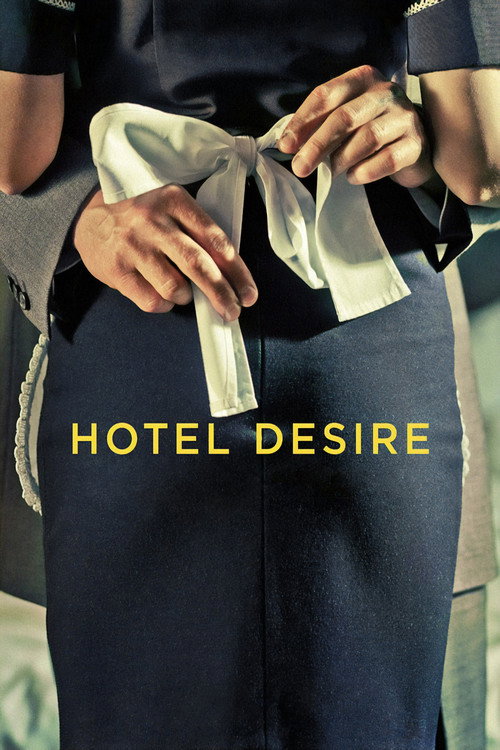
 Germany
“Moya's script is slender but effective, using the heatwave as a metaphor for repressed desire. Volm and Schick generate real heat in their few scenes together.”
Boyd van Hoeij
Variety
Berlin, summer 2011. The city bakes under a record heatwave, and inside the luxury Hotel de Rome, maid Antonia moves through corridors thick with stillness. She cleans rooms, makes beds, and dodges the hotel manager's scrutiny. At night she returns to a cramped apartment where her young son Luca waits. This is her life: invisible labor, quiet exhaustion, the kind of solitude that feels permanent.
Then Julius Pass checks in. A celebrated blind portrait painter, he occupies a suite that quickly becomes a studio. Antonia is assigned to clean it. Their first exchange is brief, he asks her to describe the light coming through the window. She does, and something shifts. Julius perceives the world through touch and sound, and he senses in Antonia a depth that other guests overlook. He asks her to sit for a portrait, not a visual likeness but a tactile one, made by running his hands over her face. The request is intimate, unsettling, impossible to refuse.
Directed by Sergej Moya, Hotel Desire unfolds in 38 minutes, shot on a budget of $230,758. It premiered on German television in December 2011 and later found an international audience on streaming platforms. Saralisa Volm and Clemens Schick anchor the film with performances that turn a slender premise into something quietly explosive. The film was nominated for Best Short Film at the German Film Critics Association Awards and the Max Ophüls Prize.
Availability and pricing can change. Confirm on the provider's site before purchasing.
The story begins before dawn. Antonia wakes in her small Berlin apartment, kisses her sleeping son Luca, and cycles through empty streets to the Hotel de Rome. Inside, the lobby is cool and marble-floored, a world apart from the heat pressing against the windows. She changes into her uniform, gathers her cleaning cart, and begins her rounds.
Her day starts with a minor crisis: a guest named Sarah has lost a wedding ring. The hotel manager, a stern man with little patience, warns Antonia that the ring must be found or she'll be held responsible. The pressure mounts as Antonia scrubs bathrooms and folds towels, the ring weighing on her mind.
Mid-morning, she is assigned to clean Suite 412, occupied by Julius Pass. She knocks, enters, and finds him seated by the window, a canvas on his easel. He is blind, but his studio is meticulous, paints arranged by texture, brushes laid out in a precise grid. He asks her to describe the view. She tells him about the pigeons on the ledge, the woman across the street watering geraniums, the haze that blurs the rooftops. He listens with an intensity that makes her feel seen.
Their conversation is interrupted by the receptionist calling Antonia away. But she returns later, drawn by something she can't name. Julius is working on a portrait of a woman he met years ago in Paris. He tells Antonia that he paints from memory and touch, not sight. She asks if he could paint her. He says yes, but only if she trusts him enough to sit still while he maps her face with his hands.
The heatwave intensifies. Antonia's shifts blur together. She steals time to visit Julius between tasks, risking her job. The hotel staff notices: the flirtatious doorman makes a joke, the gossipy receptionist raises an eyebrow. Only Marcel, a middle-aged bartender who has seen everything, offers no judgment.
The lost ring resurfaces, Antonia had accidentally swept it into her cart. She returns it to Sarah, but the manager's suspicion lingers. Meanwhile, Julius's portrait progresses. He asks Antonia to remove her uniform jacket so he can feel the line of her shoulders. She hesitates, then complies. The scene is charged but not graphic; the camera lingers on her face, on the way she closes her eyes.
A subplot involving a French model in the hotel bar adds comic relief, but the film's focus remains on Antonia's interior world. She calls her babysitter to check on Luca. She stares at herself in a bathroom mirror, as if seeing a stranger. The heat, the exhaustion, the longing, all of it builds toward a single question: will she let herself want something, even if she can't keep it?
Trailer [Dubbed]
Critical Consensus
Hotel Desire is a brief, atmospheric German drama that prioritizes mood over narrative depth. Saralisa Volm's central performance and the chemistry between leads elevate a thin plot, but the film's softcore elements and brevity leave it feeling more like an extended vignette than a fully realized story.
“Moya's script is slender but effective, using the heatwave as a metaphor for repressed desire. Volm and Schick generate real heat in their few scenes together.”
Boyd van Hoeij
Variety
“The film is a masterclass in economy, every glance, every brushstroke matters. It's a shame the running time doesn't allow for deeper exploration of its themes.”
Claudia Lenssen
Der Tagesspiegel
“Saralisa Volm carries the film with a performance of quiet desperation. The final portrait scene is genuinely moving, a reminder that cinema can still surprise with tenderness.”
Martin Schwickert
epd Film
“The film's softcore label is misleading; this is more about emotional nudity than physical. The kiss, when it comes, feels earned rather than exploitative.”
Kirsten Taylor
Berlin Film Journal
Saralisa Volm
Antonia
Clemens Schick
Julius Pass
Jan-Gregor Kremp
Marcel
Herbert Knaup
Hotel Manager
Palina Rojinski
Julia
Frederick Lau
Doorman
Trystan Pütter
Receptionist
Carlo Ljubek
Dennewitz
Liroy Gehrke
Luca
Petar Knezevic
French Model
Keziban Inal
Sarah
Hans-Uwe Bauer
Director
Sergej Moya
Writer
Sergej Moya
Composer
Stefan Maria Schneider
Cinematographer
Armin Franzen
Producers
Julia Lischinski, Sascha Schwingel, Christopher Zwickler
German Film Critics Association Awards (2012)
Best Short Film: Nominated
Max Ophüls Prize (2012)
Best Short Film: Nominated
Join the community
fans discussing