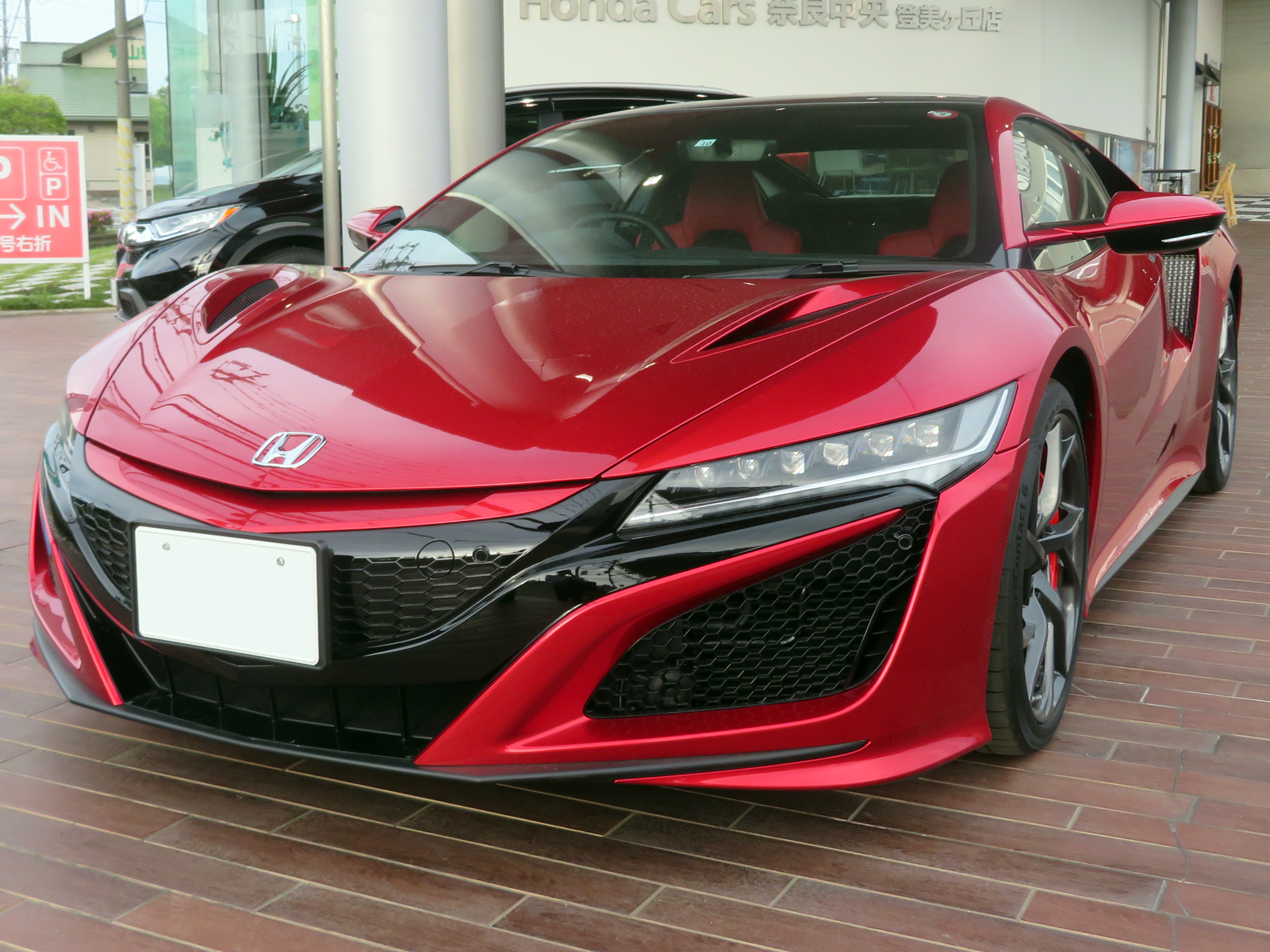
Honda NSX
by Honda
"The supercar that redefined everyday usability"
Rating
4.6/5
Overview
The Honda NSX, sold in North America under the Acura brand, is a two-seat mid-engine sports car produced across two generations. The first-generation NSX (1990–2005) was a landmark vehicle: the first production car with an all-aluminum monocoque body, featuring a naturally aspirated V6 engine with Honda's VTEC variable valve timing. It aimed to deliver supercar performance with the reliability and refinement of a Honda. Legendary Formula One driver Ayrton Senna contributed to chassis development at the Nürburgring. The car earned near-universal acclaim for its handling, build quality, and daily usability, challenging established European exotics like the Ferrari 348 and Porsche 911.
The second-generation NSX (2016–2022) reimagined the concept as a hybrid supercar. It paired a twin-turbocharged 3.5-liter V6 with three electric motors, producing a combined 573 horsepower and 476 lb-ft of torque. A nine-speed dual-clutch transmission and Sport Hybrid Super Handling All-Wheel Drive (SH-AWD) provided torque vectoring and all-weather capability. The car could accelerate from 0 to 60 mph in 2.9 seconds and reached a top speed of 191 mph. Despite its technological sophistication, sales underperformed Honda's projections, with about 2,600 units built over seven years. The second generation was discontinued after the 2022 model year, with a 600-horsepower Type S limited edition of 350 units marking the finale.
Key Features
- All-aluminum monocoque body (first production car to use it)
- VTEC variable valve timing
- Titanium connecting rods (first generation)
- Sport Hybrid SH-AWD with torque vectoring (second generation)
- Nine-speed dual-clutch transmission (second generation)
- Multiple drive modes: Quiet, Sport, Sport+, Track (second generation)
- Pop-up headlights (1990-1996), fixed headlights (1997-2005)
- NSX-T targa top variant (from 1995)
Specifications
| Generation | First (NA1/NA2), Second (NC1) |
| Engine (First Gen) | 3.0L C30A V6 (1991-1996), 3.2L C32B V6 (1997-2005) |
| Power (First Gen) | 270 hp (3.0L), 290 hp (3.2L) |
| Engine (Second Gen) | 3.5L twin-turbo V6 + three electric motors |
| Combined Power (Second Gen) | 573 hp (581 hp from 2019) |
| Combined Torque (Second Gen) | 476 lb-ft |
| Transmission (First Gen) | 5-speed manual, 4-speed automatic |
| Transmission (Second Gen) | 9-speed dual-clutch automatic |
| 0-60 mph (First Gen) | 5.0 seconds |
| 0-60 mph (Second Gen) | 2.9 seconds |
| Top Speed (First Gen) | 168 mph |
| Top Speed (Second Gen) | 191 mph |
| Curb Weight (First Gen) | 3,010 lbs |
| Curb Weight (Second Gen) | 3,803 lbs |
| Drivetrain (Second Gen) | Sport Hybrid SH-AWD |
| Body Construction | All-aluminum monocoque |
Pros & Cons
Pros
- • Revolutionary all-aluminum construction
- • Exceptional reliability for a supercar
- • Everyday usability and refinement
- • Advanced hybrid all-wheel-drive system (second gen)
- • Strong owner community and aftermarket support
Cons
- • Limited interior space and cargo capacity
- • Modest power compared to later competitors
- • Second gen heavy and less emotionally engaging than rivals
- • High pricing for second gen relative to brand perception
- • Second gen sales underperformed, leading to early discontinuation
Frequently Asked Questions
How much does a Honda NSX cost?
Is the Honda NSX worth it?
What are the Honda NSX specs?
When was the Honda NSX released?
Honda NSX vs Acura NSX: What's the difference?
Keywords
Product Info
- Brand
- Honda
- Manufacturer
- Honda Motor Co., Ltd.
- Category
- sports car
- Released
- 1990-08-01
- Price
- $60,000 (1991 base) – $200,000+ (used)
- Availability
- Discontinued
- First Generation Production
- 1990–2005
- Second Generation Production
- 2016–2022
- Chief Engineer (First Gen)
- Shigeru Uehara
- Development Driver
- Ayrton Senna
- Total Production (First Gen)
- ~18,000 units
- Total Production (Second Gen)
- ~2,600 units
Where to Buy
Join the community
fans discussing