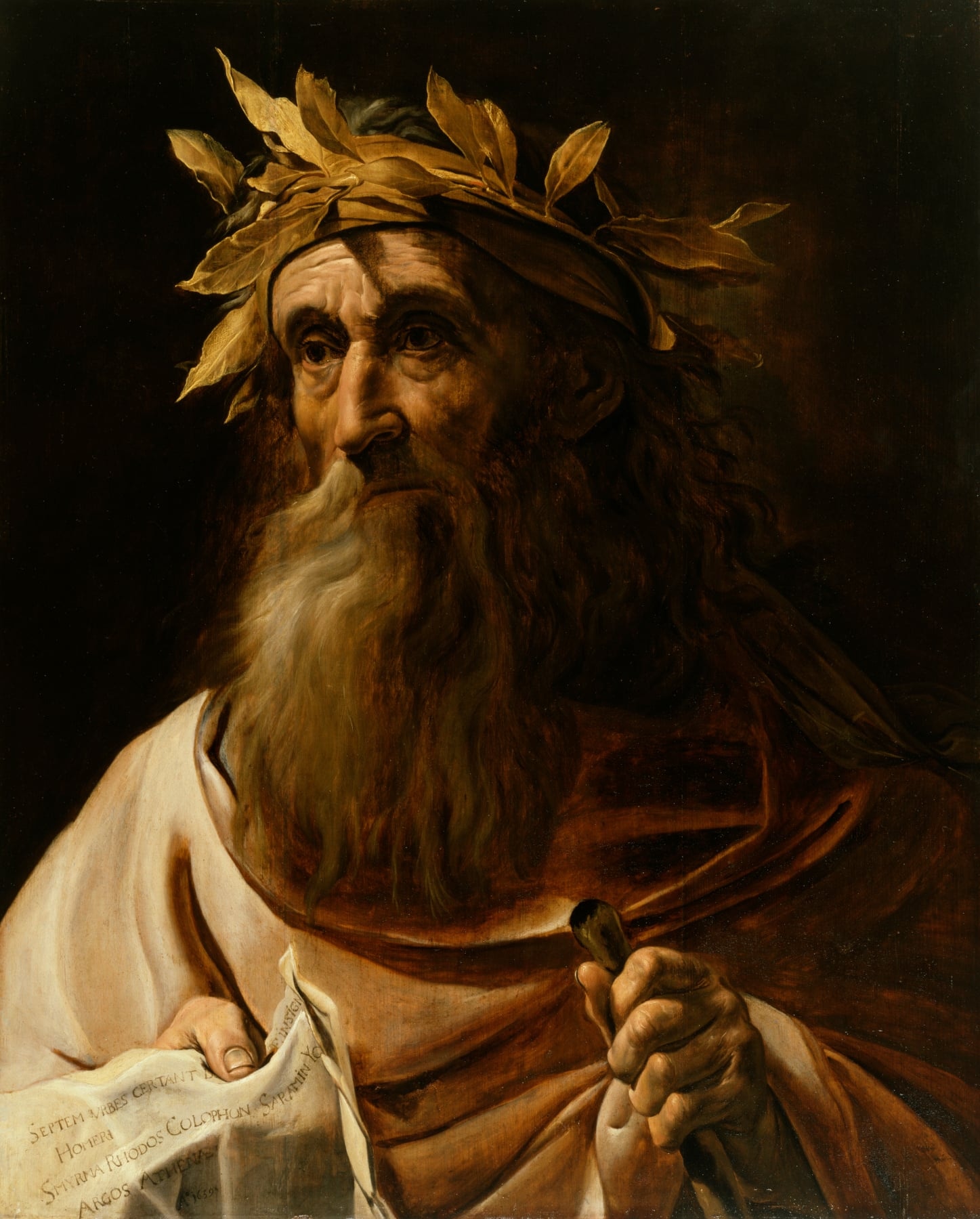
Homer
Birthday
Birth Sign
Birthplace
Ionian League
Age
Died at -100
About
Homer was the ancient Greek poet credited with composing the Iliad and the Odyssey, two epic poems that form the bedrock of Western literature. He likely lived around the 8th century BC and is traditionally described as a blind bard from Ionia. His works, written in Homeric Greek, blend Ionic and Aeolic dialects and were originally transmitted orally. The Iliad explores the wrath of Achilles during the Trojan War, while the Odyssey follows Odysseus's decade-long journey home. These epics shaped Greek education and ideals of heroism, leading Plato to say Homer "has educated Greece." Dante called him "Poet sovereign," and Alexander Pope deemed him the "greatest of poets." Today, his influence pervades literature, art, and film.
Early Life & Background
Homer lived before any systematic chronological record-keeping, so his early life is almost entirely unknown. The earliest reference points like the Olympic Games (first held in 776 BC) provide only a rough context. Ancient traditions, now considered legendary by scholars, claimed he was a blind bard from Ionia, a region along the coast of modern-day Turkey that included Smyrna, Chios, and Samos. Seven different cities each claimed to be his birthplace, with Smyrna and Chios among the most persistent. The poems themselves were composed orally, passed down through generations of bards before ever being written down. The first literary mentions of Homer appear in the 7th century BC, in works by Archilochus, Alcman, Tyrtaeus, and Callinus, suggesting his epics were already widely known and respected by then.
Career Growth
Homer's career is defined by two monumental works. The Iliad, set during the final year of the Trojan War, centers on the quarrel between King Agamemnon and the warrior Achilles, delving into themes of rage, honor, and mortality. The Odyssey recounts the ten-year journey of Odysseus as he battles gods and monsters to return home to Ithaca. Scholars generally believe the two poems were composed by different authors, around the late 8th or early 7th century BC. In the Classical period, these epics became central to Greek education, studied by every citizen. During the 3rd century BC, scholars at the Library of Alexandria produced critical editions that standardized the texts. The Renaissance saw a resurgence of interest as Latin and vernacular translations spread across Europe, cementing Homer's place as the fountainhead of Western literary tradition.
Career Timeline
Public Image & Style
Homer is universally revered as the foundational figure of Western literature. His works are studied in schools and universities worldwide. No official fandom name exists, but his epics have inspired countless adaptations, from James Joyce's Ulysses to the film O Brother, Where Art Thou? The "Homeric Question" continues to spark scholarly debate. His public persona is that of a blind, wise bard, a symbol of ancient storytelling and cultural unity.
Fame & Fandom
The community surrounding Homer has never organized into a modern fanbase with a specific name or social media campaigns. Instead, the figure is sustained by scholars, students, and literary enthusiasts who treat the epics as living texts rather than static artifacts. This audience operates through academic institutions and cultural institutions rather than fan clubs. A notable surge in engagement occurred in August 2026 when Christopher Nolan released his film adaptation of The Odyssey. Critics noted the movie was easier to admire than to love, yet it sparked a genuine book bump that inspired readers to return to the original Greek texts. Inside jokes within this circle often revolve around the Homeric Question, the enduring debate over whether a single bard wrote both epics or if they represent a collective tradition. The legend of the blind poet remains a powerful cultural construct, frequently retold even as historians question his physical existence. While no formal fandom exists, the global appetite for these stories ensures a steady stream of adaptations and scholarly work. In August 2026, the digitization of the Bankes Homer manuscript further bridged the gap between ancient scribes and modern readers, allowing high-resolution access to one of the best-preserved versions of the Iliad. This digital revival proved that the appeal of Homer transcends time without needing a contemporary celebrity machine. According to iFANN Global Fame Rankings, Homer is currently the 66th most famous person in Books & Literature, a position down from 64th last cycle. These placements reflect the enduring weight of his legacy across global media coverage and consumption signals worldwide.
Interesting Facts and Legends
The name Homer in Greek may translate to either hostage or blind, reflecting the mystery of his identity. Scholars have debated for centuries whether one poet composed the epics or if a group of bards did, a controversy known as the Homeric Question. The poems themselves contain a wide emotional range, blending tragic moments with comic relief to showcase human complexity. Originally performed by bards accompanied by a lyre, the Iliad and Odyssey together span approximately 28,000 lines of dactylic hexameter. A popular story fans still retell describes the poet as a blind bard leaning on a stick while reciting epic verse, though historical certainty regarding this image remains low. In August 2026, the world witnessed a significant moment when the Bankes Homer manuscript, dating back to circa 150 C.E., was digitized and made available in high resolution. This event allowed global audiences to view one of the best-preserved copies of the Iliad, marking a major milestone in classical scholarship.
Notable Quotes
“He has taught Greece. — Plato”
“Poet sovereign. — Dante Alighieri, Divine Comedy”
“The greatest of poets. — Alexander Pope”
Family & Personal Life
Nothing reliable is known about Homer's family. Ancient biographies, considered mythical by modern scholars, suggest fantastical lineages: some claimed he descended from a Muse, Apollo, Orpheus, or even Telemachus, the son of Odysseus. One tradition from the time of Emperor Hadrian named Epicaste (daughter of Nestor) and Telemachus as his parents. These stories are not taken as historical fact.
Notable Connections
Relationships & Dating History
Death & Aftermath
Historical consensus indicates that Homer, the ancient Greek poet traditionally credited with composing the Iliad and the Odyssey, lived during the 9th or 8th century BCE. Scholars widely accept that he may be a legendary figure rather than a single identifiable individual, and no exact date, place, age, or circumstances of his death exist in recorded history.
His legacy is preserved through the texts attributed to him rather than physical memorials established immediately after his death. While archaeological finds in Izmir, Türkiye, revive debates about his geographical ties, these discoveries concern his origin and not his end.
Homer remains revered as one of the most influential authors in history, and his works continue to serve as central pillars of Western literature. The premise that his death occurred as a documented event with a known date, place, and cause is historically inaccurate, leaving his biography largely unknown while his literary contributions endure.
Net Worth (Estate Value)
$0
iFANN Editorial Team estimate
Per iFANN's editorial analysis, the net worth for Homer stands at $0. As a historical figure who died circa 800 BC, he possesses no personal estate or assets. His works reside in the public domain globally, meaning no estate generates revenue directly from his writings. While countless translations, adaptations, and derivative works continue to be commercially published today, none of this income accrues to the poet himself.
Awards & Accolades
View 4 records, honours and achievementsKnown For
Iliad
~8th century BC · Author
Odyssey
~8th century BC · Author
Keywords
Sources
Quick Facts
- Profession
- poet, author, writer
- Born
- ~8th century BC
- Birthplace
- Ionian League
- Died
- ~8th century BC
- Gender
- Male
Frequently Asked Questions
Did Homer actually exist?
When was Homer born?
Was Homer blind?
What did Homer write?
Where was Homer born?
Similar People
Join the community
fans discussing