 Japan
JapanAbout
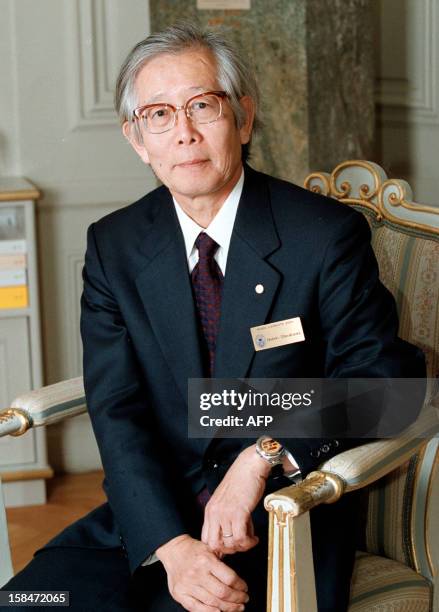
Hideki Shirakawa is a Japanese chemist and engineer, Professor Emeritus at the University of Tsukuba and honorary professor at Zhejiang University. He is celebrated worldwide for the discovery and development of conductive polymers—plastics that can conduct electricity—work that earned him the 2000 Nobel Prize in Chemistry alongside Alan G. MacDiarmid and Alan J. Heeger. His research fundamentally challenged the long-held assumption that polymers were strictly insulators, laying the foundation for the field of organic electronics.
Today, Shirakawa's legacy is one of curiosity, collaboration, and the transformative power of accidental discovery. His pioneering work opened the door to flexible displays, OLEDs, and plastic solar cells, technologies that now permeate modern life. As a professor emeritus, he continues to inspire through his enduring contributions to science and his commitment to education.
His discovery, which began with a serendipitous laboratory accident, has had a profound impact on materials science. Shirakawa's story is a testament to how unexpected results can lead to revolutionary advancements, and his name remains synonymous with the birth of conductive polymers.
Early Life & Background
Hideki Shirakawa was born on August 20, 1936, in Tokyo, Japan, the son of a physician. Growing up in Tokyo during a period of significant upheaval, he developed an early interest in chemistry. He enrolled at the Tokyo Institute of Technology, where he earned his Bachelor of Science degree in 1961, his Master of Science degree in 1963, and his Doctor of Philosophy in 1966, all in chemical engineering.
After completing his Ph.D., Shirakawa became a research associate at the Tokyo Institute of Technology in April 1966. His early career was marked by meticulous polymer chemistry research. In 1967, a visiting researcher mistakenly added about 1,000 times the normal amount of catalyst during an attempt to synthesize polyacetylene. Instead of the expected black powder, the reaction produced a shiny, silvery film. Intrigued by this unexpected material, Shirakawa began investigating its properties, setting the stage for his later breakthrough.
In the early 1970s, Alan MacDiarmid visited Tokyo and learned of Shirakawa's work, leading to an invitation to the University of Pennsylvania. There, Shirakawa joined forces with MacDiarmid and Alan Heeger, beginning a collaboration that would change materials science.
Career Growth
Shirakawa's collaboration with MacDiarmid and Heeger at the University of Pennsylvania proved pivotal. In 1977, they published a landmark paper demonstrating that polyacetylene, when exposed to iodine vapor, became conductive, its conductivity increasing by over a billion times. This work established the field of conductive polymers and laid the groundwork for what became known as plastic electronics.
Shirakawa returned to Japan and continued his research. He was promoted to full professor and later joined the University of Tsukuba, where he served until his retirement, eventually becoming Professor Emeritus. In October 2000, he received the Nobel Prize in Chemistry, jointly with MacDiarmid and Heeger, for the discovery and development of conductive polymers. The prize recognized not only the scientific breakthrough but also its far-reaching applications, from flexible displays to organic solar cells.
In his later years, Shirakawa focused on education and outreach. In February 2022, he led the fifth Gateway to Science event for young people, hosted online by Tokyo Tech. He also received an honorary professorship from Science Tokyo, the institution formed from the merger of the Tokyo Institute of Technology and other bodies, cementing his enduring legacy. In 2017, he received the University of Pennsylvania Medal for Distinguished Achievement at a banquet honoring the three Nobel laureates.
Career Timeline
Public Image & Style
Shirakawa is perceived as a dedicated, modest scientist whose accidental discovery transformed materials science. Media portrayals often emphasize the serendipitous nature of his breakthrough and his collaborative spirit with MacDiarmid and Heeger. He is revered within the scientific community as a pioneer, though he has no popular-culture fandom. His legacy is celebrated through educational programs and institutional honors, and he remains an inspiration to young researchers. His humility and dedication to science education are frequently noted, as evidenced by his participation in youth outreach events well into his eighties.
Fame & Fandom (iFAMOUS Rankings)
The global audience for Hideki Shirakawa operates on a frequency entirely different from celebrity culture. There are no fan clubs, no birthday billboards, and no ritualistic gatherings in his name. Instead, his following is the worldwide scientific community, a dispersed network of chemists, materials scientists, and students who revere his work through citations and academic adoption rather than social media engagement. His legacy is measured by the billion-fold increase in conductivity he unlocked, transforming plastic into a conductor and enabling the OLED screens that now define modern life. While he remains an inspiration to young researchers and maintains a presence in educational outreach, he holds no formal fandom moniker or organized fanbase structure. The iFANN Global Fame Engine has evaluated this profile as of August 2026, confirming that while his impact is monumental, he does not currently hold a placement in the published rankings such as the Global Top 1,000 or any Top-100 scope list. This absence from the charts reflects his status as a foundational figure whose fame is embedded in the infrastructure of technology itself, rather than in the volatile metrics of pop culture visibility.
Interesting Facts and Legends
Hideki Shirakawa's career began with a serendipitous error: adding roughly 1,000 times the normal amount of catalyst to a reaction produced a silvery film instead of the expected black powder. Treating this polyacetylene with iodine vapor subsequently boosted its electrical conductivity by more than one billion times, a dramatic proof of concept that shattered the belief that polymers must be insulators. Today, this discovery underpins the entire field of organic electronics, including flexible solar cells and OLED displays. Beyond the lab, Shirakawa is known for his humility and dedication to education, participating in youth outreach events well into his late eighties. His scholarly output includes 125 documented papers with 6,779 citations. A defining moment of his career is the accidental synthesis of conductive polyacetylene, where a simple mistake led to a material that could conduct electricity like metal. This work, shared with Nobel co-laureates Alan G. MacDiarmid and Alan J. Heeger, fundamentally altered the trajectory of materials science. In July 2026, his enduring influence was recognized again when he received an honorary professor title at Ibaraki University, proving his relevance decades after his initial breakthrough.
Notable Quotes
“The discovery was accidental, but we were prepared to recognize it.”
“Science is not about certainty, but about curiosity and collaboration.”
“I hope young people will find the same joy in discovery that I did.”
Family & Personal Life
Shirakawa was born in Tokyo, the son of a physician. His family life has remained largely private, and little is publicly known about his parents or siblings. He is married and has at least one son, as mentioned in his Nobel biographical essay. His family has supported his scientific career but has stayed out of the public eye, consistent with his modest persona. His family background, with a physician father, may have influenced his disciplined approach to research.
Notable Connections
Relationships & Dating History
Information about Shirakawa's romantic relationships is virtually nonexistent in public sources. He was married, though details about his wife are not documented. He has at least one son. His personal life remained private, and no dating history or high-profile relationships have been reported. As of the latest available information, he is presumed to be widowed or married, but no current relationship status has been publicly confirmed.
Salary, Net Worth In 2026
$5 Million
iFANN Editorial Team estimate
As an academic scientist, Shirakawa's financial standing remains modest compared to commercial celebrities. His income streams have historically derived from university salaries, research grants, and the Nobel Prize award, which in 2000 provided approximately 9 million Swedish kronor to be shared among the three laureates. No public estimates of his personal wealth exist outside of editorial analysis. Per iFANN's editorial analysis, his estate and earnings are estimated at around $5 Million as of 2026. This figure represents a speculative assessment given the lack of reliable private financial data regarding his specific holdings. His financial legacy is tied strictly to his academic contributions and institutional honors rather than commercial ventures or product royalties.
Awards Won (2)
Shirakawa received the 2000 Nobel Prize in Chemistry, the highest honor in his field, for the discovery and development of conductive polymers. He also received the University of Pennsylvania Medal for Distinguished Achievement in 2017 and an honorary professorship from Science Tokyo.
2000 · Chemistry
Discovery and development of conductive polymers
2017 · Academic
Lifetime achievement
Known For
Discovery of conductive polymers
1977 · Co-discoverer
Nobel Prize in Chemistry
2000 · Laureate
Keywords
Sources
Quick Facts
- Profession
- chemist, engineer, professor
- Born
- August 20, 1936
- Birthplace
- Tokyo, Japan
- Gender
- Male
- Birth Sign
- Leo
- Education
- Tokyo Institute of Technology (B.S., M.S., Ph.D.)
- Nobel Prize
- Chemistry, 2000
Personal Details
- Full Name
- Hideki Shirakawa
- Children
- 1 son
- Education
- Tokyo Institute of Technology (B.S. 1961, M.S. 1963, Ph.D. 1966)
Frequently Asked Questions
How did Hideki Shirakawa discover conductive polymers?
Is Hideki Shirakawa still alive?
What did Hideki Shirakawa win the Nobel Prize for?
Where did Hideki Shirakawa study?
What is Hideki Shirakawa's net worth?
Similar People
Join the community
fans discussing