“It is a film that knows how to be both a crowd-pleaser and a serious work of history, balancing the joy of discovery with the pain of discrimination.”
Manohla Dargis
The New York Times
 United States
"Meet the minds behind the mission you know."
The Cold War space race reached a fever pitch in 1961 when NASA needed to catch up to the Soviet Union. The agency's Langley Research Center in Hampton, Virginia, relied on a team of African-American women known as "human computers" to perform the complex calculations that kept the space program moving. These women worked in the West Area Computing unit, a segregated section of the building where they faced daily indignities and systemic barriers.
Three specific mathematicians stand out in this history. Katherine Goble Johnson possessed an uncanny talent for geometry and orbital mechanics but had to walk miles to use a separate restroom. Dorothy Vaughan managed the computing team and foresaw the threat of new IBM mainframe computers. Mary Jackson fought through the legal system to attend night classes required for her engineering promotion. Their stories intersect with the high-stakes pressure of launching astronaut John Glenn into orbit.
Stream
Availability and pricing can change. Confirm on the provider's site before purchasing.
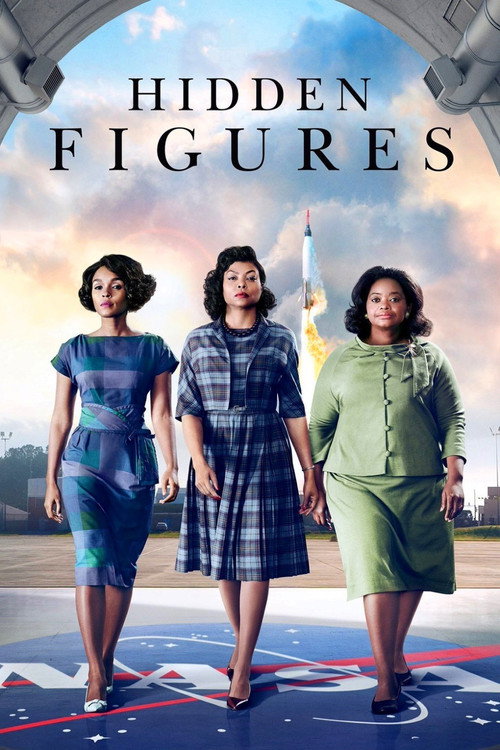
The narrative opens in 1961 against the backdrop of the escalating Space Race between the United States and the Soviet Union. At NASA's Langley Research Center in Hampton, Virginia, racial segregation laws dictate every aspect of life, including access to restrooms and cafeterias. The story introduces three brilliant African-American women working as "human computers," performing intricate mathematical calculations essential to the nation's space program despite facing deep-seated gender bias and racism.
Katherine Goble Johnson (Taraji P. Henson) arrives at the Space Task Group led by Al Harrison (Kevin Costner). She is a mathematician with an exceptional ability for geometry and orbital mechanics. Despite her genius, she faces the indignity of walking over a mile to use the "Colored" restroom located far from the West Area Computing building. Her husband, Jim Johnson (Mahershala Ali), supports her ambition but worries about the dangers she faces daily. Katherine must prove her worth to a team of white male engineers who initially doubt her capabilities. Her central conflict involves solving trajectory problems for Alan Shepard's upcoming flight while fighting for the right to access the same resources and information as her white colleagues.
Dorothy Vaughan (Octavia Spencer) serves as the supervisor of the West Area Computing unit. She is a mother of four and a fiercely protective leader who anticipates the threat posed by the arrival of IBM mainframe computers. Dorothy realizes that if she does not learn to master this new technology, her entire department will be rendered obsolete. Her storyline focuses on her quiet determination to educate herself and her team in FORTRAN programming, often studying late into the night after her family duties, while simultaneously navigating the racial hierarchy that seeks to undermine her authority.
Mary Jackson (Janelle Monáe) is a young, ambitious engineer whose goal is to become one of NASA's first black female engineers. However, the path to this promotion requires her to take advanced night classes at a segregated high school, which are legally closed to African Americans. Mary's journey is defined by her fight to petition the city council for permission to attend these courses, challenging the very segregation laws that govern the town of Hampton.
The plot weaves these three stories together as the stakes rise with the impending launch of astronaut John Glenn (Glen Powell). The Soviet Union has already sent Yuri Gagarin into orbit, and the pressure on NASA to catch up is immense. As the team races against time to calculate the re-entry data for Glenn's mission, they face technical failures, bureaucratic roadblocks, and personal sacrifices. Katherine discovers a critical flaw in the computer data that could jeopardize the mission, forcing her to confront the arrogance of the system she serves. Meanwhile, Dorothy secures her team's future by mastering the machine, and Mary successfully argues her case to become an engineer. The film builds toward the historic moment of Glenn's launch, emphasizing the collective effort required to overcome systemic racism and sexism.
Official Trailer
Critical Consensus
Hidden Figures delivers a powerful biographical drama that shines a light on unsung heroes of the early space race. While it occasionally leans into formulaic storytelling, the exceptional performances by its lead trio and the film's commitment to historical truth make it a deeply moving celebration of resilience and intelligence.
“It is a film that knows how to be both a crowd-pleaser and a serious work of history, balancing the joy of discovery with the pain of discrimination.”
Manohla Dargis
The New York Times
“The movie is a triumph of spirit and talent, anchored by three powerhouse performances that bring these real-life legends to vivid life.”
Peter Travers
Rolling Stone
“A rousing, emotionally resonant piece of cinema that manages to be both a tribute to the past and a call to action for the present.”
Owen Gleiberman
Variety
Director
Theodore Melfi
Writers
Allison Schroeder, Margot Lee Shetterly, Theodore Melfi
Composers
Pharrell Williams, Hans Zimmer, Benjamin Wallfisch
Cinematographer
Mandy Walker
Producers
Theodore Melfi, Donna Gigliotti, Pharrell Williams, Peter Chernin, Jenno Topping
Academy Awards (2017)
Best Picture: Nominated
Academy Awards (2017)
Best Adapted Screenplay: Nominated
Academy Awards (2017)
Best Supporting Actress: Nominated
Golden Globe Awards (2017)
Best Motion Picture – Drama: Nominated
Screen Actors Guild Awards (2017)
Outstanding Performance by a Cast in a Motion Picture: Won
Join the community
fans discussing